Handheld Systems – Volume 5.1 – Jan/Feb 1997
Handheld Systems, originally PIE Developers and later PDA Developers, was the premier independent printed resource for mobile developers in the mid-to-late 1990s. At various points billing itself as “A Technical Journal for PDA Developers,” each issue contained detailed articles, tutorials, and coding examples covering all major handheld platforms.
Published by San Francisco-based Creative Digital Systems, the journal was expertly managed and edited by Steve Mann (who also wrote a number of articles in each issue).
Were you involved with this artifact? If so, we would like to include your story on this page. Let us know how you contributed.
Artifact Details
Creative Digital, Inc.
United States
English
January, 1997
$13.95 US, $14.95 Canada
Perfect bound printed journal with yellow paper cover and white paper.
In this issue:
- Handheld News
- Hey Rocky! Watch Me Pull a Rabbit Outa My Hat
- Windows CE Phase II: The Rollout
- Handheld Mobility: Taking it to the Desktop
- IR Reflections
- Wright Strategies, Inc.
- NS BASIC Corner: A NetNews Program
- MoBettaDrag
- Previews and Reviews (Advanced Data Representation)
- Newton 2.1 Audio
- Pilot Serial Programming
- The Newton 2.1 Grayscale APIs
- Finding and Preventing GEOS Bugs
- Unix and Pilots
- Drag and Drop: Direct Manipulation
- Simon's Scriptorium
- Microsoft Windows CE: History and Design
8.5" x 11" (54 pages)
Handheld Systems 5.1
January, 1997
Acquired from publisher
2018-07-27
Organizations
People

History
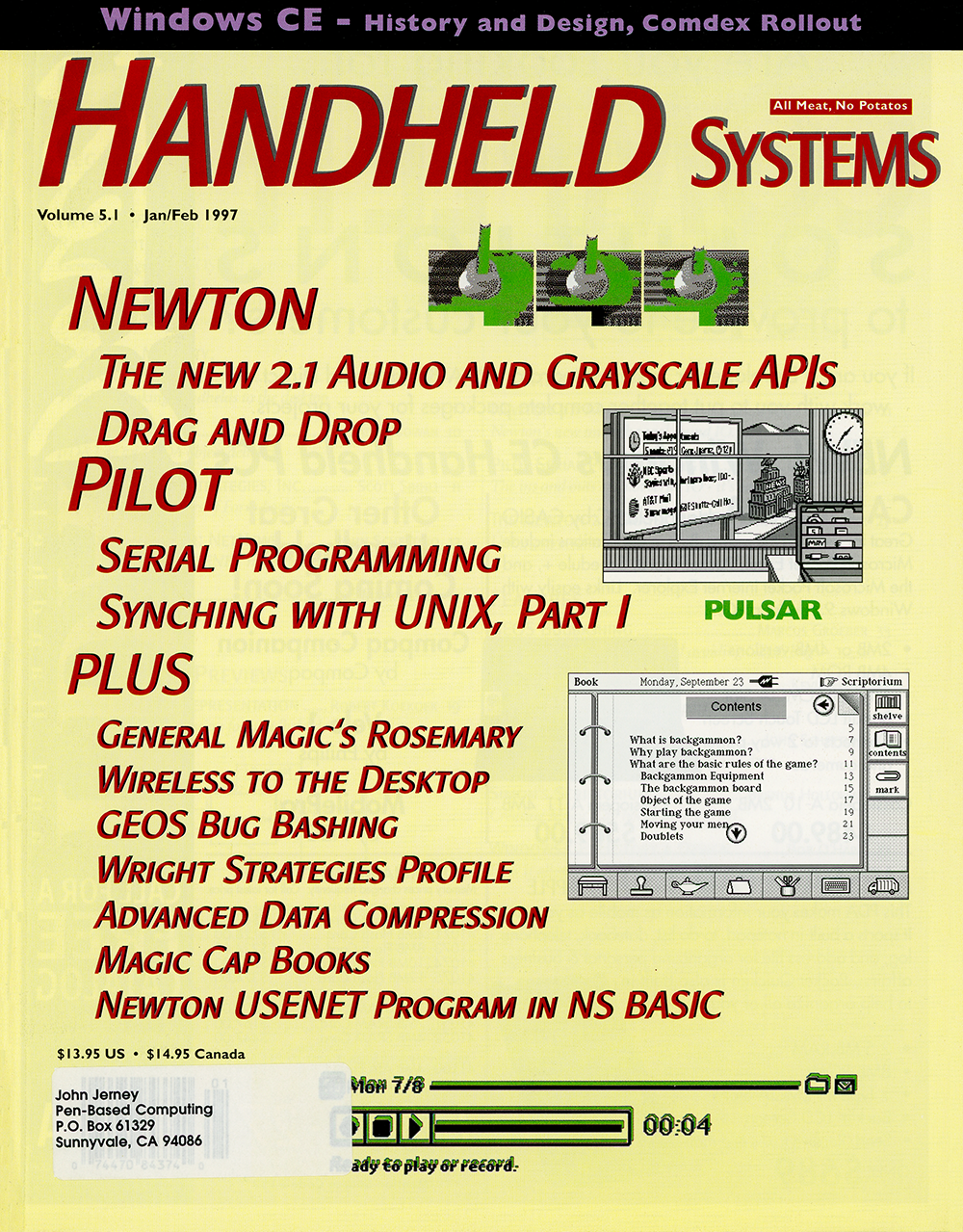
Handheld Systems, Volume 5.1, dated January/February 1997, was an issue of the developer-focused journal Handheld Systems, published at a cover price of $13.95 in the United States and $14.95 in Canada.1 The cover promoted the issue's coverage of Microsoft's Windows CE, including its history and design and its rollout at Comdex.1
The issue's featured Newton articles documented the platform's new 2.1 audio and grayscale APIs and its drag-and-drop support, while its Pilot coverage included serial programming and the first part of a series on synchronizing the device with UNIX.1 Additional articles addressed General Magic's Rosemary, wireless connectivity to the desktop, GEOS bug bashing, advanced data compression, Magic Cap books, a profile of Wright Strategies, and a Newton USENET program written in NS BASIC.1
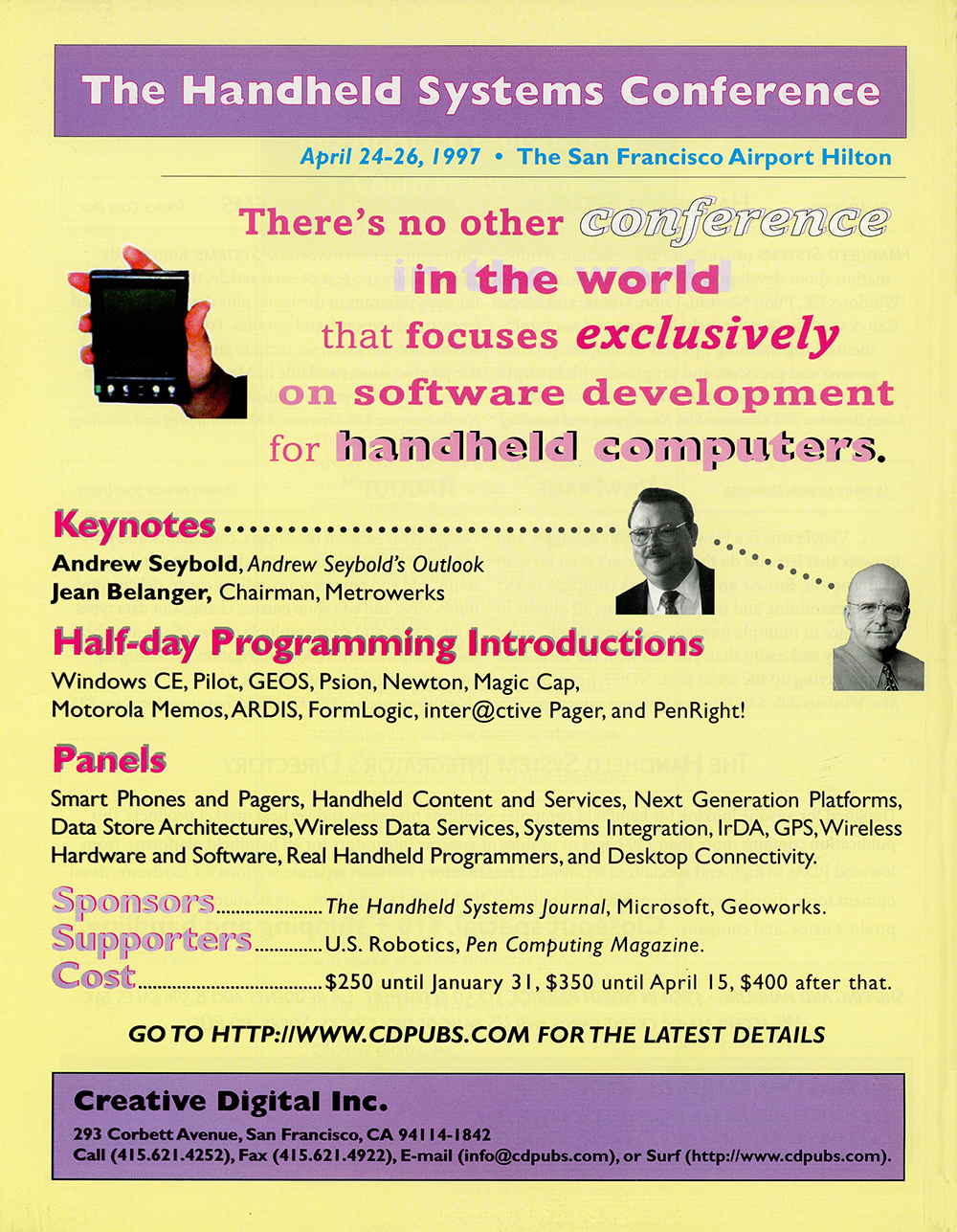
The journal was published by Creative Digital, Inc. of San Francisco, located at 293 Corbett Avenue.2 The issue's back cover advertised the Handheld Systems Conference, scheduled for April 24-26, 1997 at the San Francisco Airport Hilton and billed as the only conference focused exclusively on software development for handheld computers.2 The advertised keynote speakers were industry analyst Andrew Seybold and Metrowerks chairman Jean Belanger, with the Handheld Systems Journal, Microsoft, and Geoworks listed as sponsors and U.S. Robotics and Pen Computing Magazine as supporters.2 Conference registration was priced at $250 until January 31, $350 until April 15, and $400 thereafter.2
On March 17, 1997, Creative Digital Publishing Inc. announced that the final agenda for the Handheld Systems Conference - formerly known as PDA Developers - had been posted to the company's web site.3 Entering its third year, the conference added IBM's Thomas Zimmerman, co-founder of the virtual-reality company VPL Research, as a third keynote speaker and expanded its sponsor and supporter list to include Hewlett-Packard, Psion, General Magic, Apple Computer, Nokia Mobile Phones, Palm Computing, and Research In Motion.3 Steve Mann was listed as the conference contact for Creative Digital Publishing.3
AI generated using primary sources referenced in the footnotes
Footnotes
- Creative Digital, Inc., Handheld Systems - Volume 5.1 - Jan/Feb 1997 (image scan), January 1997
- Creative Digital, Inc., Handheld Systems - Volume 5.1 - Jan/Feb 1997 (image scan), January 1997
- Creative Digital Publishing Inc., Creative Digital Posts Handheld Systems Conference Final Agenda, March 17, 1997
Oral History
Connections
This artifact's place in the wider network of people, organizations, and artifacts. Drag to pan, scroll to zoom, and tap any node to focus its connections.