PenMagic Numero 2.0 (Product Fact Sheet)
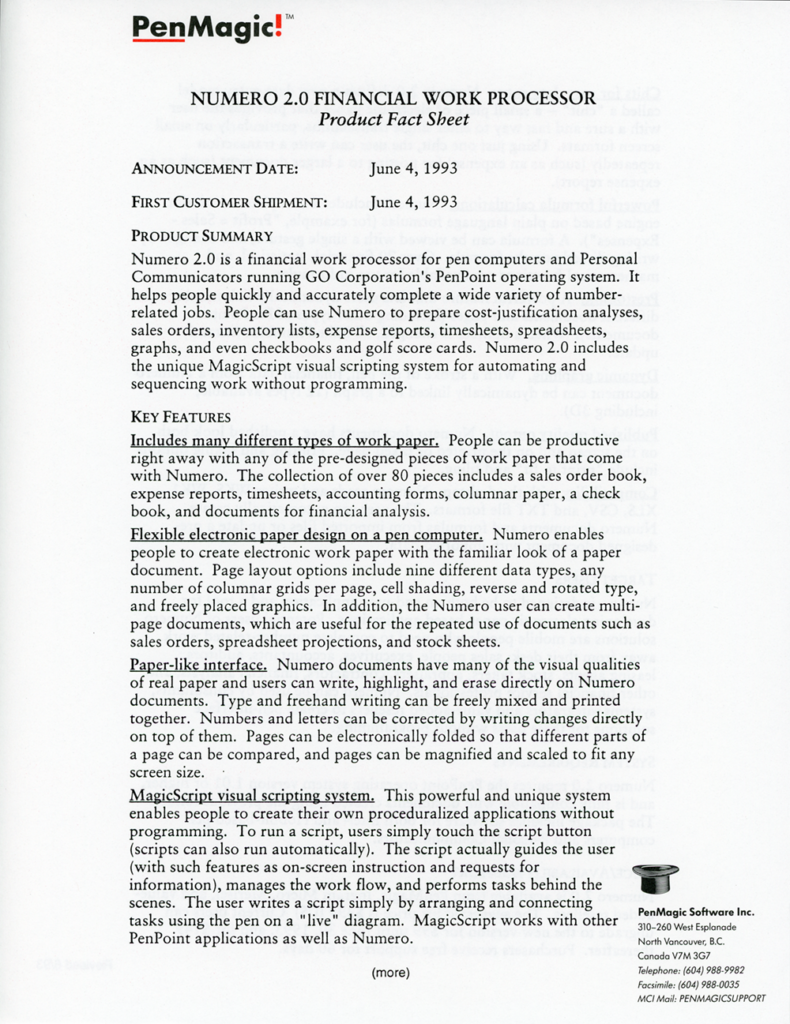
This is an original product fact sheet from North Vancouver, British Columbia-based PenMagic Software providing a product summary, explaining target users, and describing key features and benefits, among other information.
Were you involved with this artifact? If so, we would like to include your story on this page. Let us know how you contributed.
Artifact Details
PenMagic Software Inc.
Canada
English
June 4, 1993
Single sheet, two-sided printed page.
8.5" x 11"
6EKX6GPOUS
June, 1993
Acquired from developer
2026-06-09
Organizations


History
This product fact sheet documents PenMagic Numero 2.0, a financial work processor for pen computers and Personal Communicators running GO Corporation's PenPoint operating system, announced and first shipped on June 4, 1993 by PenMagic Software Inc. Numero was positioned for completing sales orders, inventory lists, expense reports, timesheets, spreadsheets, graphs, checkbooks, and even golf score cards on a pen device, and shipped with more than eighty pre-designed work pages including sales-order books, expense reports, timesheets, accounting notes, columnar paper, a check book, and financial analysis documents.
Users could compose their own multi-page templates combining different data types, columnar grids per page, cell shading, reverse and rotated type, and freely placed graphics, and could write, highlight, and erase directly on a page, mix typed and handwritten content freely, correct numbers and letters by writing changes on top of them, fold a page electronically so different parts could be compared, and scale pages to fit any size screen.
The release included PenMagic's MagicScript visual scripting system, which let users assemble and sequence pre-built scripts without programming and which worked across other PenPoint applications as well as Numero itself.1
Numero 2.0 introduced a new data entry construct called a "chit" — a small piece of electronic paper sized for single transactions and useful for recording a repeated entry such as an expense for later posting to a larger document — and a calculation engine based on plain-language formulas such as "Profit = Sales − Expenses" with more than seventy financial, statistical, and mathematical functions available for use in formulas.
Dynamic graphing rendered Numero data into twelve chart types including 3D, and the PivotLink feature dynamically linked numbers across different documents and pages so that any change propagated instantly to every linked number. Numero read and wrote WK3, WK1, XLS, CSV, and TXT file formats and could automatically build Numero documents from files produced by Excel, 1-2-3, and other desktop spreadsheets.
The release required PenPoint version 1.01 or higher and shipped with software for both Intel- and Hobbit-based pen computers and Personal Communicators, at a suggested list price of $399 (US), with upgrades from earlier versions priced at $99 through June 30, 1993 and $149 thereafter, plus sixty days of free support.2
PenMagic Software Inc. was a privately held company based in North Vancouver, British Columbia, founded in September 1990 by a team of personal computer industry veterans and financially backed by Kleiner Perkins Caufield & Byers among other venture capital firms; at the time of the Numero 2.0 release the company's product line consisted of Numero, Numero Executive Assistant, and The Numero Software Developer Toolkit. Norm Francis served as president of PenMagic Software Inc., and Ron McIntyre served as the company's contact in North Vancouver for inquiries on the Numero releases.
Eight weeks after the Numero 2.0 shipment, on July 30, 1993 at MacWorld Expo, PenMagic announced a product licensing agreement with Apple Computer Inc. to develop two financial applications for Apple's Newton Personal Digital Assistant — Money Magazine Business Forms and Money Magazine Financial Assistant — with Apple holding the exclusive license to market both for any PDA running the Newton operating system, and with Business Forms priced at $39.95 and Financial Assistant at $99.95 for Fall 1993 retail availability through Apple's existing channels.3
The two Money Magazine applications appeared in the initial Starcore Publishing portfolio of six Newton titles, where PenMagic was listed as a developer partner alongside Random House, GeoSystems, Pensee, and Blank, Berlyn & Co., with some titles shipping on PCMCIA cards for the MessagePad's card slot and others on diskette for download from a personal computer.4
A broader follow-up announcement on September 13, 1993 placed PenMagic among more than twenty-five developers shipping applications and titles for the Newton MessagePad, with PenMagic's contribution to the suite identified as the two Money Magazine financial applications developed under the Apple licensing agreement.5
AI generated using primary sources referenced in the footnotes
Footnotes
- PenMagic Software Inc., PenMagic Numero 2.0 (Product Fact Sheet) (image scan), June 4, 1993
- PenMagic Software Inc., PenMagic Numero 2.0 (Product Fact Sheet) (image scan), June 4, 1993
- PenMagic Software Inc., PenMagic Software Inc. Enters Licensing Agreement with Apple Computer Inc., July 30, 1993
- Apple Computer, First Newton Titles From PIE's Starcore Publishing Group, July 30, 1993
- Apple Computer, Developers Announce Full Suite of Solutions for Apple's Newton MessagePad, September 13, 1993
Oral History
Connections
This artifact's place in the wider network of people, organizations, and artifacts. Drag to pan, scroll to zoom, and tap any node to focus its connections.