
State of the Pen: The Ink Isn’t Dry Yet
From the Original Pages
Click a page to enlarge · Alt-click to open the full issue
Post-Comdex observations
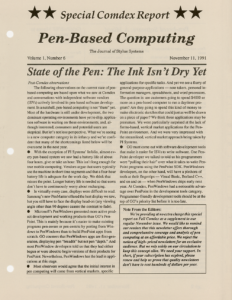
The following observations on the current state of pen-based computing are based upon what we saw at Comdex and conversations with independent software vendors (ISVs) actively involved in pen-based software development. In a nutshell, pen-based computing is not “there” yet. Most of the hardware is still under development, the two dominant operating environments have yet to ship, application software is waiting on these environments, and, although interested, consumers and potential users are skeptical. But let’s not lose perspective. What we’re seeing is a new computer category in its infancy and we’re confident that many of the shortcomings listed below will be overcome in the next year.
- With the exception of PI Systems’ Infolio, almost every pen-based system we saw had a battery life of about four hours, give or take an hour. This isn’t long enough for true mobile computing. Vendors argue that users typically use the machine in short time segments and that a four-hour battery life is adequate for the work day. We think that misses the point. Longer battery life is needed so that users don’t have to continuously worry about recharging.
- In virtually every case, displays were difficult to read. Samsung’s new PenMaster offered the best display we saw, but you still have to face the display head-on (any viewing angle other than 90 degrees causes the contrast to fade).
- Microsoft’s PenWindows presented more active product development and working products than GO’s PenPoint. This is mainly because it’s easier to make existing programs pen-aware or pen-centric by porting from Windows to PenWindows than to build PenPoint apps from scratch. GO counters that PenWindows apps are first-generation, displaying pen “breadth” but not pen “depth.” And most PenWindow developers told us that they had either begun or were about to begin versions of their products for PenPoint. Nevertheless, PenWindows has the lead in applications at this stage.
- Most observers would agree that the initial interest in pen computing will come from vertical markets, specific applications for specific tasks. And yet we see a flurry of general-purpose applications — note takers, personal information managers, spreadsheets, and word processors. The question is: are customers going to spend $4000 or more on a pen-based computer to run a daytimer program? Are they going to spend this kind of money to make electronic sketches that could just as well be drawn on a piece of paper? We think these applications may be premature. We were particularly surprised at the lack of forms-based, vertical market applications for the PenPoint environment. And we were very impressed with the streamlined, vertical market approach being taken by PI Systems.
- GO must come out with software development tools that make it easier for ISVs to write software. One PenPoint developer we talked to told us his programmers were “pulling their hair” over what it takes to write PenPoint programs using the PenPoint SDK. PenWindows developers, on the other hand, will have a plethora of tools at their fingertips — Visual Basic, Borland C++, and on and on — when PenWindows ships early next year. At Comdex, PenWindows had a noticeable advantage over PenPoint in the development tools category. Programmer-friendly development tools should be at the top of GO’s priority list before it is too late.
Note From the Editors: We’re providing at no extra charge this special report on Fall Comdex as a supplement to our regular November issue. We would like to remind our readers that this newsletter offers thorough and comprehensive coverage and analysis of pen computing at an affordable price. We reject the notion of high-priced newsletters for an exclusive audience. But we rely solely on our circulation to keep this concept alive. We need your support. In short, if your subscription has expired, please renew and help us prove that quality newsletters don’t have to cost hundreds of dollars per year.
Transcribed from Pen-Based Computing, Volume 1, Number 6 — November 11, 1991. Page 1.