
ARM and the Hobbit: Tale of Two Chips
From the Original Pages
Click a page to enlarge · Alt-click to open the full issue
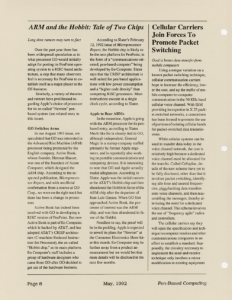
Long time rumors may turn to fact
Over the past year there has been widespread speculation as to what processor GO would initially adopt for porting its PenPoint operating system to a RISC-based architecture, a step that many observers feel is necessary for PenPoint to establish itself as a major player in the OS business.
Similarly, a variety of theories and rumors have proliferated regarding Apple’s choice of processor for its so-called “Newton” pen-based system (see related story in this issue).
GO Switches Arms
In our August 1991 issue, we speculated that GO was interested in the Advanced Risc Machine (ARM) processor being promoted by the English company, Active Book, whose founder, Herman Hauser, was one of the founders of Acorn Computer, which designed the ARM chip. According to the respected publication, Microprocessor Report, and with unofficial confirmation from a source at GO Corp., we were on the right track but there has been a change in processors.
Active Book has indeed been involved with GO in developing a RISC version of PenPoint. But now Active Book is part of Eo Computer, which is backed by AT&T, and has adopted AT&T’s CRISP architecture (C-machine Reduced Instruction Set Processor), the so-called “Hobbit chip”, as its main platform. Eo Computer’s staff includes a group of hardware designers who came from GO after GO decided to get out of the hardware business.
According to Slater’s February 12, 1992 issue of Microprocessor Report, the Hobbit chip is likely to be the next platform for PenPoint, in the form of a “communications-oriented, pen-based computer” being developed by Eo Computer. Slater says that the CRISP architecture is well suited for pen based applications with low power consumption and a “higher code density” than competing RISC processors. Most instructions execute in a single clock cycle, according to Slater.
Apple to Bear ARMs
In the meantime, Apple is going with the ARM processor for its pen-based entry, according to Slater. Much like Eo is closely tied to GO, although independent, General Magic is a startup company staffed primarily by former Apple engineers, and is reportedly also working on portable communications and computing devices. It is interesting to note that GO and Apple actually traded allegiances. According to Slater, Apple was the initial customer for AT&T’s Hobbit chip and then abandoned the Hobbit in favor of the ARM chip after the departure of Jean-Luis Gassee. When GO first approached Active Book, the processor of interest was the ARM chip, and was then abandoned in favor of the Hobbit.
Needless to say, the proof will be in the pudding. Apple is expected to unveil its plans for “Newton” at the Consumer Electronics Show later this month. Eo Computer may be further away from a product announcement but we would bet that more details will be disclosed in the next few months.
Transcribed from Pen-Based Computing, Volume 2, Number 2 — May 1992. Page 8.