
Can Apple Move into Consumer Electronics?
From the Original Pages
Click a page to enlarge · Alt-click to open the full issue
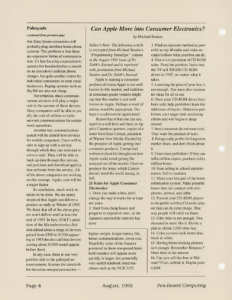
Editor’s Note: The following article is excerpted from Michael Swaine’s “Programming Paradigm” column in the August 1992 issue of Dr. Dobb’s Journal and is reprinted with permission from Michael Swaine and Dr. Dobb’s Journal.
Apple is starting a consumer products division. Apple is not well known in this market, and traditional consumer-goods vendors might say that this market is not well known in Apple. Perhaps a word of advice would be appropriate. Perhaps it would even be appreciated.
Rumor has it that one can see, taped to a wall here and there in Apple’s Cupertino quarters, copies of a letter from Stan Cornyn, president of Warner New Media. Excited by the prospect of Apple getting into consumer products, Cornyn had written to share his thoughts on how Apple could avoid getting Betamaxed out of the market. I here reproduce the letter, which Cornyn doesn’t mind the world seeing, in full.
21 Rules for Apple Consumer Electronics
- Once you make a box, don’t change the way it works for at least ten years.
- Start from cheap boxes and progress to expensive ones, as the Japanese automobile industry has done.
- Find an exposure method as powerful as top 40 radio and video arcades to show what your box can do.
- Hire a vice-president of CD-ROM sales. Fund the position. Insist that the VP sell 500,000 CD-ROM drives in 1992, no matter what it takes.
- Lowering the price of your box is not enough. You must also increase its value for all to see.
- Once your CD-ROM drives have been sold, help publishers learn the addresses of buyers. Otherwise publishers can’t target their marketing efforts and will begin to sleep around.
- Real consumers do not want tools. They want the product of tools.
- Forego early profits for long-term market share, and don’t bitch about it.
- Court mass publishers. If they can sell a million copies, you have sold a million boxes.
- Stop selling to school administrators. Sell to students.
- Make your box part of the home information system. Make portable boxes that can connect with telephones, stereos, and cable.
- Present your CD-ROM players to the public as Ultra CD audio players that can do extra things. That way people will catch on faster.
- Fifty titles is not enough. Two thousand is more like it. Devise a plan to obtain 2,000 titles fast.
- Color pictures look better than black & white.
- Having better-looking pictures isn’t enough. Remember Betamax? More titles is the answer.
- Can you sell this box at Wal-mart? If not, rethink it. Maybe paint it pink.
- Whoever makes a box that easily converts to digital video is the winner. Whoever doesn’t is planning obsolescence.
- CD systems using TV screens will always be cheaper. Emphasize the advantages of monitor display.
- Don’t call it a computer. Call it, for instance, a Time Machine. Not P3-TV. 4D-TV is a better choice.
- Start product development with a breakthrough marketing campaign. Force your engineers to catch up with you.
- Careful market research results in one sure thing: You will be late to market.
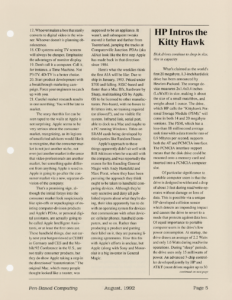
The story that this list can be seen taped to the walls at Apple is not surprising. Apple seems to be very serious about the consumer market, recognizing, as its legions of unsolicited advisors would like it to recognize, that the consumer market is not just another niche, not even just another market in the sense that video professionals are another market, but something quite different from anything Apple is used to. Apple is going to go after the consumer market via a new, separate division of the company. That’s a promising sign, although the initial forays into the consumer market look suspiciously like spin-offs or repackagings of existing computer-division products and Apple’s PDAs, or personal digital assistants, are actually going to be called Apple Intelligent Assistants, or at least the first ones are. These handheld things, due out early next year but previewed at CEBIT in Germany and CES and the Mobile’92 Conference in the U.S., are not really consumer products, but they do show Apple taking a step in the direction of “toasterization.” The original Mac, which many people thought looked like a toaster, was supposed to be an appliance. It wasn’t, and subsequent tweaks moved it farther and farther from Toasterland, jumping the tracks at Computerville Junction. PDAs (aka AIAs) look like the first step Apple has made back in that direction since 1984.
Here’s what the weeklies think the first AIA will be like: Due to ship in January, 1993. Priced under $700 and falling. RISC-based and faster than a Mac IIfx, hardware by Sharp, multitasking OS by Apple. OS to be licensed to other manufacturers. Pen-based, with no boxes to fit letters into, no training required (or allowed?), and no visible file system. Infrared link, serial port, able to dock to a Mac and maybe to a PC running Windows. Titles on SRAM cards being developed by third-parties like Random House.
Apple’s approach to these things apparently didn’t sit well with Bill Atkinson when he was still with the company, and was reportedly the reason for his founding General Magic with Andy Hertzfeld and Marc Porat, where they have been pursuing the approach they think ought to be taken to handheld computing devices. Although they’re very secretive and deny all published reports about what they’re doing, their idea apparently has to do with an operating system for devices that communicate with other devices: cellular phones, handheld computers, and so on. Rather than producing a product and putting their label on it, they are pursuing licensing agreements. How this fits with Apple’s efforts is unclear, but Apple (along with Sony and Motorola) is a big investor in General Magic.
Transcribed from Pen-Based Computing, Volume 2, Number 3 — August 1992. Pages 4, 5.