
CIC Announces New Handwriter Bundle for Windows and Mac
From the Original Pages
Click a page to enlarge · Alt-click to open the full issue
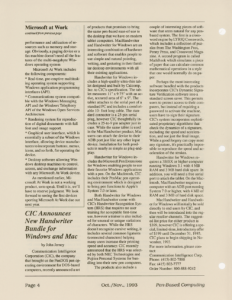
Communication Intelligence Corporation (CIC), the company that brought us the PenDOS pen operating environment for DOS-based computers, recently announced a set of products that promises to bring the same pen-based ease-of-use to the desktop that we have on modern tablet computers. MacHandwriter and Handwriter for Windows are an interesting combination of hardware and software that enables people to use simple and natural pointing, writing, and gesturing in their familiar desktop environments with all their existing applications.
Handwriter for Windows includes a high-quality ultra-thin tablet designed and built by Calcomp, Inc. to CIC’s specification. The tablet measures 11″ x 9.75″ with an active, textured area of 6″ x 9″. The tablet attaches to the serial port of a standard PC and includes a comfortable 10-foot long cable. The standard connector is a 25-pin serial plug, however CIC thoughtfully includes a 25-to-9 pin adapter just in case. While the same tablet is used in the MacHandwriter product, Mac users can attach the device to their ADB port just like any other input device. Installation for both products is nearly as simple as plug-and-play.
Handwriter for Windows includes the Microsoft Pen Extensions for Windows enabling people to use their favorite Windows applications with a pen. On the Macintosh, CIC includes their PenMac pen operating environment which is designed to bring pen functions to Apple’s System 7.0 or later.
Both Handwriter for Windows and MacHandwriter come with CIC’s Handwriter Recognition System (HRS) that requires no user training for acceptable first-time use, however a trainer is also included for unusual or unique variations of characters. While the HRS doesn’t recognize cursive writing, it includes several common ligatures (connected characters) helping many users increase their printing speed and accuracy. CIC recently announced that the HRS was selected by both NEC Technologies and Fujitsu Personal Systems for bundling into their new pen computers.
The products also include a couple of interesting pieces of software that seem natural for any pen-based system. The first is a crossword engine by LYRIQ Crosswords, which includes a collection of puzzles from The Washington Post, Penny Press, and Crossword Magazine. A second program is called MathBook which simulates a piece of paper that can calculate common mathematical operations in a style that one would normally do on paper.
Perhaps the most interesting software bundled with the products incorporates CIC’s Dynamic Signature Verification software into a standard screen saver. This permits users to protect access to their computers, but instead of requiring a password to activate the machine, users have to sign their signature. CIC’s system incorporates sophisticated proprietary algorithms that check the dynamics of a signature, including the speed and acceleration, and not just the final image. While a good forgery can copy most any signature, it’s practically impossible to reproduce the speed and acceleration of the strokes.
Handwriter for Windows requires a 386SX or higher computer running Windows 3.1 with 4 MB RAM and 3 MB hard disk space. In addition, you will need a free serial port to attach the tablet. On the Macintosh, MacHandwriter requires a computer with an ADB port running System 7.0 or higher, with 4 MB of RAM and 3 MB of hard disk space.
MacHandwriter and Handwriter for Windows will initially be sold directly to end users by CIC, and then will be introduced into the regular reseller channels. The suggested list price for either product is $399, however CIC is offering a special, limited-time, introductory offer of $199 until December 31, 1993. CIC plans to begin shipping in November, 1993.
For more information, please contact:
Communication Intelligence Corp.
Phone: (415) 802-7888
Fax: (415) 802-7777
Order Number: 800-888-9242
Transcribed from Pen-Based Computing, Volume 3, Number 5 — November 1993. Page 4.