
There are no Strings on Me!
From the Original Pages
Click a page to enlarge · Alt-click to open the full issue
from Pinocchio, ©Walt Disney
Wireless communications are starting to enter the mainstream. That would have to be the likely conclusion of anyone touring through the dozens of exhibitor booths at Fall COMDEX featuring a range of wireless hardware, software, and communications services.
Through the analog cellular service, wireless voice communications is hitting its stride with somewhere between 12 and 15 million subscribers in the United States and millions more in both Europe and Asia. These technologies, along with new digital packet systems, are racing past the promise stage and moving firmly into the realm of everyday deliverable services. (For detailed information about the new Cellular Digital Packet Data standard, please turn to page 10 of this issue).
In this article, we’ll examine several of the more interesting wireless offerings that were either introduced or updated at Fall COMDEX in Las Vegas.
Travelling Wireless
Travelling Software, together with National Semiconductor, introduced a new and convenient way for mobile users to synchronize and print files from portable computers onto desktop-based systems.
Dubbed LapLink Wireless with AirShare, the product is a combination of hardware and software that uses Radio Frequency (RF) technology to connect the portable device to the desktop computer.
LapLink Wireless comes with everything you need to complete the link, including two AirShare radio modules developed by National Semiconductor, along with LapLink Remote Access and Synchro Plus, both from Travelling Software. Synchro Plus enables you to perform file synchronization in the background in Windows whenever the two devices are in radio contact.
The AirShare modules measure 2.25″ x 3.5″ x 0.5″ and, using the supplied Velcro fasteners, can be attached directly to a desktop or mobile PC. The current device attaches to the computer’s serial port and weighs three ounces. However, it is clear that Traveling Software is aiming to bring this into an even more convenient PCMCIA form factor.
The AirShare module works within a radius of 30 feet, more than enough for the typical data transfer scenario. In addition, the frequency of the unit is user selectable, enabling you to manually prevent conflict with other devices in the neighborhood.
The suggested retail price for LapLink Wireless is $299.95 and will be available through resellers in January 1994. For more information, please contact Traveling Software at (800) 343-8080.
The Killer Mobile App?
Many of us think of wireless email as the coming killer mobile application. However, Navigation Technologies (NavTech) wants us to go past electronic mail and think about the kinds of information and services that we’ll need using wireless data transfer.
With this in mind, NavTech demonstrated their Navigable Map Databases and Mobile DriverGuide technology at COMDEX. This service, used in conjunction with a wireless data or messaging service, enables users to request detailed driving directions in most metropolitan areas.
To use the service, a person enters the origin and destination addresses into an HP, DOS/Windows, or Apple portable computer. The software transmits the message over the wireless network and returns a step-by-step set of directions in seconds using NavTech’s Mobile DriverGuide. The database also includes information about points of interest such as restaurants, hotels, and ATM machines.
While the service is not yet available, NavTech demonstrated its operation using a range of wireless service providers, including RadioMail, ARDIS, and McCaw’s CDPD network. NavTech itself is a partnership of several major participants in the Intelligent Vehicle Highway Systems (IVHS) industry, including the American Automobile Association, European Geographic Technologies, Motorola, Philips Electronics, Nichimen Corp. (Japan), and others.
For more information, please contact Navigation Technologies at (408) 737-3200
Hopping on the Wireless Train
While it’s exciting to think about sending and receiving messages while speeding to Lake Tahoe, most mobile users are likely to be closer to their home station when they need access to information and files. For this, wireless local area networks (LAN) are a compelling solution.
A new entry in this field, RDC Communications, demonstrated their PortLAN system which enables workers to move around freely while maintaining connectivity to their LAN.
The PortLAN system is composed of three elements:
- The User Unit, which is a modem/radio transceiver attached to the mobile PC using either a PCMCIA Type II or ISA slot.
- The Access Point, which coordinates the communication between over 100 user units. The Access Points can be interconnected using standard Ethernet to form larger networks.
- The Network Management software, which uses a graphical interface and industry standard SNMP to monitor and manage the network.
PortLAN operates in the unlicensed ISM 2.4 GHz frequency band and transmits data at 1 Mbit/sec at a range up to 50 meters. By being Ethernet compatible, PortLAN supports existing applications used with popular network operating systems such as Novell’s NetWare.
RDC claims that PortLAN’s main advantage is its use of Frequency Hopping (FH) spread spectrum transmission, instead of the more common Direct Sequence (DS). By using FH, RDC states that their wireless network is more secure and less prone to RF interference.
RDC plans to receive FCC approval for the PortLAN in spring 1994. For more information, contact RDC at (408) 739-7994 in the United States, or 972-2-519311 in Israel.
EMBARC Adds New Services
Several new information services for the EMBARC system were announced either at, or slightly before, Fall COMDEX this year. EMBARC (Electronic Mail Broadcast to a Roaming Computer) is a one-way, wireless data and messaging service offered in more than 230 metropolitan areas in the United States and Canada.
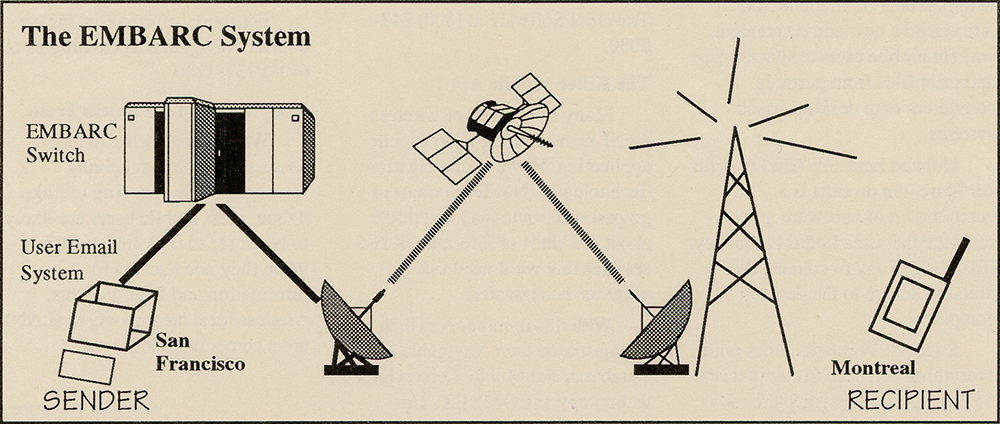
EMBARC enables you to send a message of up to 30 Kbytes to either single or multiple recipients with equal ease. Using a compact device known as NewsStream, or the newer PCMCIA card known as NewsCard, users can receive data files and messages on their portable computers.
The NewsCard is a Type II PCMCIA card that runs on a single AAA battery for up to three weeks. The card is fully functional when either attached or separate from a mobile computer, and has 128 Kb of memory enabling it to store approximately 40 pages of typewritten text.
Other new announcements include:
- Support for PDA-class devices running the GEOS operating system including the Casio Z-7000, Tandy Z-PDA, and the GRiD 2390.
- Support for Apple’s Newton through a custom PCMCIA NewsCard designed and manufactured by Motorola.
- Integration with the RadioMail electronic messaging service enabling EMBARC users to be accessible through the RadioMail service.
In collaboration with On-Site Information Systems, Inc., Motorola also announced a new electronic mail gateway that enables users who normally have their mailbox on a major public or private email service, such as the Internet, to receive their messages on mobile devices using EMBARC’s wireless network.
The gateway supports a broad range of email systems including America Online, CompuServe, Delphi, Prodigy, cc:Mail, Microsoft Mail, NetWare MHS, and others. This means that users can receive and read, but not reply, to their email from anywhere in the EMBARC network.
Finally, Windows software maker Kedwell Software announced that it has upgraded its DataBoss for C++ object-oriented CASE tool enabling users to create applications that are EMBARC-enabled without the need to learn the intricacies of wireless communications technology.
Using DataBoss, users can create custom applications that accept broadcast database updates and changes on mobile computing devices. For more information, contact Jim Calhoun at (312) 988-2795
Solectek Stresses Plug-and-Play
Stressing the importance of ease-of-use and the need for plug-and-play within the wireless LAN world, San Diego-based Solectek introduced its newest member of wireless Ethernet products – the AIRLAN/PCMCIA.
AIRLAN incorporates its essential workings in a PCMCIA Type II, Release 2.0 card weighing a mere 5.25 ounces. The antenna attaches to the portable computer using a self mounting bracket. AIRLAN draws it power from the computer, freeing users from worrying about bulky external AC cables.
Since the AIRLAN is compatible with the IEEE 802.3 Ethernet standard, you can use the device with any wired or wireless Ethernet LAN. The system operates at 2 Mbps and Solectek provides drivers for all the major network operating systems including Novell’s NetWare 4.x, 3.x, and NetWare Lite, along with Microsoft’s LAN Manager and Windows for Workgroups.
To ensure reliability of data transfer, AIRLAN relies on spread spectrum radio technology using frequencies from 902-928 MHz. This enables the AIRLAN to use a small, omni-directional antenna which can provide coverage through walls, ceilings, and floors for a range up to 800 feet. Using Solectek’s AIRLAN/Hub product as an access point, you can extend the distance of the wireless LAN and link it into existing wired Ethernet networks.
The AIRLAN is priced at $699. For more information, please contact Solectek at (800) 437-1518.
Megahertz Offers Cellular Modems
Even with all the effort behind wireless digital data, sending messages and faxes over the standard cellular service will continue to be a popular form of communication. Recognizing this, PCMCIA modem leader Megahertz introduced a new PCMCIA cellular fax modem for use with select cellular telephones.
The card is a full-featured, 14.4 Kbps Type II PCMCIA device that is specifically compatible with the Mitsubishi 3500 and 4000, NEC P100, and Diamondtel 20 and 22 series cellular phones. While this represents a market of approximately 1.5 million users, Megahertz predicts that it will add support for additional devices in the coming months.
For those occasions where a regular land-line is available, users can hook into a standard phone jack and use the card as a standard fax modem. The modem incorporates the standard set of error correcting and compressing protocols including V.42 and V.42bis. Using V.42bis, users can achieve speeds up to 57.6 Kbps over land line connections and 38.4 Kbps using a cellular connection.
For more information, contact Megahertz at (800) LAPTOPS, or (801) 272-6000.
Transcribed from Pen-Based Computing, Volume 3, Number 6 — December 1993. Pages 3, 4, 5.