
Conversation with Dr. John Butler
From the Original Pages
Click a page to enlarge · Alt-click to open the full issue
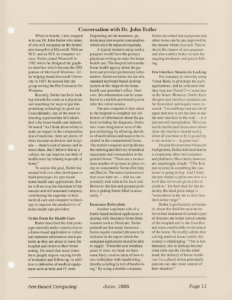
While in Seattle, I also stopped in to see Dr. John Butler who many of you will recognize as the former pen evangelist at Microsoft. With an M.D. and an M.S. in computer science, Butler joined Microsoft in 1982 where he designed the graphics interface which became the GDI portion of Microsoft Windows. After helping found Microsoft University in 1987, he moved into the group writing the Pen Extension for Windows.
Recently, Butler has been looking towards his roots as a physician and searching for ways to put this promising technology to good use. Coincidentally, one of the most interesting opportunities he’s identified is the home health care industry. He noted, “As I think about where to make an impact in the computerization of medicine, there are plenty of folks focused on doctors and hospitals — there’s a lot of money and interest there. But I believe that as a culture, we can improve our state of health more by relating to people at home.”
To realize this goal, Butler has teamed with two other developers to build prototypes for pen-based home health care applications. Butler will serve as the President of this nascent and still unnamed company, contributing his expertise in both medical care and computer technology to improve the productivity of home health care providers.
Order Form for Health Care
Butler described the first prototype currently under construction as a forms-based application to collect and maintain information about patients as they are about to leave the hospital and return to their home setting. He noted that many times these people require varying levels of treatment and follow-up, in addition to deliveries of medical equipment such as beds and IV units. Depending on the treatment, patients may also require consumables which must be replaced regularly.
A typical scenario using such a program would have the primary physician writing an order for home health care. The hospital informs the home health agency about the patient and provides preliminary information. Butler envisions the use of a standard keyboard-based desktop system at this stage in the home health care provider’s office. However, this information can be transferred to a mobile pen-based system after this initial session.
The pen computer is then taken to the hospital to complete the collection of information about the patient including the diagnosis. Butler sees some imaginative uses of the pen technology by allowing sketches of medical data and maps to be included in the computerized forms. The mobile computer also facilitates the ordering and delivery of medical equipment and consumables to the patient’s home. “There are a tremendous number of systems in place today to computerize forms after they are filled in. The transcription errors that occur later on — that we can normally deal with in the back-end. However, the first and greatest problem is getting forms filled in accurately.”
Insurance Boilerplate
Another important role of a forms based medical application is dealing with insurance forms from insurers such as Medicare. Butler pointed out that many insurance forms require standard phrases to be included in the report which the computer application should be able to supply. “From the user interface point of view, we think we have some fairly creative ideas of how to mix boilerplate with handwriting, thereby avoiding [a lot] of handwriting.” By using a mobile computer, Butler described that equipment and other items can be pre-approved by the insurer where required. This reduces the chance of non-payment and also enables better records for ongoing treatment and patient billing.
Pen Interface Standards Lacking
His company is currently using Visual Basic to prototype the early applications, and he indicated that they may use Visual C++ sometime in the future. However, Butler feels that pen user interface standards are far from ideal and require more research. “I would hope that we can all agree that now is not the time to nail the user interface to the wall — it is just not well enough done. There are sterile intellectual discussions about [how the interface should work], when all you have to do is go and try it out on user — at great cost.”
Despite his extensive Microsoft background, Butler indicated that he is examining other environments and platforms. His criteria, however, are surprisingly simple. “[The best pen system] is something the customer is going to buy. And I think the pen market is price sensitive to a level that we’ve not given a lot of credit to.” He feels that for this industry, the ideal price range is “somewhere in the six to nine hundred dollar range.”
Butler is particularly enthusiastic about this field because he believes that treatment of certain types of illnesses are better suited outside of the hospital and in the friendlier and more comfortable environment of the home. He readily admits that solving medical issues within this society is challenging. “This is fundamental, this is perhaps beyond what John can do. On the other hand, the delivery of home health care [is a place] where potentially patients can take more control of their situation.”
Transcribed from Pen-Based Computing, Volume 3, Number 3 — June 1993. Page 11.