
Executive View: A Conversation with Newton Source’s Stephen Elms
From the Original Pages
Click a page to enlarge · Alt-click to open the full issue
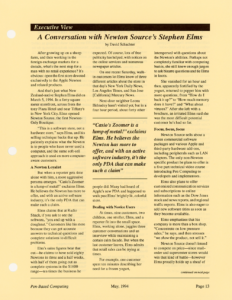
After growing up on a sheep farm, and then working in the foreign exchange markets for a decade, what’s the next step for a man with no retail experience? It’s obvious: open the first store devoted exclusively to the Apple Newton and related products.
And that’s just what New Zealand-native Stephen Elms did on March 5, 1994. In a forty square meter storefront, across from the tony Plaza Hotel and near Tiffany’s in New York City, Elms opened Newton Source, the first Newton-Only Boutique.
“This is a software store, not a hardware store,” says Elms, and his selling technique backs that up. He patiently explains what the Newton is to people who have never used a computer, and the same soft-sell approach is used on more computer-aware customers.
A Newton Loyalist
But when a reporter gets time alone with him, a more aggressive persona emerges. “Casio’s Zoomer is a lump of metal!” exclaims Elms. He believes the Newton has more to offer, and with an active software industry, it’s the only PDA that can make such a claim.
“Casio’s Zoomer is a lump of metal!” exclaims Elms. He believes the Newton has more to offer, and with an active software industry, it’s the only PDA that can make such a claim”
Elms claims that at Radio Shack, if you ask to see the software, “you end up with a doughnut.” Customers like his store because they can get accurate answers to technical questions and complete solutions to difficult problems.
Elm’s sales figures bear that out—he claims to have sold eighty Newtons in three and a half weeks, with half of them going out as complete systems in the $1600 range—ten times the business he expected. Of course, lots of free publicity has helped, with notices on the online services and numerous newspaper articles.
On one recent Saturday, walk-in customers let Elms know of three different articles about the store in that day’s New York Daily News, Los Angeles Times, and San Jose [California] Mercury News.
Next-door neighbor Leona Helmsley hasn’t visited yet, but in a four hour period, about forty other people did. Many had heard of Apple’s new PDA and happened to walk past Elms’ brightly lit, colorful store.
Dealing with Novice Users
At times, nine customers, two children, one stroller, Elms, and a reporter fit into the small space. Elms, working alone, juggles three customer conversations and an interview while maintaining a certain calm facade. But when the last customer leaves, Elms admits that retail sales can be trying at times.
For example, one customer spent ten minutes describing her need for a frozen yogurt, interspersed with questions about the Newton’s abilities. Perhaps not completely familiar with computing basics, she still knew enough jargon to ask bizarre questions and tie Elms in knots.
She vanished for an hour and then, apparently fortified by the yogurt, returned to pepper him with more questions, from “How do I back it up?” to “How much memory does it have?” and “What about viruses?” After she left with a brochure, an irritated Elms said she was the most difficult potential customer he’s had so far.
Focus, focus, focus
Newton Source sells about a dozen commercial software packages and various Apple and third-party hardware add-ons, including peripherals such as LAN adapters. The only non-Newton specific product he plans to offer is a five part technical video course introducing Pen Computing to developers and implementors.
Elms also plans to offer customized communication services and subscriptions to online information such as the Dow Jones stock and news reports, and regional traffic reports. Elms is also eager to add new software titles as soon as they become available.
Elms emphasizes that his company is more than a box shop. “Concentrate on low pressure sales,” he says, and then stresses “we show the product, not sell it.”
Newton Source doesn’t intend to compete on price—since mail-order and supercenter stores would win that kind of battle—however Elms proudly holds up a sheaf of fulfilled Federal Express shipping orders attesting to his mail-order sales.
Instead, Elms sees the Newton Source as a boutique with service given a high priority. An example of this is his offer to help new users get started by downloading their Sharp Wizard databases at no cost. But oddly, Elms expressed no interest in hosting user groups or working closely with the Newton community.
The Future’s So Bright…
Elms sees only a bright future, Apple’s early problems notwithstanding. New York Post reporter Colin Minor—a typical customer according to Elms—proves his point. Minor walks into Newton Source and asks skeptically if Apple has fixed the well-known glitches with the Newton.
After a two minute demo with some low-key selling by Elms, Minor says the MessagePad 110 is “remarkably better,” but leaves without buying one. Elms claims Apple’s overselling failed so spectacularly, customers are surprised how well the Newtons now work.
The next customer asks about filenames. “It’s not like a computer where you have to give filenames,” Elms explains patiently for perhaps the fiftieth time that day. “I love it! I love it!” admits the customer but, like Minor, leaves without buying.
Whether Newton Source will survive after the initial free publicity wears off is unclear. “It’s inevitable that one of these products will take off,” says Elms. The question is, can a sheep farmer’s son, with no retailing background, working out of a tiny but expensive storefront, keep the doors open until then?
Elms is betting on it.
Transcribed from Pen-Based Computing, Volume 4, Number 4 — May 1994. Pages 13, 14.