
The Day of the Infrared Standard Approaches
From the Original Pages
Click a page to enlarge · Alt-click to open the full issue
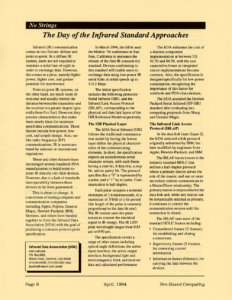
Infrared (IR) communication comes in two flavors: diffuse and point-to-point. In a diffuse IR system, users are not required to maintain a strict line-of-sight in order to exchange data. However, this comes at a price, namely higher power, higher cost, and greater potential for interference.
Point-to-point IR systems, on the other hand, are much more directional and usually restrict the distance between the transmitter and the receiver to a greater degree (generally from 0 to 3 m). However, they possess characteristics that make them nearly ideal for moderate speed data communications. These factors include low-power, low-cost, and simple design. Also, unlike radio frequency (RF) communications, IR is unencumbered by national or international regulations.
These and other features have encouraged several handheld PDA manufacturers to build point-to-point IR directly into their devices. However, due to a lack of standards, interoperability between these devices is far from guaranteed.
This is about to change. A consortium of leading computer and communication companies including Apple, Fujitsu, General Magic, Hewlett-Packard, IBM, Siemens, and others have banded together to form the Infrared Data Association (IrDA) with the goal of producing a common point-to-point specification.
In March 1994, the IrDA used the Mobile ’94 conference in San Jose, California to announce the release of the first IR connectivity standard. Devices conforming to this standard will enable users to exchange data using low-power IR serial links at initial speeds up to 115.2 Kbps.
The initial specification includes the following protocols: Serial Infrared (SIR), and the Infrared Link Access Protocol (IRLAP), corresponding to the physical and data link layers of the OSI Reference Model respectively.
The SIR Physical Layer
The IrDA Serial Infrared (SIR) follows the traditional communication model by having the lowest layer define the physical characteristics of the communicating elements. In short, the specification expects an asynchronous serial character stream, with each frame having a start bit, 8 data bits, a stop bit, and no parity bit. The protocol specifies that a “0” is represented by a pulse, and a “1” by no pulse. Communication is half-duplex.
Each pulse occupies a nominal minimum of 1.6 microseconds, to a maximum of 3/16th of a bit period (the length of the pulse is inversely proportional to the data bit rate). The IR emitter uses this pulse to convert the electrical signal to IR energy. The IR LED peak wavelength ranges from 0.85 μm to 0.90 μm.
The specification covers a range of other issues including optical angle definitions, the active input interface, the active output interface, background light and electromagnetic field, and receiver data and calculated performance.
The IrDA estimates the cost of a discrete component implementation at between US $1.50 and $4.50, with the cost expected to lower as integrated circuit implementations become common. Also, the specification is designed specifically for low-power consumption, recognizing the importance of this factor for notebook and PDA-class devices.
The IrDA accepted the Hewlett Packard Serial Infrared (HP-SIR) standard after evaluating two competing proposals from Sharp and General Magic.
The Infrared Link Access Protocol (IRLAP)
At the data link layer (layer 2), the IrDA selected a link protocol originally submitted by IBM, but later modified by engineers from Apple, Hewlett-Packard, and IBM.
The IRLAP traces its roots to the industry standard HDLC that defines a half-duplex protocol where a primary station serves the role of the master, and one or more secondary stations communicate in a Master/Slave relationship. The primary station is responsible for the data link and, while any station can be dynamically selected as primary, it continues to control the communication session until the connection is closed.
The IRLAP uses most of the standard HDLC frames including:
- Unnumbered frames (U frames), for establishing and closing connections.
- Supervisory frames (S frames), for conveying control information.
- Information frames (I frames), for carrying the data between the devices.
The IRLAP extends the standard HDLC to include features that are unique to the dynamic nature of IR communications. These include:
- Dynamic addressing for adhoc communication, including address conflict resolution.
- Special communication recovery mechanisms.
- Dynamic station discovery.
- Extended setup for communication parameters.
- Contention control mechanisms for the IR medium access.
The Link Management Protocol
Since communication between PDAs and other IR-equipped devices is likely to be highly dynamic, any IR protocol needs to contain elements to help in three essential tasks. The IrDA refers to these tasks as the following:
- Discovery
- Link Control
- Multiplexing
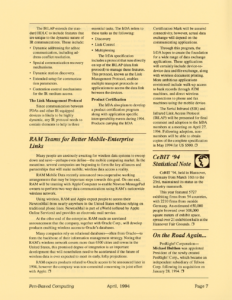
The IrDA specification includes a protocol that runs on top of the IRLAP (data link protocol) to manage these features. This protocol, known as the Link Management Protocol, enables multiple transport protocols or applications to access the data link between the devices.
Product Certification
The IrDA also plans to develop a product certification program along with application specific interoperability events during 1994. Products carrying the IrDA Certification Mark will be assured connectivity, however, actual data exchange will depend on the communicating applications.
Through this program, the IrDA hopes to create the foundation for a wide range of data exchange applications. These applications will certainly include device-to-device data and file exchange, along with wireless document printing. More ambitious applications envisioned include walk-up access to bank records through ATM machines, and direct wireless connections to phone and fax machines using the mobile device.
The Serial Infrared (SIR) and Infrared Link Access Protocol (IRLAP) will be presented for final comment and adoption to the IrDA members at a meeting on April 27, 1994. Following adoption, non-members will be able to obtain copies of the complete specification in May 1994 for US $500.
Infrared Data Association (IrDA)
John LaRoche
P.O. Box 3883,
Walnut Creek, California, USA 94598
(510) 943-6546, (510) 934-5291 (fax),
[email protected] (email)
Transcribed from Pen-Based Computing, Volume 4, Number 3 — April 1994. Pages 6, 7.