
Motorola’s Marco Embarks on an Adventure
From the Original Pages
Click a page to enlarge · Alt-click to open the full issue
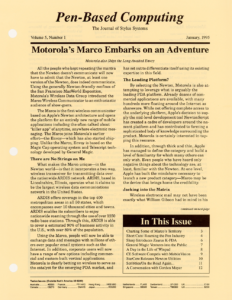
Motorola also Ships the Long-Awaited Envoy
All the people who kept repeating the mantra that the Newton doesn’t communicate will now have to admit that the Newton, at least one version of the Newton, does indeed communicate. Using the generally Newton-friendly confines of the San Francisco MacWorld Exposition, Motorola’s Wireless Data Group introduced the Marco Wireless Communicator to an enthusiastic audience of show-goers.
The Marco is the first wireless communicator based on Apple’s Newton architecture and opens the platform for an entirely new range of mobile applications including the often-talked about “killer app” of anytime, anywhere electronic messaging. The Marco joins Motorola’s earlier effort—the Envoy—which has also started shipping. Unlike the Marco, Envoy is based on the Magic Cap operating system and Telescript technology developed by General Magic.
There are No Strings on Me
What makes the Marco unique—is that it incorporates a two-way, wireless transceiver for transmitting data over the nationwide ARDIS network. ARDIS, based in Lincolnshire, Illinois, operates what it claims to be the largest wireless data communications network in the United States.
ARDIS offers coverage in the top 400 metropolitan areas in all 50 states, which encompasses over 10 thousand cities and towns. ARDIS enables its subscribers to enjoy nationwide roaming through the use of over 1250 radio base stations. Through ARDIS, ARDIS is able to cover a estimated 90% of business activity in the U.S., with over 80% of the population.
Using the Marco, people will now be able to exchange data and messages with millions of others over popular email systems such as the Internet. In addition, corporate users will now have a range of new options including commercial and custom-built vertical applications. Motorola is clearly betting on wireless to serve as the catalyst for the emerging PDA market, and has set out to differentiate itself using its existing expertise in this field.
The Leading Platform?
By selecting the Newton, Motorola is also attempting to leverage what is arguably the leading PDA platform. Already dozens of commercial applications are available, with many hundreds more floating around the Internet as shareware. While not offering complete access to the underlying platform, Apple’s decision to supply the mid-level development tool NewtonScript has created a cadre of developers around the nascent platform and has contributed to forming a sophisticated body of knowledge surrounding the product. Motorola is certainly interested in tapping this resource.
In addition, through thick and thin, Apple has managed to define the category and build a level of familiarity for which many others can only wish. Even people who have heard only negative things about the technology are, at least, familiar with the Newton. At one level, Apple has built the mindshare necessary to launch a new product category—Marco may be the device that brings home the credibility.
Jacking into the Matrix
Wireless electronic mail may not have been exactly what William Gibson had in mind in his classic novel Neuromancer, however the two messaging options for the Marco may still make some business people feel like digital cowboys.
People have the option of signing up for either or both of the following services when they purchase the Marco:
- RadioMail, which connects people to the messaging services of the Internet, America Online, CompuServe, and Prodigy.
- ARDIS PersonalMessaging, which enables peer-to-peer wireless messaging between PersonalMessaging subscribers on communicators, desktop computers, and fax machines.
The two systems can be thought of as complementary in that RadioMail is best suited for users wishing to communicate with a wide range of people, perhaps located on various online services. ARDIS PersonalMessaging, on the other hand, is better suited for custom, vertical applications where people need to communicate with a limited peer group.
The Application’s the Thing
Clearly, Marco will tap into the growing library of commercial, horizontal applications for the Newton. However, the new wireless connectivity options make the device a natural for Apple’s new found interest in promoting highly-vertical applications of their technology.
Currently, several applications will benefit from the Marco, including:
- SalesMate, a sales automation application from KPMG Peat Marwick.
- SkySales, a sales tracking tool based on Lotus Notes from SkyNotes.
- SkyDispatch, a field service electronic clipboard, also from SkyNotes.
- bonds@hand, an up-to-the-moment information access application for treasury certificate quotes and foreign exchange rates from info@hand.
Other applications that were announced or demonstrated along with the Marco introduction include:
- iTRAN for PDAs from Independence Technologies, Inc., enabling the Marco to work with large-scale transaction-processing systems using the ARDIS network. Contact Susan Machado at (510) 438-8735.
- Mobile App Builder from The Memphis Group, Inc., a C/C++ development system for creating mobile-aware applications to access to corporate data. Contact Tim Mukherjee at (212) 759-2407.
- Intelligent Mobile Server from Real World Solutions, a server application development system. Contact John Stossel at (408) 364-7330.
- Mail on the Run! from River Run Software Group, enabling wireless access to corporate email and CompuServe mail. Contact Robert Perry at (203) 861-0090.
Marco and Envoy, Envoy and Marco…
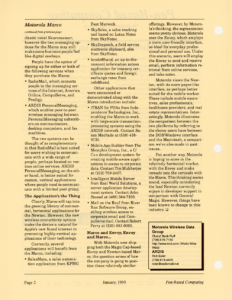
With Motorola now shipping both the Magic Cap-based Envoy and Newton-based Marco, the question arises of how the company is going to position these relatively similar offerings. However, by Motorola’s thinking, the segmentation seems pretty obvious. Motorola sees the Envoy, which employs a more user-friendly interface, as ideal for everyday professional and personal use. Under this scenario, users will employ the Envoy to send and receive email, perform information retrieval from online services, and take notes.
Motorola views the Newton, with its more paper-like interface, as perhaps better suited for the mobile worker. These include mobile executives, sales professionals, healthcare providers, and real estate representatives. Interestingly, Motorola illustrates the comparison between the two platforms by referring to the choice users have between the DOS/Windows interface and the Macintosh, a comparison we’ve also made in past issues.
Put another way, Motorola is hoping to score in the relatively horizontal market with the Envoy and make inroads into the verticals with the Marco. This thinking seems sound, especially considering the lead Newton currently enjoys in developer support in comparison with General Magic. However, things have been known to change in this industry.
Motorola Wireless Data Group
Cheryl Beck-Ruff
(708) 576-7150
http://www.mot.com (World Wide Web)ARDIS
Rob Euler
(708) 913-4405
[email protected]
Transcribed from Pen-Based Computing, Volume 5, Number 1 — January 1995. Pages 1, 2.