
ARDIS First to Support Motorola Wireless Modem
From the Original Pages
Click a page to enlarge · Alt-click to open the full issue
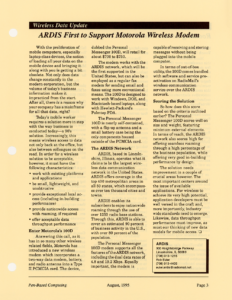
With the proliferation of mobile computers, especially laptop-class devices, the notion of loading all your data on the mobile device and bringing it along with you is getting a bit obsolete. Not only does data change constantly in the modern corporation, but the volume of today’s business information makes it impractical from the start. After all, there is a reason why your company has a mainframe for all that data, right?
Today’s mobile worker requires a solution more in step with the way business is conducted today—a 90’s solution. Increasingly, this means wireless access to data not only back at the office, but also between colleagues on the road. In order for a wireless solution to be acceptable, however, it must have the following characteristics:
- work with existing platforms and applications
- be small, lightweight, and unobtrusive
- provide exceptional local access (including in-building performance)
- provide nationwide access with roaming, if required
- offer acceptable data throughput performance
Enter Motorola’s 100D
Answering this call, as it has in so many other wireless related fields, Motorola has introduced a new wireless modem which incorporates a two-way data modem, battery, and radio antenna into a Type II PCMCIA card. The device, dubbed the Personal Messenger 100D, will retail for about $700 to $750.
The modem works with the ARDIS network, which will be the first supported in the United States, but can also be employed as a regular fax modem for sending email and faxes using more conventional means. The 100D is designed to work with Windows, DOS, and Macintosh-based laptops, along with Hewlett-Packard’s Palmtop PDA.
The Personal Messenger 100D is nearly self-contained, with a flip-up antenna and a small battery case being the only components housed outside of the PCMCIA card.
The ARDIS Network
ARDIS, based in Lincolnshire, Illinois, operates what it claims to be the largest wireless data communication network in the United States. ARDIS offers coverage in the top 400 metropolitan areas in all 50 states, which encompasses over ten thousand cities and towns.
ARDIS enables its subscribers to enjoy nationwide roaming through the use of over 1250 radio base stations. Through this, ARDIS is able to cover an estimated 90 percent of business activity in the U.S., with over 80 percent of the population.
The Personal Messenger 100D modem supports all the features of the ARDIS network, including the dual data rates of 4.8 and 19.2 Kbps. Equally important, the modem is capable of receiving and storing messages without being plugged into the mobile computer.
In terms of out-of-box utility, the 100D comes bundled with software and service pre-activation on RadioMail’s wireless communication service over the ARDIS network.
Scoring the Solution
So how does this score based on the criteria outlined earlier? The Personal Messenger 100D scores well on size and weight, featuring minimum external elements. In terms of reach, the ARDIS network also scores high for offering seamless roaming through a high percentage of the business population, while offering very good in-building performance by design.
The solution needs improvement in a couple of crucial areas however. The most important centers around the issue of available applications. For wireless to achieve its very high potential, application developers must be well versed in the craft and, more importantly, industry wide standards need to emerge. Likewise, data throughput performance must improve, as must our thinking of new data models for mobile access.
ARDIS
300 Knightsbridge Parkway
Lincolnshire, IL 60069
(708) 913-1215
Rob Euler
(708) 913-4405
[email protected]
Transcribed from Pen-Based Computing, Volume 5, Number 8 — August 1995. Page 3.