
Team-Oriented Software Practicum at Washington State University
From the Original Pages
Click a page to enlarge · Alt-click to open the full issue
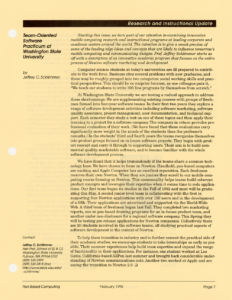
Starting this issue, we turn part of our attention to examining innovative mobile computing research and instructional programs at leading corporate and academic centers around the world. The intention is to give a sneak preview of some of the leading edge ideas and concepts that are likely to influence tomorrow’s mobile computing and communicating designs. Prof. Jeffrey Schlimmer starts us off with a description of an innovative academic program that focuses on the entire process of Newton software marketing and development.
Computer science students at today’s universities are ill prepared to contribute to the work force. Business cites several problems with new graduates, and these may be roughly grouped into two categories: social working skills and practical perspectives. This should be no surprise because, as one colleague puts it, “We teach our students to write 300 line programs by themselves from scratch.”
At Washington State University we are testing a radical approach to address these shortcomings. We are supplementing existing courses with groups of freshmen formed into four-year software teams. In their first two years they explore a range of software development activities including software marketing, software quality assurance, project management, user documentation, and technical support. Each semester they study a text on one of these topics and then apply their learning to a project for a software company. The company in return provides real professional evaluation of their work. (We have found that these evaluations carry significantly more weight in the minds of the students than the professor’s remarks.) In the students’ third and fourth years the teams reorganize themselves into product groups focused on in-house software projects. They begin with product concept and carry it through to supporting users. Their aim is to build commercial quality, marketable software, and to become familiar with the whole software development process.
We have found that it helps tremendously if the teams share a common technology base. We have chosen to focus on Newton. Handheld, pen-based computers are exciting and Apple Computer has an excellent reputation. Each freshman receives their own Newton. When they are juniors they enroll in our mobile computing course focusing on Newton. This commonality helps teams build coherent product concepts and leverages their expertise when it comes time to code applications. Our first team began its studies in the Fall of 1992 and most will be graduating this May. A second junior-level team is collaborating with the first in supporting four Newton applications with over 150 users and in the development of a fifth. Their applications are advertised and supported via the World-Wide Web. A third team of freshmen began last Fall. They completed two marketing reports, one on pen-based drawing programs for an in-house product team, and another under non-disclosure for a regional software company. This Spring they will be testing pre-release applications for Newton companies. Collectively there are 20 students involved in the software teams, all studying practical aspects of software development in the context of Newton.
To help them transition to industry and to further cement the practical side of their academic studies, we encourage students to take internships as early as possible. Their summer experiences help build team expertise and expand the range of functionality in their applications. For instance, one student worked at Los Gatos, California-based AllPen last summer and brought back considerable understanding of Newton communications code. Another two worked at Apple and are easing the transition to Newton 2.0.
—
Contact:
Jeffrey C. Schlimmer
Asst. Prof., School of EE & CS
Washington State University
Pullman, WA 99164-2752
(509) 335-2399
(509) 335-3818 (fax)
http://www.eecs.wsu.edu/~schlimme/
Transcribed from Pen-Based Computing, Volume 6, Number 2 — February 1996. Page 7.