
Understanding the Value of PDAs
From the Original Pages
Click a page to enlarge · Alt-click to open the full issue
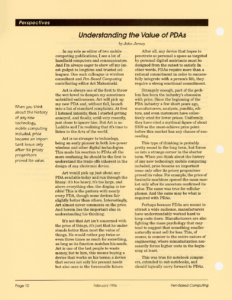
In my role as editor of two mobile computing publications, I see a lot of handheld computers and communicators. And I’m always eager to show off my latest gadget to longtime and trusted colleagues. One such colleague is wireless consultant and Pen-Based Computing contributing editor Art Makosinski.
Art is always one of the first to throw the wet towel to dampen my sometimes unbridled enthusiasm. Art will pick up my new PDA and, without fail, launch into a list of standard complaints. At first I listened intently, then I started getting annoyed, and finally, until very recently, just chose to ignore him. But Art is no Luddite and I’m realizing that it’s time to listen to the Arts of the world.
Art is no stranger to technology, being an early pioneer in both low-power wireless and other digital technologies. This made his reaction to PDAs all the more confusing; he should be the first to understand the trade-offs inherent in the design of any electronic device.
Art would pick up just about any PDA available today and run through the litany: it’s too heavy, it’s too large, and above everything else, the display is terrible! This is the pattern with nearly every PDA, though some devices fair slightly better than others. Interestingly, Art almost never comments on the price. And herein lies the important clue in understanding his thinking.
It’s not that Art isn’t concerned with the price of things, it’s just that he understands better than most the value of things. He would rather pay twice or even three times as much for something, as long as its function matches his needs. Art is one of the last people to waste money, but to him, this means buying a device that works on his terms; a device that serves not only his present needs but also ones in the foreseeable future.
(Pull-quote) When you think about the history of any new technology, mobile computing included, price became an important issue only after its pricey progenitors proved its value.
After all, any device that hopes to penetrate so personal a space as targeted by personal digital assistants must be designed from the outset to satisfy. In other words, PDAs require more than a rational commitment in order to successfully integrate with a person’s life, they require a strong emotional commitment.
Strangely enough, part of the problem has been the industry’s obsession with price. Since the beginning of the PDA industry a few short years ago, manufacturers, analysts, pundits, editors, and even customers have collectively cried for lower prices. Uniformly, they have cited a mythical figure of about $300 as the must-achieve price point before this market has any chance of succeeding.
This type of thinking is probably pretty sound in the long term, but forces us into a strange corner in the shorter term. When you think about the history of any new technology, mobile computing included, price became an important issue only after its pricey progenitors proved its value. For example, the price of facsimile machines opened the mass market only after its ancestors confirmed its value. The same was true for cellular phones. And the same may be what is required with PDAs.
Perhaps because PDAs are meant to attract a wide audience, manufacturers have understandably worked hard to keep costs down. Manufacturers are also fighting the mass psychology that may tend to suggest that something smaller naturally must sell for less. This, of course, is counter to the entire nature of engineering, where miniaturization necessarily forces higher costs in the beginning at least.
This was true for notebook computers, extended to sub-notebooks, and should logically carry forward to PDAs.
This has consistently meant that new technology is often considerably more expensive than the mass market will support. But if the technology is sound, the device works, and it solves a real problem, price is generally a second tier consideration for the important class of early adopters. The worse type of product to offer these trend-setters is one that fails to perform. Boost the price but reduce the disappointment.
Without realizing it, most manufacturers have tried to defy this history by attempting to leapfrog directly past the core early adopters and appeal to the second-generation adopters which are markedly more price sensitive. In doing so, they have made some critical trade-offs that have tended to compromise the entire market—quite the opposite from their obvious intention.
People have been stung by early deficiencies and the image of the whole class of device has suffered as a result. Few people that are on the fence about PDAs believe that these products are “insanely great.” Instead, they have placed themselves in a perpetual holding pattern, continuing to circle around and survey the grounds.
(Pull-quote) The worse type of product to offer these trend-setters is one that fails to perform. Boost the price but reduce the disappointment.
The solution? Manufacturers should certainly keep working on the inexpensive end since a certain fraction of customers will always place price over all other considerations. But a fair portion of the attention should turn towards people that are willing to exchange money for value. I suspect that this is a respectable market, and a market in which Art will feel more than comfortable. At the very least, manufacturers may finally be able to ignite the imagination of enthusiasts and cynics alike.
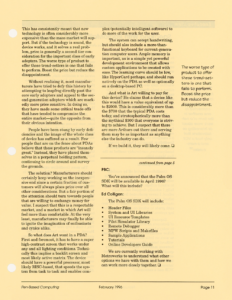
So what does Art want in a PDA? First and foremost, it has to have a super high-contrast screen that works under any and all lighting conditions. Technically this implies a backlit screen and most likely active matrix. The device should have a powerful processor, most likely RISC-based, that speeds the system from task to task and enables complex (potentially intelligent software) to do more of the work for the user.
The system can accept handwriting, but should also include a more-than-functional keyboard for current-generation computer users. Ample memory is important, as is a simple yet powerful development environment that allows custom applications to be created with ease. The learning curve should be low, like HyperCard perhaps, and should run natively on the PDA as well as optionally on a desktop-based PC.
And what is Art willing to pay for this device? He claims that a device like this would have a value equivalent of up to $2000. This is considerably more than the $700 that the typical PDA costs today, and stratospherically more than the mythical $300 that everyone is striving to achieve. But I suspect that there are more Arthurs out there and serving them may be as important as anything else the industry can do.
If we build it, they will likely come.
Transcribed from Pen-Based Computing, Volume 6, Number 2 — February 1996. Pages 10, 11.