
Scribbles
From the Original Pages
Click a page to enlarge · Alt-click to open the full issue
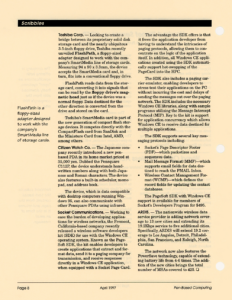
Toshiba Corp. — Looking to create a bridge between its proprietary solid disk storage card and the nearly ubiquitous 3.5-inch floppy drive, Toshiba recently unveiled FlashPath, a floppy-sized adapter designed to work with the company’s SmartMedia line of storage cards. Measuring 94 x 90 x 3.3mm, the device accepts the SmartMedia card and, in turn, fits into a conventional floppy drive.
“FlashPath is a floppy-sized adapter designed to work with the company’s SmartMedia line of storage cards.”
FlashPath reads data from the storage card, converting it into signals that can be read by the floppy drive’s magnetic head just as if the device was a normal floppy. Data destined for the other direction is converted from the drive and stored on the card.
Toshiba’s SmartMedia card is part of the new generation of compact flash storage devices. It competes directly with the CompactFlash card from SanDisk and the Miniature Card from Intel, AMD, among others.
Citizen Watch Co. — The Japanese company recently introduced a new pen-based PDA in its home market priced at 35,000 yen. Dubbed the Pensquare C112P, the device understands handwritten numbers along with both Japanese and Roman characters. The device also features a built-in scheduler, memo pad, and address book.
The device, which is data compatible with desktop computers running Windows 95, can also communicate with other Pensquare PDAs using infrared.
Socket Communications. — Working to ease the burden of developing applications for wireless networks, the Fremont, California-based company recently released a wireless software developers kit (SDK) for use with the Windows CE operating system. Known as the PageSoft SDK, the kit enables developers to create applications that extract and format data, send it to a paging company for transmission, and receive responses directly in a Windows CE application, when equipped with a Socket Page Card.
The advantage the SDK offers is that it frees the application developer from having to understand the intricacies of paging protocols, allowing them to concentrate on the logic of the application itself. In addition, all Windows CE applications created using the SDK automatically support hot-swapping of the PageCard into the HPC.
The SDK also includes a paging carrier emulator, enabling developers to stress test their applications on the PC without incurring the cost and delays of sending the messages out over the paging network. The SDK includes the necessary Windows CE libraries, along with sample programs utilizing the Message Intercept Protocol (MIP). Key to the kit is support for application concurrency which allows Windows CE to receive data destined for multiple applications.
The SDK supports several key messaging protocols including:
- Socket’s Page Descriptor Footer (PDF)—which packetizes and sequences data.
- Mail Message Format (MMF)—which supports email fields for data destined to reach the PMAIL Inbox.
- Wireless Contact Management Format (WCMF)—which defines the record fields for updating the contact databases.
The PageSoft SDK with Windows CE support is available for members of Socket’s Developers Program for $495.
ARDIS. — The nationwide wireless data service provider is adding network coverage to 13 new cities and extending its 19.2Kbps service to five additional cities. Specifically, ARDIS will extend 19.2 coverage to Los Angeles, Detroit, Philadelphia, San Francisco, and Raleigh, North Carolina.
The network now also features the PowerSave technology, capable of extending battery life from 4-6 times. The addition of the new cities brings the total number of MSAs covered to 425.
The Federal Communications Commission approved a plan to allocate 300 MHz of spectrum for unlicensed wireless data communications. In particular, the FCC approved spectrum at 5.15-5.35GHz and 5.725-5.875GHz, a move that is expected to stimulate the development of new wireless LAN products.
Toshiba America Electronic Components, Inc. revealed that its “SmartMedia” Solid State Floppy Disk Card (SSFDC) will be used with the PDR-2A color digital camera developed and sold by Toshiba and its subsidiaries. The PDR-2A is capable of capturing and storing 24 true-color (24-bit) images on a 2MB SmartMedia card, and 48 images on the 4MB version.
Working with AirTouch Satellite Services and Loral Space & Communications, Canadian Satellite Communications Inc.—better known as Cancom—plans to offer fixed and mobile wireless services throughout Canada using the Globalstar satellite communications system. Globalstar is a low-earth orbit (LEO) system that will offer voice, data, and fax capabilities through a $2.5 billion system of 48 satellites.
Konica Corp. unveiled the Q-EZ still digital camera using Intel’s Series 100 2MB Flash memory Miniature Card. The company is offering a Miniature Card-to-PC Type II adapter enabling you to move snapshots between the camera and PC Card-equipped desktop and notebook computer systems.
Mitsubishi Electric Corp. is planning to release a 1.7-inch floppy drive that, while only one-quarter the size of a 3.5-inch drive, delivers the same 1.44MB storage capacity. The drive, which Nikkei English News is reporting weighs a mere 45 grams, may reach capacities up to 20MB in the not-too-distant future.
Matsushita Kotobuki Electronics has increased their production of the LS-120 floppy drive to 300,000 per month, with production expected to reach 500,000 by the end of the year. Capable of storing 120MB of data, LS-120 drives also read current 3.5-inch floppies.
Hitachi has developed a single-chip IC supporting send and receive RF functions for GSM/EGSM.
Transcribed from Pen-Based Computing, Volume 7, Number 4 — April 1997. Pages 8, 9.