
Speaking with ARDIS’ Purnell and McGee
From the Original Pages
Click a page to enlarge · Alt-click to open the full issue
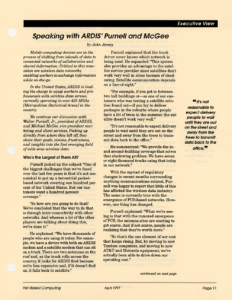
Mobile computing devices are in the process of shifting from islands of data to connected networks of collaborative and shared information. Critical to this transition are wireless data networks, enabling workers to exchange information while on-the-go.
In the United States, ARDIS is leading the charge to equip workers and professionals with wireless data service, currently operating in over 425 MSAs [Metropolitan Statistical Areas] in the country.
We continue our discussion with Walter Purnell, Jr., president of ARDIS, and Michael McGee, vice president marketing and client services. Picking up directly from where they left off, they share their goals, visions, frustrations, and insights into the fast emerging field of wide area wireless data.
Who’s the Largest of Them All?
Purnell picked up the subject: “One of the biggest challenges that we’ve faced over the last few years is that it’s not economical to put up a terrestrial packet-based network covering one hundred percent of the United States. But our customers want a hundred percent coverage.”
“So how are you going to do that? We’ve concluded that the way to do that is through inter-connectivity with other networks. And whereas a lot of the other players are talking about doing this, we’ve done it.”
He explained: “We have thousands of people who are using it today. For example, we have a device with both an ARDIS modem and a satellite modem that can sit on a truck. There are two antennas on the roof and, as the truck rolls across the country, it looks for ARDIS first because we’re less expensive and, if it doesn’t find us, it falls back to satellite.”
Purnell explained that the truck driver never knows which network is being used. He expanded: “This system also provides an advantage to the satellite service provider since satellites don’t work very well in cities because of shadowing. Satellite communication depends on a line-of-sight.”
“For example, if you get in between two tall buildings or—as one of our customers who was testing a satellite solution found out—if you try to deliver packages in the suburbs where people have a lot of trees in the summer, the satellite doesn’t work very well.”
“It’s not reasonable to expect delivery people to wait until they are out on the street and away from the trees to transmit data back to the office.”
“It’s not reasonable to expect delivery people to wait until they are out on the street and away from the trees to transmit data back to the office.”
He summarized: “We provide the in- and around-building coverage that solves that shadowing problem. We have seven or eight thousand trucks using that today in our network.”
With the myriad of regulatory changes in recent months surrounding anything communications-related, Purnell was happy to report that little of this has affected the wireless data industry. The same is currently true with the emergence of PCS-based networks. However, one thing has changed.
Purnell explained: “What we’re seeing is that with the rumored emergence of PCS, the antenna sites are starting to get scarce. And if not scarce, people are realizing that they’re worth more.”
“So that’s the one element of our cost that keeps rising. But, by moving to new Tandem computers, and moving to new AT&T and Motorola equipment, we’ve actually been able to drive down our operating cost.”
The Tale of the Better Mousetrap
As is the case with many technical innovations and solutions, wireless data service providers soon came to discover that having the better mousetrap didn’t necessitate a rush to their doorstep by consumers, horizontal and vertical alike. There’s a good reason for this: wireless data networks have tended to be tricky beasts, forcing potential users to learn not only a new series of terms and technologies, but also often forcing them to integrate complete solutions for themselves.
For example, early users often had to turn to one vendor for the modem, another vendor for the middleware, and still another for the wireless data service itself. And in cases where solutions were bundled, they could tend to be inflexible, offering a one-size-fits-all approach.
Purnell was well aware of this issue and addressed it directly by saying: “One of the things we’ve changed over the last few years is that we’ve gotten a lot more flexible. We’ve adapted much more to marketing and we’ve tried to do a lot of things that enable our costumers to do business with us.”
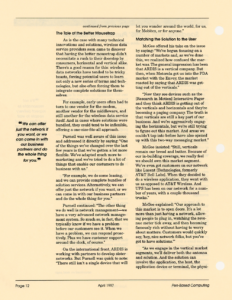
“For example, we do some leasing, and we can provide complete bundles of solution services. Alternatively, we can offer just the network if you want, or we can come in with our business partners and do the whole thing for you.”
“We can offer just the network if you want, or we can come in with our business partners and do the whole thing for you.”
Purnell continued: “The other thing we do well is network management—we have a very advanced network management system. So much so, in fact, that we typically know if we have a problem before our customers see it. When we have a problem, we can respond proactively. Plus we have customer support around the clock, of course.”
On the international front, ARDIS is working with partners to develop sister networks. But Purnell was quick to note: “There still isn’t a single device that will let you wander around the world, for us, for Mobitex, or for anyone.”
Matching the Solution to the User
McGee offered his take on the issue by saying: “We’ve begun focusing on a number of markets and, as we’ve done this, we realized how confused the market was. The general impression has been that ARDIS is a vertical company. But then, when Motorola got us into the PDA market with the Envoy, the market reacted by saying that ARDIS was getting out of the verticals.”
“Now they see devices such as the [Research in Motion] Interactive Pager and they think ARDIS is getting out of the verticals and horizontals and they’re becoming a paging company. The truth is that verticals are still a key part of our business. And we’re aggressively engaging the horizontals, but we’re still trying to figure out this market. And areas we couldn’t tap into before have also opened up with this two-way messaging market.”
McGee insisted: “Still, verticals remain our bread and butter. Because of our in-building coverage, we really feel we should own this market segment. We’ve even got customers on our network like Lucent [Technologies, formerly AT&T Bell Labs]. When they decided to do a wireless application, they went with us as opposed to AT&T Wireless. And UPS has been on our network for a number of years, with a couple thousand trucks.”
McGee explained: “Our approach to this market is to open doors. It’s a lot more than just having a network, allowing people to plug in, watching the revenue meter tick away, and then becoming famously rich without having to worry about matters. Customers would quickly say, ‘hey, nice network folks, but you’ve got to have solutions.'”
“As we engage in the vertical market segments, we’ll deliver both the antenna and solution. And the solution can involve the application, the host, the application device or terminal, the physical connectivity, the middleware, and even the justification associated with it.”
McGee summarized: “Our view is, we know how to do all this, but we’ll take any role the customer want us to take. If the customer wants us to just be a carrier, we’ll be a carrier. If the customer wants a more complete solution, we’ll do that as well. The good news is that there’s a lot more solution-enabling middleware available now which makes this a much easier exercise.”
“Our other strategy has been to partner. We realize that with some market segments, we don’t necessarily have the industry expertise or even the solution. In these cases, we partner with key players within that market. In transportation, for example, we’ve worked with American Mobile Satellite.”
Business Unusual
As with any business, you often find yourself following new business into some unusual corners. McGee offered an example of this by describing an application that probably would not immediately be associated with wireless data.
He began: “An interesting application we’ve come across is in the security market. The system I’m thinking of in particular protects banks, jewelry stores, and other places that already have security systems installed.”
“The role of wireless is when somebody tries to break in or there’s a fire. In these cases, a message is sent to the control center. But instead of a wireline, this system does the job using wireless so the bad guys can’t cut the line. Our in-building coverage positions us very well to offer this type of service.”
Offering advanced paging services has also become a staple for ARDIS. Purnell observed: “Interestingly, a third of the traffic over our network has always been pages. What IBM did, for example, was buy a four-thousand dollar device for their sophisticated application. But once they had that, they thought they might as well do their paging over it as well.”
“Now, with devices like the Interactive Pager, we can attract people who couldn’t quite justify the total cost of ownership equation before. And we’re doing it by planning to distribute this through a variety of paging resellers.”
McGee added: “We always felt that paging wasn’t anything new to us; we know how to do two-way messaging and acknowledgment processing. The key is getting it into a platform that could address the cost of ownership challenge.”
Wireless and Handheld PCs
One grand vision has always held that the perfect marriage of wireless would be to a handheld PC or personal digital assistant. As PDAs and HPCs have grown in capability, and with Microsoft’s recent validation of the category, new opportunities featuring the integration of the two technologies are more likely than ever.
McGee concurred: “We’re very bullish about Windows CE. And as part of our partnering strategy, we’ve teamed up with a company called Ikon, which is a major office systems company that has positioned itself as the EDS for non-mainframe sort of shops, meaning the LAN and copier environment, etc.”
Continuing, McGee added: “ARDIS is also migrating to support Microsoft Exchange on the desktop. This allows me to set up a series of filters on my desktop to forward all urgent email to my mobile address—basically any email I get from Walt, any of my peers, or any of my staff.”
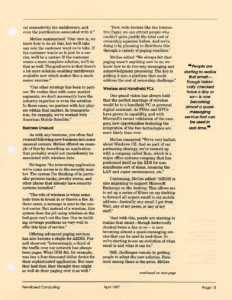
“And with this, people are starting to realize that email—though historically checked twice a day or so— is now becoming almost a quasi-messaging service that can be used in real-time. So we’re starting to see an evolution of what email is and what it can be.”
“People are starting to realize that email— though historically checked twice a day or so— is now becoming almost a quasi-messaging service that can be used in real-time.”
Still, challenges remain in getting people to adopt the new solution. Foremost among these is the price. McGee noted: “When you pay five or six hundred dollars for a handheld computer, but the modem by itself is still in the five-hundred dollar range, this can be a problem. In trying to address the barrier of entry, we’ve put together a $69.95 per month offering.”
“For this, people get the modem along with a hundred kilobytes of ARDIS air time through the Ikon gateway service. All this for one price over a 24 month period. We think this will help a lot to make it easier for people to try wireless.”
Purnell nonetheless finds the horizontal market a tough nut to crack. He confided: “I’m a bit frustrated because I don’t know how to make this horizontal market happen. I had an interesting debate with Robert Growney, who’s now the president of Motorola.”
“And in the midst of this debate—he was chairman of our board at that time—he asked that if I had a choice, tomorrow morning, to have fifty-thousand more users on our network, would I prefer that they be vertical or horizontal? I said, vertical. Why? I know what they’re going to do.”
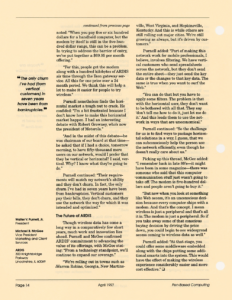
Purnell continued: “Their requirements will match my network’s ability and they don’t churn. In fact, the only churn I’ve had in seven years have been from bankruptcies. Vertical customers pay their bills, they don’t churn, and they use the network the way for which it was intended and optimized.”
“The only churn I’ve had (from vertical customers) in seven years have been from bankruptcies.”
The Future of ARDIS
Though wireless data has come a long way in a comparatively few short years, much work and innovation lies ahead. Purnell and McGee confirmed ARDIS’ commitment to advancing the value of its offerings, with McGee stating: “From a technology standpoint, we’ll continue to expand our coverage.”
“We’re rolling out in towns such as Warren Robins, Georgia, New Martinsville, West Virginia, and Hopkinsville, Kentucky. And this is while others are still rolling out major cities. We’re still growing as always, but it’s driven by customers.”
Purnell added: “Part of making this network work for mobile professionals, I believe, involves filtering. We have vertical customers who send spreadsheets across the network, but they don’t send the entire sheet—they just send the key data or the changes to that key data. The same is true when you want to surf the Web.”
“You can do that but you have to apply some filters. The problem is that with the horizontal user, they don’t want to be bothered with all that. They say ‘don’t tell me how to do it, just let me do it.’ And this leads them to use the network in ways that are uneconomical.”
Purnell continued: “So the challenge for us is to find ways to package horizontal solutions in a way, I guess, that we can subconsciously help the person use the network efficiently, even though he doesn’t really care about us.”
Picking up this thread, McGee added: “I remember back in late 80’s—it might have been in some magazine—there was someone who said that this computer communication stuff just wasn’t going to take off. The modem is five-hundred dollars and people aren’t going to buy it.”
“But now when you look at something like Web access, it’s an unconscious decision because every computer ships with a modem. And that’s the concept. I mean wireless is just a peripheral and that’s all it is. The modem is just a peripheral. So if you take away some of that conscious buying decision by driving the price down, you could begin to see widespread access coming to wireless data as well.”
Purnell added: “At that stage, you could offer some middleware embedded along with the chips putting some additional smarts into the system. This would have the effect of making the wireless experience considerably easier and more cost effective.”
Walter V. Purnell, Jr.
President
Michael B. McGee
Vice President
Marketing and Client Services
ARDIS
300 Knightsbridge Parkway
Lincolnshire, IL 60069
Transcribed from Pen-Based Computing, Volume 7, Number 4 — April 1997. Pages 11, 12, 13, 14.