
Rosemary Redefines Magic Cap
From the Original Pages
Click a page to enlarge · Alt-click to open the full issue
New Operating System Offers Greatler Market Flexibility
Notwithstanding an innovative communications architecture based on intelligent software agents, together with the most intuitive user interface to come along since the original Macintosh, General Magic has had more than its share of setbacks and shortcomings. To begin with, the company had the “misfortune” of starting to work on building a communications infrastructure just a couple of years before the widespread awareness and acceptance of the Internet.
Likewise, when it came to designing the underlying object framework for the Magic Cap operating system, the designers could not confidently say that C++ would hold the position that it does today. This forced them, in a large degree, to create their own object model on top of conventional C.
Finally, before the widespread adoption of low-cost, high-performance RISC chips, the company’s hardware designers were forced to look towards more conventional CISC-based chips to serve as the processing core of the platform. Add to that, General Magic was forced to wade through the negative media wake of the early Newton. Times have indeed been tough, as witnessed by the fact that two of the founders of the company are no longer around: Chief Scientist Bill Atkinson and Magic CEO, Marc Porat.
In Porat’s place comes Steve Markman, a seasoned Novell veteran, and with him, a new strategy.
Just Like Starting Over…
Gone are the days of proprietary networks—Magic is now dedicated to bringing the flexibility and power of the Internet to handheld platforms. In terms of software architecture, a rewrite promises to make things easier for developers all around. And move over pokey CISC processors—the new reference design features an advanced MIPS core that makes the spinning hat (equivalent to the hourglass in Windows or the watch on the Mac) a far less likely occurrence.
“The company’s new version of Magic Cap is called Rosemary, and represents a ground-up rewrite of the operating system.”
The company’s new version of Magic Cap is called Rosemary, and represents a ground-up rewrite of the operating system. The new code is leaner, faster, and includes features that can potentially make hardware designs even cheaper such as the SoftModem technology that now relies on software in place of a dedicated chip, but still moves data around at 28.8 Kbps. The thinking behind this? Fewer chips translates to less expensive hardware.
The new architecture also offers added flexibility in terms of precisely which components are built into the system, and which can be left behind. The result is that Rosemary will now be suitable for a wider range of devices, ranging from memory-restricted smart phones to keyboard-enhanced handheld PCs and PDAs.
Imagine…
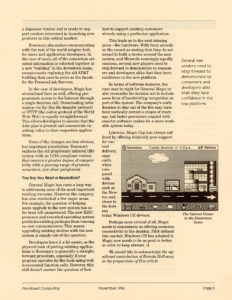
Rosemary is also a better world citizen, offering built-in support for the double-byte Unicode standard, as well as being more sensitive to variations in sort order, presentation differences, and the like. In fact, as you can see from the desk scene above, Magic has been working on a Japanese version and is ready to support vendors interested in launching new products in this critical market.
Rosemary also makes communicating with the rest of the world simpler, both for users and application developers. In the case of users, all of the connection-oriented information is collected together in a new “building” in the downtown scene, conspicuously replacing the old AT&T building that used to serve as the facade for the PersonaLink Services.
In the case of developers, Magic has streamlined here as well, offering programmers access to the Internet through a single function call. Downloading information via ftp (the file transfer protocol) or HTTP (the native protocol of the World Wide Web) is equally straightforward. This allows developers to assume that the data pipe is present and concentrate on adding value to their respective applications.
Some of the changes are less obvious, but important nonetheless. Rosemary replaces the old proprietary infrared (IR) system with an IrDA-compliant version that ensures a greater degree of compatibility with a growing range of printers, computers, and other peripherals.
You Say You Want a Revolution?
General Magic has come a long way in addressing some of the most important existing concerns. However, the company has also overlooked a few major areas. For example, the question of helping users upgrade to the new system has so-far been left unanswered. The new RISC processor and reworked operating system precludes existing packages from running on new communicators. This means upgrading existing devices with the new system is simply out-of-the-question.
Developers have it a bit easier, as the physical task of porting existing applications to Rosemary is generally a straightforward procedure, especially if your program operates by-the-book using well documented function calls. However, this still doesn’t answer the question of how best to support existing customers already using a particular application.
“Several new vendors need to step forward to demonstrate to consumers and developers alike that they have confidence in the new platform.”
This leads us to the next missing piece—the hardware. With Sony already on the record as stating that they do not intend to built a device around the new system, and Motorola seemingly equally cautious, several new players need to step forward to demonstrate to consumers and developers alike that they have confidence in the new platform.
In terms of software features, the time may be right for General Magic to also reconsider its decision not to include some form of handwriting recognition as part of the system. The company’s early decision to stay out of the fire may have been tactically correct a couple of years ago, but faster processors coupled with smarter software makes for a more workable system today.
Likewise, Magic Cap has always suffered by offering relatively poor support for content delivery, especially when compared with devices such as the Newton and, closer to the horizon today, Windows CE devices.
Perhaps most critical of all, Magic needs to concentrate on offering seamless connectivity to the desktop. Pilot defined this market, Windows CE has adopted it, Magic now needs to be as good or better in order to keep abreast.
We would like to acknowledge the significant contribution of Brenda Holloway in the preparation of this article.
Transcribed from Pen-Based Computing, Volume 6, Number 11 — November 1996. Pages 4, 5.