
Apple Forced to Rethink Strategy
From the Original Pages
Click a page to enlarge · Alt-click to open the full issue
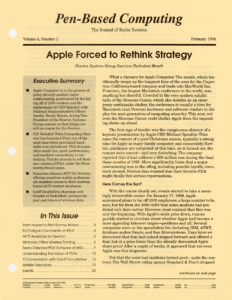
Newton Systems Group Survives Turbulent Month
What a January for Apple Computer. The month, which traditionally wraps up the happiest time of the year for the Cupertino, California-based company and leads into MacWorld San Francisco, the largest Macintosh conference in the world, was anything but cheerful. Crowded in the very modern exhibit halls of the Moscone Center, which also doubles as an emergency earthquake shelter, the conference is usually a time for Macintosh (and Newton) hardware and software vendors to display the next-generation of computing wizardry. This year, not even the Moscone Center could shelter Apple from the impending shake-up ahead.
The first sign of trouble was the conspicuous absence of a keynote presentation by Apple CEO Michael Spindler. Then came the rumors of a poor Christmas season, typically a strong time for Apple as many family computer, and conceivably Newton, purchases are completed at this time. As it turned out, the rumors were correct—and very disturbing. The company reported that it had suffered a $69 million loss during the final three months of 1995. More significantly, hints that a major restructuring was in the offing, including possible layoffs, circulated around. Newton fans worried that their favorite PDA might finally feel serious repercussions.
Here Comes the Sun?
With the course clearly set, events started to take a seemingly irreversible course. On January 17, 1996, Apple announced plans to lay off 1300 employees, a large number to be sure, but far from the 3000-4000 that some analysts had predicted only days earlier. However, most realized that this was only the beginning. With Apple’s stock price down, rumors quickly started to circulate about whether Apple had become a more appealing takeover target—problems and all. Several companies were on the speculation list, including IBM, AT&T, database-maker Oracle, and Sun Microsystems. Days later we discovered that Sun had indeed stepped forward and offered a deal, but at a price lower than the already discounted Apple share price! After a couple of weeks, it appeared that not even Apple was this desperate.
Not that the news had suddenly turned good—quite the contrary. The Wall Street rating agency Standard & Poor’s dropped its ratings on Apple’s senior debt and commercial paper, lowering some of its debt to junk bond status. Could Michael Spindler survive such an assault? Early indications were that he had come through the initial restructuring unscathed. Apple even published an open letter in the Wall Street Journal from Mr. Spindler assuring everyone that, notwithstanding the mistakes, everything was still pretty positive for the company, its developer partners, and customers.
Out With the Old, In With the New
As is often the case in situations such as these, no amount of support from the company could quell the increasing cries for accountability at the top. Momentum continued to build as published reports indicated that Apple Chairman and long-time company veteran A.C. “Mike” Markkula had stated that Mr. Spindler was suffering from unspecified health problems, presumably related to his well-known high blood pressure condition. By this time, many felt that the pole had been greased and Mr. Spindler’s exit was imminent.
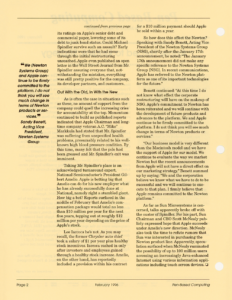
(Pull-quote) We (Newton Systems Group) and Apple continue to be firmly committed to the platform. I do not think you will see much change in terms of Newton products or services.
— Sandy Benett, Acting Vice President, Newton Systems Group
Taking Mr. Spindler’s place is an acknowledged turnaround expert, National Semiconductor’s President Gilbert Amelio. Apple is betting big that Amelio can do for his new employer what he has already successfully done at National, namely right a stumbled giant. How big a bet? Reports surfaced in the middle of February that Amelio’s compensation package would total no less than $10 million per year for the next five years, topping out at roughly $12 million per year depending on the price of Apple’s stock.
Lee Iaccoca he’s not. As you may recall, the former Chrysler auto chief took a salary of $1 per year plus healthy stock incentives. Iaccoca cashed in only after investors and employees gained through a healthy stock increase. Amelio, on the other hand, has reportedly included a provision within his contract for a $10 million payment should Apple be sold within a year.
So how does this affect the Newton? Speaking with Sandy Benett, Acting Vice President of the Newton Systems Group (NSG), shortly after the January 17th announcement, he noted: “The January 17th announcement did not make any specific reference to the Newton Systems Group [NSG]. In recent communications, Apple has referred to the Newton platform as one of its important technologies for the future.”
Benett continued: “At this time I do not know what effect the corporate restructuring will have on the makeup of NSG. Apple’s commitment to Newton has been reiterated and we will continue with the development of future products and advances to the platform. We and Apple continue to be firmly committed to the platform. I do not think you will see much change in terms of Newton products or services.
“Our business model is very different than the Macintosh model and we have the support of Apple for our model. We continue to evaluate the way we market Newton but the recent announcements from Apple will not have a direct effect on our marketing strategy.” Benett summed up by saying: “We and the corporation believe we know what we have to do to be successful and we will continue to execute to that plan. I firmly believe that Apple remains committed to the Newton platform.”
As far as Sun Microsystems is concerned, talks apparently broke off with the ouster of Spindler. For his part, Sun Chairman and CEO Scott McNealy publicly expressed hope that Apple succeeds under Amelio’s new direction. McNealy also took the time to refute rumors that Sun was interested in purchasing the Newton product line. Apparently, speculation surfaced when McNealy ruminated the possibility of up to 100 million users accessing an increasingly Java-enhanced Internet using various information applications including touch screen devices.
Transcribed from Pen-Based Computing, Volume 6, Number 2 — February 1996. Pages 1, 2.