
GO Deals Hardware Design To Phoenix
From the Original Pages
Click a page to enlarge · Alt-click to open the full issue
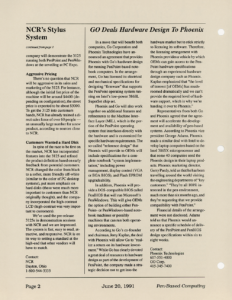
In a move that will benefit both companies, Go Corporation and Phoenix Technologies have announced an agreement that provides Phoenix with Go’s hardware design for running PenPoint-based notebook computers. In the arrangement, Go has licensed its electrical and mechanical specifications for designing “firmware” that supports the PenPoint operating system running on Intel’s low-power 386SL SuperSet chip set.
Phoenix and Go will also work together on additional features and refinements to the Machine Interface Layer (MIL), which is the portion of the PenPoint operating system that interfaces directly with the hardware and is customized for specific hardware requirements. The so-called “reference design” that Phoenix will provide to OEMs will include specifications for a complete notebook “system implementation,” including power management, display control (VGA or EGA BIOS), and Flash EPROM upgradeability.
In addition, Phoenix will provide a DOS-compatible BIOS called PenBIOS that will run Microsoft’s PenWindows. This will give OEMs the option of building either PenPoint- or PenWindows-based notebook machines or possibly machines that can run both operating environments.
According to Go’s co-founder and chairman, Jerry Kaplan, the deal with Phoenix will allow Go to “realize a return on its hardware investment.” While Go has clearly devoted a great deal of resources to hardware design as part of the development of PenPoint, the company made a strategic decision not to get into the hardware market but to stick strictly to licensing its software. Therefore, the licensing arrangement with Phoenix provides a vehicle by which OEMs can gain access to the PenPoint hardware specifications through an experienced hardware design company such as Phoenix. Kaplan emphasized that “the level of interest [of OEMs] has mushroomed dramatically and we can’t provide the required level of hardware support, which is why we’re handing it over to Phoenix.”
Representatives from both Go and Phoenix agreed that the agreement will accelerate the development and availability of pen-based systems. According to Phoenix vice president George Adams, Phoenix made a similar deal with Intel to develop laptop computers based on the Intel 386SX microprocessor and that some 40 companies used the Phoenix design in their laptop products. Phoenix marketing director, Gerry Purdy, told us that he has been travelling around the world visiting the engineering departments of “key customers.” “They’re all 100% interested in the pen environment, much more than six months ago, and they’re requesting that we provide compatibility with PenPoint.”
Financial details of the arrangement were not disclosed. Adams told us that Phoenix would announce a specific schedule of delivery of the PenPoint and PenBIOS design specifications within six to eight weeks.
Contact:
Phoenix Technologies
617-551-4000
GO Corp.
415-345-7400
Transcribed from Pen-Based Computing, Volume 1, Number 3 — June 20, 1991. Page 2.