
News from the Wireless LAN Market
From the Original Pages
Click a page to enlarge · Alt-click to open the full issue
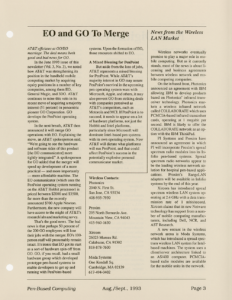
Wireless networks eventually promise to play a major role in mobile computing. But as it currently stands, most of the news is about licensing and business agreements between wireless network and mobile computing companies.
On the infrared front, Photonics announced an agreement with IBM allowing IBM to develop products based on Photonics’ infrared transceiver technology. Photonics markets a wireless infrared network called COLLABORATE which uses PCMCIA-based infrared transceiver cards, operating at 1 megabit per second. IBM is likely to offer the COLLABORATE network as an option with the IBM ThinkPad.
PI Systems and Proxim have announced an agreement in which PI will incorporate Proxim’s spread spectrum radio modules into its Infolio pen-based systems. Spread spectrum radio networks appear to be the leading wireless network solution for hospital pen-based applications. Proxim’s RangeLAN adapters will be available in Infolio systems by the end of this year.
Xircom has introduced spread spectrum wireless LAN system operating at 2.4 GHz with a data transmission rate of 1 mbit/second. Xircom claims that its new Netwave technology has support from a number of mobile computing manufacturers, including Dell, NCR, and AST Research.
A new entrant in the wireless network arena is Moda Systems, which has introduced a spread spectrum wireless LAN system for Intel-based machines. The system uses a client/server architecture linked to an AS/400 computer. PCMCIA-based radio modules are available for the mobile units in the network.
Wireless Contacts:
Photonics
2940 N. First St.
San Jose, CA 95134
408-955-7930Proxim
295 North Bernardo Ave.
Mountain View, CA 94043
415-960-1630Xircom
26025 Mureau Rd.
Calabasas, CA 91302
818-878-7600Moda Systems
One Kendall Sq.
Cambridge, MA 02139
617-494-0402
Transcribed from Pen-Based Computing, Volume 3, Number 4 — September 1993. Page 3.