
FCC Allocates New Spectrum for PCS
From the Original Pages
Click a page to enlarge · Alt-click to open the full issue
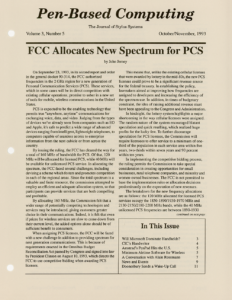
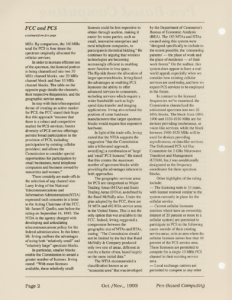
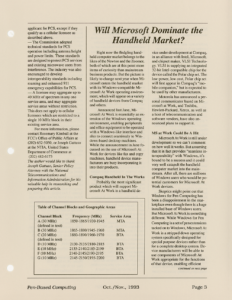
On September 23, 1993, in its second report and order in the general docket 90-314, the FCC authorized frequencies in the 2 GHz region for a new generation of Personal Communication Services (PCS). These services, which in some cases will be in direct competition with existing cellular operations, promise to usher in a new set of tools for mobile, wireless communications in the United States.
PCS is expected to be the enabling technology that permits true “anywhere, anytime” communications for exchanging voice, data, and video. Judging from the types of devices we’ve already seen from companies such as EO and Apple, it’s safe to predict a wide range of advanced devices ranging from intelligent, lightweight telephones, to computers capable of seamless access to enterprise information from the next cubicle or from across the country.
By issuing the ruling, the FCC has cleared the way for a total of 160 MHz of bandwidth for PCS. Of that, 120 MHz will be allocated for licensed PCS, while 40 MHz will be available for unlicensed PCS service. In allocating the spectrum, the FCC faced several challenges, including devising a scheme which fosters and promotes competition in each of the regional areas. Since the total spectrum is a valuable and finite resource, the commission attempted to employ an efficient and adequate allocation system, so that participants can provide services that are both compelling and profitable.
By allocating 160 MHz, the Commission felt that a wider range of potentially competing technologies and services may be introduced, giving customers greater choice in their communications. Indeed, it is felt that even if prices for wireless services are slow to come down from their current level, the added options alone should be sufficient benefit to consumers.
When assigning PCS licenses, the FCC will be faced with a new challenge in addition to providing spectrum for next generation communications. This is because of requirements enacted in the Omnibus Budget Reconciliation Act passed by Congress and signed into law by President Clinton on August 10, 1993, which directs the FCC to use competitive bidding when awarding PCS licenses.
This means that, unlike the existing cellular licenses that were awarded by lottery in the mid-80s, the new PCS licenses could prove to be a significant revenue source for the federal treasury. In establishing the policy, lawmakers aimed at improving how frequencies are assigned to developers and increasing the efficiency of the spectrum use. In addition, in times of budgetary constraint, the idea of raising additional revenue must have been appealing to the Congress and Administration.
In hindsight, the lottery system highlights a major shortcoming in the way cellular licenses were assigned. The random nature of the system encouraged blatant speculation and quick reselling, which realized huge profits for the lucky few. To further discourage speculation for PCS licenses, the Commission will require licensees to offer service to a minimum of one-third of the population in each service area within five years, two-thirds within seven years and 90 percent within ten years.
In implementing the competitive bidding process, the ruling permits the Commission to take special consideration in creating opportunities for small businesses, rural telephone companies, and minority and women-owned businesses. The FCC is not permitted to base the implementation rules or allocation decisions predominantly on the expectation of new revenues.
The breakdown for the new frequency allocations are as follows: the 120 MHz allocated for licensed PCS services occupy the 1850-1890/1930-1970 MHz and 2130-2150/2180-2200 MHz bands, while the 40 MHz unlicensed PCS frequencies are between 1890-1930 MHz. By comparison, the 160 MHz total for PCS is four times the spectrum originally allocated for cellular services.
In order to increase efficient use of the spectrum, the licensed portion is being channelized into two 30 MHz channel blocks, one 20 MHz channel block and four 10 MHz channel blocks. The table on the opposite page details the channels, their respective frequencies, and the geographic service areas.
In step with their often repeated theme of creating an active market for PCS, the FCC stated their hope that this approach “ensures that there is a robust and competitive market for PCS services; fosters diversity of PCS service offerings; permits broad participation in the provision of PCS, including participation by existing cellular providers; and allows the Commission to consider special opportunities for participation by small businesses, rural telephone companies and business owned by minorities and women.”
There certainly are trade-offs in the selection of any channel size. Larry Irving of the National Telecommunications and Information Administration (NTIA) expressed such concerns in a letter to the Acting Chairman of the FCC, Mr. James H. Quello, sent before the ruling on September 14, 1993. The NTIA is the agency charged with developing and articulating telecommunications policy for the federal administration. In this letter, Mr. Irving outlines the advantages of using both “relatively small” and “relatively large” spectrum blocks.
In particular, smaller blocks enable the Commission to award a greater number of licenses. Irving stated: “With more licenses available, these relatively small licenses could be less expensive to obtain through auction, making it easier for some parties, such as small, innovative enterprises and rural telephone companies, to participate in the initial bidding.” He continues by arguing that wireless technologies are becoming increasingly efficient in enabling more function in less space.
The flip side favors the allocation of larger spectrum blocks. Irving listed the advantages as enabling PCS licensees the ability to offer advanced services to consumers, including services which require a wider bandwidth such as high-speed data transfer and imaging applications. Irving also echoed the position of some hardware manufacturers that larger spectrum blocks would require less expensive hardware.
In light of the trade-offs, Irving stated that the NTIA supports the suggestion “that the Commission take a bifurcated approach, award[ing] a combination of ‘large’ and ‘small’ PCS licenses.” He stated that this creates the maximum number of spectrum blocks while providing the advantages inherent in both approaches.
The geographic services areas for PCS are categorized as Major Trading Areas (MTAs) and Basic Trading Areas (BTAs), as defined by the Rand McNally atlas. Under the plan adopted by the FCC, there are 51 MTA and 492 BTA service areas in the United States. This is not the only option that was available to the FCC. Indeed, Irving suggested a compromise between the geographic size of MTAs and BTAs, stating: “The Commission should not be limited by the fact that Rand McNally & Company produced only two sets of areas, different in size by a factor of ten, based largely on the same initial data.”
The NTIA recommended a classification known as an “economic area” that was developed by the Department of Commerce’s Bureau of Economic Analysis (BEA). The 183 MTAs and BTAs created using this system were “designed specifically to include to the extent possible, the ‘commuting patterns’ — the place of work and the place of residence — of their work forces.” On the surface, this system does appear to have a real-world appeal, especially when we consider how existing cellular services are used today, and how we expect PCS services to be employed in the future.
In contrast to the licensed frequencies we’ve examined, the Commission channelized the unlicensed spectrum into two 20 MHz blocks. The block from 1890-1900 and 1920-1930 MHz are for devices providing isochronous, or voice-like services, while the block between 1900-1920 MHz will be used for devices providing asynchronous, or data-like services. The Unlicensed PCS Ad Hoc Committee for 2 GHz Microwave Transition and Management (UTAM, Inc.) was conditionally designated as the frequency coordinator for these spectrum blocks.
Other highlights of the ruling include:
- The licensing term is 10 years, with license renewal similar to the system currently in place for the cellular service.
- Current cellular licensees (entities which have an ownership interest of 20 percent or more in a cellular system) are permitted to participate in PCS in the following cases: outside of their existing service areas, or in an area where the cellular licensee serves less than 10 percent of the PCS service area. These licensees are permitted to compete for a single 10 MHz PCS channel in their existing service area.
- Local exchange carriers are permitted to compete as any other applicant for PCS, except if they qualify as a cellular licensee as described above.
- The Commission adopted technical standards for PCS operation including antenna height and power limits. These standards are designed to protect PCS services and existing microwave users from interference. The industry was also encouraged to develop interoperability standards including roaming and enhanced 911 emergency capabilities for PCS.
- A licensee may aggregate up to 40 MHz of spectrum in any one service area, and may aggregate service areas without restriction. This does not apply to cellular licensees which are restricted to a single 10 MHz block in their existing service area.
For more information, please contact Rosemary Kimball at the FCC’s Office of Public Affairs at (202) 632-5050, or Joseph Gattuso at the NTIA, United States Department of Commerce at (202) 482-6173
The author would like to thank Joseph Gattuso, Senior Policy Attorney with the National Telecommunications and Information Administration for his valuable help in researching and preparing this article.
Table of Channel Blocks and Geographic Areas
| Channel Block | Frequency (MHz) | Service Area |
|---|---|---|
| A (30 MHz) | 1850-1865/1930-1945 | MTA |
| (defined in text) | ||
| B (30 MHz) | 1865-1880/1945-1960 | MTA |
| C (20 MHz) | 1880-1890/1960-1970 | BTA |
| (defined in text) | ||
| D (10 MHz) | 2130-2135/2180-2185 | BTA |
| E (10 MHz) | 2135-2140/2185-2190 | BTA |
| F (10 MHz) | 2140-2145/2190-2195 | BTA |
| G (10 MHz) | 2145-2150/2195-2200 | BTA |
Transcribed from Pen-Based Computing, Volume 3, Number 5 — November 1993. Pages 1, 2, 3.