
Mobile Computing Products Abound At Fall COMDEX
From the Original Pages
Click a page to enlarge · Alt-click to open the full issue
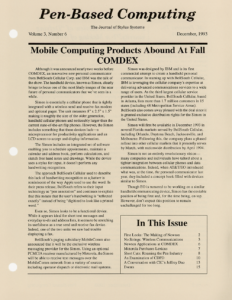
Although it was announced nearly two weeks before COMDEX, an innovative new personal communicator from BellSouth Cellular Corp. and IBM was the talk of the show. The handheld device, known as Simon, clearly brings to focus one of the most likely images of the near future of personal communicators that we’ve seen in a while.
Simon is essentially a cellular phone that is tightly integrated with a wireless send and receive fax modem and optional pager. The unit measures 8″ x 2.5″ x 1.5″ making it roughly the size of the older generation, handheld cellular phones and noticeably larger than the current state-of-the-art flip phones. However, the Simon includes something that these devices lack—a microprocessor for productivity applications and an LCD screen to accept and display information.
The Simon includes an integrated set of software enabling you to schedule appointments, maintain a calendar and address book, perform calculations, and sketch free hand notes and drawings. While the device uses a stylus for input, it doesn’t perform any handwriting recognition.
The approach BellSouth Cellular used to describe this lack of handwriting recognition as a feature is reminiscent of the way Apple used to use the word. In their press release, BellSouth refers to their input technology as “pen annotation” and continues to explain that this means that the user’s handwriting is “reflected exactly” instead of being “digitized to look like a printed word.”
Even so, Simon looks to be a functional device. While it appears ideal for short text messages and everyday to-do and address lists, it seems to be stretching its usefulness as a true send and receive fax device. Indeed, one of the two units we saw had trouble displaying a fax.
BellSouth’s paging subsidiary MobileComm also announced that it will be the exclusive wireless messaging provider for the Simon. Using an optional PCMCIA receiver manufactured by Motorola, the Simon will be able to receive text messages over the MobileComm network from a variety of sources including operator dispatch or electronic mail systems.
Simon was designed by IBM and is its first commercial attempt to create a handheld personal communicator. In teaming up with BellSouth Cellular, IBM is leveraging the cellular company’s expertise at delivering advanced communications services to a wide range of users. As the third largest cellular service provider in the United States, BellSouth Cellular, based in Atlanta, lists more than 1.7 million customers in 15 states (including 48 Metropolitan Service Areas). BellSouth also comes away pleased with the deal since it is granted exclusive distribution rights for the Simon in the United States.
Simon will first be available in December 1993 in several Florida markets served by BellSouth Cellular, including Orlando, Daytona Beach, Jacksonville, and Melbourne. Following this, the company plans a phased rollout into other cellular markets that it presently serves by March, with nationwide distribution by April 1994.
Simon is not an entirely revolutionary vision—many companies and individuals have talked about a tighter integration between cellular phones and data communications. Indeed, when AT&T/EO introduced what was, at the time, the personal communicator last year, they included a concept book filled with devices similar to Simon.
Though EO is rumored to be working on a similar handheld communicating device, Simon has the enviable position of being first and, for the time being, on top. However, don’t expect this position to remain unchallenged for too long.
Transcribed from Pen-Based Computing, Volume 3, Number 6 — December 1993. Page 1.