
Technology Review: Introducing the Cellular Digital Packet Data (CDPD) Standard
From the Original Pages
Click a page to enlarge · Alt-click to open the full issue
Many of us see the need for efficient, effective wireless data communications as obvious. What is not obvious is how to get from here to there—there being a seamless system which enables us to use our existing distributed applications, connect to existing online data services, and send and receive data from the corporate enterprise.
McCaw Cellular Communications took us a step closer with the November 15th rollout of its Cellular Digital Packet Data network in Las Vegas, right in time for an eager audience at COMDEX.
Dubbed AirData, McCaw plans to have the CDPD service available in five metropolitan areas before the end of January 1994, in addition to Las Vegas. These cities are: New York, Dallas, Miami, Seattle, and San Francisco.
Advantages of CDPD
Instead of building a new wireless data network from scratch, CDPD employs the existing cellular voice network as the base of its infrastructure. The idea behind CDPD is that at any given time, a certain percentage of the voice channels are idle.
CDPD takes advantage of this “wasted” bandwidth to send data using the same channels of the cellular network. The CDPD specification is designed to guarantee that data and voice can coexist peacefully without interference or corruption.
Understanding the Specification
The CDPD system is an open, non-proprietary standard, that encourages vendors to create equipment that can be used at all stages of the network. To really understand CDPD, it helps to have the Cellular Digital Packet Data System Specification, Release 1.0, which was released on July 19, 1993.
The document and specification details every CDPD-specific component of the system and was produced by Ameritech Mobile Communications, Bell Atlantic Mobile Systems, Contel Cellular, GTE Mobile Communications, McCaw Cellular Communications, NYNEX Mobile Communications, PacTel Cellular, and Southwestern Bell Mobile Systems.
The goals of the specification include ensuring that equipment supplied by several vendors are compatible and interoperate effectively. This interoperability crosses several levels, including those between a user’s mobile equipment and the CDPD Service Provider; between the CDPD network and existing data networks; and between various CDPD Service Providers in different geographic regions.
The Importance of Off-the-Shelf
One of the most important considerations when selecting any data network—whether it is a local area network or a wide-area service—is its support for your existing distributed applications. The cost of creating new applications, along with the training required makes this infeasible in many circumstances.
CDPD simplifies matters considerably by supporting two international and industry network layer protocols: the Internet Protocol (IP), and the Connectionless Network Protocol (CLNP). IP is the network protocol for the nearly ubiquitous TCP/IP protocol suite, and supports literally thousands of existing distributed applications. CLNP is part of the OSI protocol suite and has strong support in both government and foreign countries.
This also means that the CDPD network can connect directly with large data highways including the massive Internet.
The CDPD Architecture
The CDPD network is designed to enable users to exchange digital data between mobile and fixed devices attached to the network. Since many of the devices are designed to easily change location, the network must include not only the regular types of features available in most networks, but also a new class of mobility-oriented services.
Exploring CDPD Components
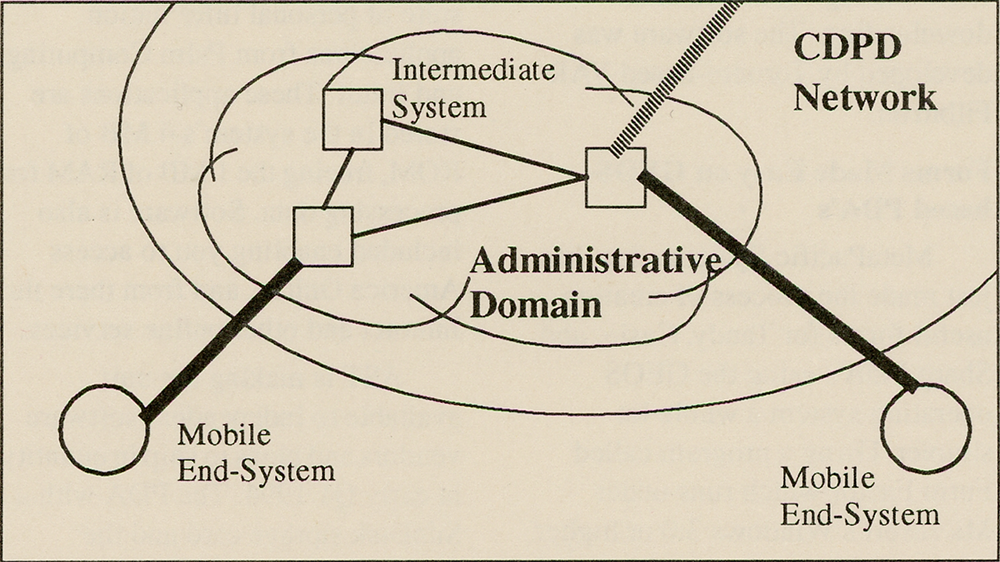
At each end of the communication, users need to use some device to compose and read their information. CDPD calls these devices end systems and makes the distinction between Fixed End Systems (F-ES) and Mobile End Systems (M-ES).
F-ES still form the majority of devices and are generally in a fixed location. Even when they are moved, they are attached to a particular point in the network, enabling conventional routing software to locate their fixed position.
M-ES, on the other hand, are designed to be on the move. This requires the CDPD network to incorporate special routing procedures in order to determine the location of the device in relation to the network at any given time. In CDPD, this is facilitated by means of a unique identifier called the Network Entity Identifier (NEI).
Attaching to the Network
The part of the CDPD subnetwork to which a M-ES connects is known as the point of network attachment. Since this is like to change with a mobile device, the CDPD network relies on two features to support these devices. The first is known as mobility management and enables the network to determine the point of attachment.
The second feature is known as radio resource management and is responsible for maintaining a connection between the M-ES and the point of attachment in the subnetwork.
Intermediate Systems
Since CDPD users can be located anywhere within the system, special devices are needed to enable distant people to communicate. In CDPD, this is handled by Intermediate Systems (IS). In principle, an IS behaves much like a router in a regular network by checking the destination of each packet submitted to the network and routing it to an IS that is logically closer to the recipient.
When the packet arrives at the IS closest to the recipient, CDPD delivers the packet directly to the person’s device (M-ES), and the communication is complete.
For people familiar with the OSI Reference Model, Intermediate Systems operate at the Network Layer (layer 3). This layer is responsible not only for routing packets, but also detecting congestion, and fragmenting and reassembling packets thereby enabling internetworks to be created from a collection of networks.
“The idea behind CDPD is that at any given time a certain percentage of the voice channels are idle.”
Organizing into Domains
Any network which intends to support thousands and millions of users needs an effective organization to monitor service and provide accurate billing for services. The CDPD system manages this complexity by partitioning itself into sections known as administrative domains. Each administrative domain is operated by an entity known as a CDPD Service Provider. This arrangement is similar to the way regional telephone and cellular service providers are operating today.
Each domain uses one or more Intermediate System to exchange data packets with other domains in the larger CDPD network. However, inter-domain communication is not limited to user data packets—domains also need to exchange system maintenance and management information including accounting and billing data, user authentication, and the current location of a user.
Other CDPD Components
The CDPD system requires two additional components to complete the service features. These entities are known as the Mobile Data Intermediate System (MD-IS) and the Mobile Data Base Station (MDBS). These elements are not included in the figure on the previous page to keep the illustration simple. However they are important components.
The MDBS is responsible for providing a mobile data link over the radio channels that are used in a particular cell. The MDBS controls the radio interface including the allocation of radio channels in such a way that it doesn’t interfere with the voice channels that are being used in a cell. The MDBS also controls the channel hopping that a data communications session may require to prevent it from colliding with voice calls.
The MD-IS serves as an interface between the MDBS (which, you’ll recall, communicates directly with the user’s M-ES), and the Intermediate Systems (IS) that connect to other parts of the CDPD network. The MD-IS is therefore responsible for managing the mobility of the users and their connection to the CDPD network.
Next Issue: New Announced Services for the CDPD Network.
Transcribed from Pen-Based Computing, Volume 3, Number 6 — December 1993. Pages 10, 11.