
A Conversation with aha’s Greg Stikeleather
From the Original Pages
Click a page to enlarge · Alt-click to open the full issue
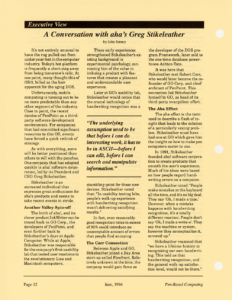
It’s not entirely unusual to have the rug pulled out from under your feet in the computer industry. Today’s hot platform is frequently a short step away from being tomorrow’s relic. At one point, many thought this of OS/2, billed as the heir apparent for the aging DOS.
Unfortunately, mobile computing is turning out to be no more predictable than any other segment of the industry. Case in point, the recent demise of PenPoint as a third-party software development environment. For companies that had committed significant resources to this OS, events have forced a quick rethink of strategy.
As with everything, some will be better positioned than others to roll with the punches. One company that has adapted quickly is aha! software corporation, led by its President and CEO Greg Stikeleather.
Stikeleather is an animated individual that expresses great enthusiasm for aha’s products and seems to take recent events in stride.
Another Valley Spin-off
The birth of aha!, and its clever product InkWriter can be traced back to GO Corp., the developers of PenPoint, and even further back to Stikeleather’s days at Apple Computer. While at Apple, Stikeleather was responsible for the company’s first usability lab that tested user reactions to the revolutionary Lisa and Macintosh computers.
These early experiences strengthened Stikeleather’s existing background in experimental psychology, convincing him of the value in imbuing a product with features that creates a pleasant and understandable user experience.
“The underlying assumption used to be that before I can do interesting work, it has to be in ASCII—before I can edit, before I can search and manipulate information.”
Later at GO’s usability lab, Stikeleather would notice that the crucial technology of handwriting recognition was a stumbling point for these new devices. Stikeleather noted that: “In usability testing labs, people’s walk-up experience with handwriting recognition wasn’t delivering satisfying results.”
In fact, even reasonably good recognition rates in excess of 90% could introduce an unacceptable amount of errors that people find annoying
The Carr Connection
Between Apple and GO, Stikeleather joined a Bay Area start-up called Forefront. Relatively unknown at the time, the company would gain fame as the developer of the DOS program Framework, later sold to the one-time database powerhouse Ashton-Tate.
It was here that Stikeleather met Robert Carr, who would later become the co-founder of GO Corp. and chief architect of PenPoint. This connection led Stikeleather himself to GO, as head of its third-party evangelism effort.
The Aha Effect
The aha effect is the term used to describe a flash of insight that leads to the solution of a particularly vexing problem. Stikeleather must have had one at GO which gave him the insight on how to make pen computers easier to use.
In 1991, Stikeleather founded aha! software corporation to create products that smooth the user’s experience. Much of his ideas were based on how people regard handwriting errors on a computer.
Stikeleather noted: “People make mistakes at the keyboard all the time, and it’s no big deal. They say ‘Oh, I made a typo.’ However, when a mistake happens with handwriting recognition, it’s a totally different reaction. People don’t say ‘Oh, I made a write-o’. They say the machine or system, however they conceptualize it, screwed up.”
Stikeleather reasoned that “we have a lifetime history in recognizing our own handwriting. This told us that handwriting recognition, and the general walk-up satisfaction level, would not be there.”
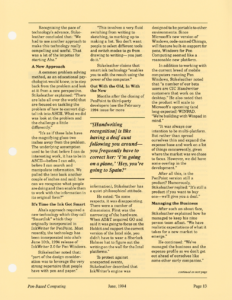
Recognizing the pace of technology’s advance, Stikeleather concluded that: “We had to use another approach to make this technology really compelling and useful. That was a lot of the impetus for starting Aha.”
A New Approach
A common problem solving method, as an educational psychologist would know, is to step back from the problem and look at it from a new perspective. Stikeleather explained: “There are labs all over the world that are focused on tackling the problem of how to convert digital ink into ASCII. What we did was look at the problem and the challenge a little differently.”
“It’s as if these labs have the magnifying glass two inches away from the problem. The underlying assumption used to be that before I can do interesting work, it has to be in ASCII—before I can edit, before I can search and manipulate information. We pulled the lens back another couple of inches and said: how can we recognize what people are doing and then enable them to work with the information in its original form?”
It’s Time the Ink Got Smart
Aha’s approach required a new technology which they call “SmartInk” that originally incorporated in InkWriter for PenPoint. Most recently, the technology has been incorporated into aha’s June 10th, 1994 release of InkWriter 2.0 for Pen Windows.
Stikeleather noted that: “part of the design consideration was to leverage the very strong repertoire that people have with pen and paper.”
“This involves a very fluid switching from writing to sketching, to marking up to making a list. You don’t want people to select different tools and switch modes to go from drawing to writing— you just do it.”
Stikeleather claims that smart ink technology “enables you to edit the result using the power of the computer.”
Out With the Old, In With the New
Months after the closing of PenPoint to third-party developers (see the February 1994 issue for more information), Stikeleather has a quiet philosophical attitude.
“[Handwriting recognition] is like having a deaf aunt following you around—you frequently have to correct her: ‘I’m going on a plane,’ ‘Hey, you’re going to Spain?'”
He noted: “In some respects, it was disappointing. There were a number of dimensions. First was the narrowing of the hardware. When AT&T acquired GO and said it was going to focus on the Hobbit and support the current version of the Intel side, you didn’t have to wear a Sherlock Holmes hat to figure out the writing on the wall for the Intel platform.”
To protect against unexpected events, Stikeleather described that InkWriter’s engine was designed to be portable to other environments. Since Microsoft’s new version of Windows, code-named Chicago, will feature built-in support for pens, Windows for Pen Computing seemed like a reasonable new platform.
In addition to working with the current breed of mobile computers running Pen Windows, Stikeleather noted that “a number of our beta users are CIC Handwriter customers that work on the desktop.” He also noted that the product will scale to Microsoft’s upcoming (and long-expected) WINPAD. “We’re building with Winpad in mind.”
“It was always our intention to be multi-platform. But rather than spread ourselves thin and expand the expense base and work on a lot of things concurrently, given where the market was we chose to focus. However, we did have some overlap in the development.”
After all this, is the PenPoint version still a product? Humorously, Stikeleather replied: “It’s still a product if you want to buy one—we’ll give you a deal.”
Managing the Business
After such an about face, Stikeleather explained how he managed to keep his nine person team afloat. “We have realistic expectations of what it takes for a new market to emerge.”
He continued: “We’ve managed the business and the expense profile so we don’t get out ahead of ourselves like some other early companies.”
Besides the seed investment, much of it coming from Stikeleather, aha! has closed two additional rounds of financing including four million dollars in January 1994.
Applications of InkWriter
Unfortunately, InkWriter does not include any software hooks for third-party developers. However, aha! has talked with VARs that are interested in applying InkWriter to forms-based problems.
Stikeleather also sees InkWriter as a useful tool for collaborative messaging. “Look at the world of the Internet today, the ASCII constrained world. There are entire books written about different ‘smiley’ faces that you can create using parentheses, commas, colons, and angle brackets to communicate more with this limited ASCII text. The challenge is to bring back the personal dimension of communication.”
He noted that when you get a printed form letter today, “you think that I’m one of a million in a mailing list somewhere.” Of course, with this type of technology, you’ll think you’re one in a million when you get a handwritten note as well.
Other Platforms
What’s next for aha! software? Stikeleather sees several compelling candidates, however some are more compelling than others.
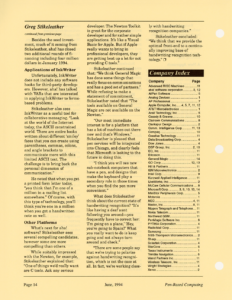
While suitably impressed with the Newton, for example, Stikeleather explained that: “One of things we’d really want are C tools. Ask any serious developer. The Newton Toolkit is great for the corporate developer and for rather simple applications. It’s like a Visual Basic for Apple. But if Apple really wants to bring in professional developers, they are getting beat up a lot for not providing C tools.”
Stikeleather continued that: “We think General Magic has done some things that really focus on communications and has a good set of partners.” While refusing to make a statement of commitment, Stikeleather noted that “The tools available on General Magic are not available on the Newton.”
“Our most immediate interest is for a platform that has a lot of machines out there now and that’s Windows.” Stikeleather is pleased that pen services will be integrated into Chicago, and clearly feels that Microsoft is looking to the future in doing this.
“I think you will see new sub-notebook computers that have a pen, and designs that make the keyboard play a secondary role in those times when you find the pen more convenient.”
What does Stikeleather think about the current state of handwriting recognition? “It’s like having a deaf aunt following you around—you frequently have to correct her: ‘I’m going on a plane,’ ‘Hey, you’re going to Spain? But you really want to do is keep going and not always turn around and check.”
“There are some people say that we’re trying to polarize against handwriting recognition, which is not the case at all. In fact, we’re working closely with handwriting recognition companies.”
Stikeleather concluded: “We think that we provide the optimal front-end to a continually improving base of handwriting recognition technology.”
Transcribed from Pen-Based Computing, Volume 4, Number 5 — June 1994. Pages 12, 13, 14.