
The Importance of Digital Signal Processing
From the Original Pages
Click a page to enlarge · Alt-click to open the full issue
DSP solutions ideal for mobile computing
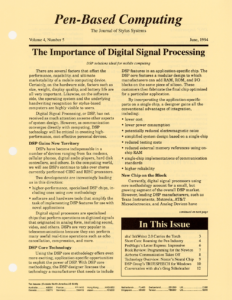
There are several factors that affect the performance, capability, and ultimate marketability of a mobile computing device. Certainly, on the hardware side, factors such as size, weight, display quality, and battery life are all very important. Likewise, on the software side, the operating system and the underlying handwriting recognition for stylus-based computers are highly visible to users.
Digital Signal Processing, or DSP, has not received as much attention as some other aspects of system design. However, as communication converges directly with computing, DSP technology will be critical in creating high-performance, cost-effective personal devices.
DSP Gains New Territory
DSPs have become indispensable in a number of devices ranging from fax modems, cellular phones, digital audio players, hard disk controllers, and others. In the computing world, we will see DSPs continue to take over chores currently performed CISC and RISC processors.
Two developments are increasingly leading us in this direction:
- higher-performance, specialized DSP chips, including ones using core methodology
- software and hardware tools that simplify the task of implementing DSP features for use with novel applications
Digital signal processors are specialized chips that perform operations on digitized signals that originated in analog form, including sound, video, and others. DSPs are very popular in telecommunications because they can perform many useful real-time operations such as echo cancellation, compression, and more.
DSP Core Technology
Using the DSP core methodology offers even more exciting, application-specific opportunities to exploit the power of DSP. With DSP core methodology, the DSP designer licenses the technology a manufacturer needs to include DSP features in an application-specific chip. The DSP core features a modular design to which manufacturers can add RAM, ROM, and I/O blocks on the same piece of silicon. These customers can then fabricate the final chip optimized for a particular application.
By incorporating the application-specific parts on a single chip, a designer gains all the conventional advantages of integration, including:
- lower cost
- lower power consumption
- potentially reduced electromagnetic noise
- simplified system design based on a single chip
- reduced testing costs
- reduced external memory references using on-chip RAM
- single-chip implementations of communication standards
- higher reliability
New Chip on the Block
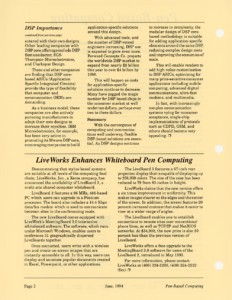
Currently, digital signal processors using core methodology account for a small, but growing segment of the overall DSP market. However, leading DSP manufacturers, such as Texas Instruments, Motorola, AT&T Microelectronics, and Analog Devices have entered with their own designs. Other leading companies with DSP core offerings include DSP Semiconductor, SGS-Thompson Microelectronics, and Clarkspur Design.
These and other companies are finding that DSP core-based ASICs (Application Specific Integrated Circuits) provide the type of flexibility that computer and communication OEMs are demanding.
As a business model, these companies are also actively pursuing manufacturers to adopt their core designs to increase their royalties. IBM Microelectronics, for example, has been very active in promoting its Mwave DSP core, encouraging companies to build application-specific solutions around this design.
With advanced tools, and the number of DSP-versed engineers increasing, DSP use is expected to grow even more. Forward Concepts Co. expects the worldwide DSP market to expand from nearly $2 billion this year to over $4 billion by 1996.
This will happen as costs for application-specific solutions continue to decrease. Many have pegged the magic number for DSP-based chips in the consumer market at well under ten dollars, perhaps even two to three dollars.
Summary
With the convergence of computing and communications well underway, flexible DSP-based solutions are essential. As DSP designs continue to increase in complexity, the modular design of DSP core-based methodology is suitable for adding application-specific elements around the same DSP, reducing complex design costs and improving the economies of scale.
This will enable vendors to add high-value customization to DSP ASICs, optimizing for many price-sensitive consumer applications including mobile computing, advanced digital communications, ultra-fast modems, and multimedia.
In fact, with increasingly complex communication systems vying for consumer acceptance, single-chip implementations of protocols such as CDPD, GSM, and others should become very appealing.
Transcribed from Pen-Based Computing, Volume 4, Number 5 — June 1994. Pages 1, 2.