
A Conversation with Aironet’s Tom Snow
From the Original Pages
Click a page to enlarge · Alt-click to open the full issue
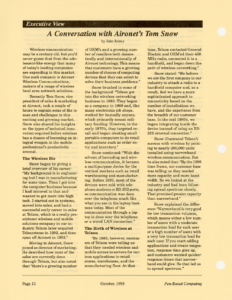
Wireless communication may be a century old, but you’d never guess that from the adolescent-like energy that many of today’s leading companies are expending in this market. One such company is Aironet Wireless Communications, makers of a range of wireless local area network solutions.
Recently Tom Snow, vice president of sales & marketing at Aironet, took a couple of hours to explain some of the issues and challenges in this exciting and growing market. Snow also shared his insights on the types of technical innovation required before wireless has a chance of becoming an integral weapon in the mobile professional’s productivity arsenal.
The Wireless Biz
Snow began by giving a brief overview of his career: “My background is in engineering but I was in manufacturing for some time. Then I got into the computer business because I had minored in that and wanted to get more into high tech. I started out in systems, moved into sales, and had a successful early career in sales at Telxon, which is a really preeminent wireless and mobile solutions company in our industry. Telxon later acquired Telesystems in 1992, and then spun off Aironet in 1993.”
Moving to Aironet, Snow joined as director of marketing. He described how most of the sales are currently done through Telxon, but also noted that “there’s a growing number of OEM’s and a growing number of resellers both domestically and internationally of Aironet technology. This means that customers have a growing number of choices of computing devices that they can select to solve their business problems.”
Snow brushed in some of the background: “Telxon got into the wireless networking business in 1983. Telxon began as a company in 1969 and, like many electronics job shops, worked for basically anyone, which primarily meant military funding. However, in the early 1970’s, they targeted retail and began creating small portable computers to do retail applications such as order entry and inventory.”
Snow continued: “With the advent of barcoding and wireless communication, it became a multipurpose device for the vertical markets such as retail warehousing and manufacturing. Before 1983, most of the devices were sold with telephone modems or RS-232 ports, so communication was done over the telephone much like what you see in the laptop business today. Most of the communication through a laptop is done over the telephone or a wired LAN connection.”
The Birth of Wireless at Telxon
“By 1983, however, customers of Telxon were telling us that they needed wireless and mobile access to servers for various applications in retail stores, warehouses, and the manufacturing floor. At that time, Telxon contacted General Electric and OEM’ed their 450 MHz radio, connected it to a handheld, and began down the path of wireless networking.”
Snow stated: “We believe we are the first company in our industry to attach a radio to a handheld computer and, as a result, feel we have a more sophisticated approach to connectivity based on the number of installations we have, and the experience from the breadth of our customer base. In the mid 1980’s, we began integrating inside the device instead of using an RS-232 external connection.”
Snow illustrated Telxon’s success with wireless by pointing to nearly 200,000 units installed using narrowband wireless communication. But he also noted that: “By the 1990 time frame, our customer base was telling us they needed more capacity and more bandwidth. So we looked at the industry and had been following spread spectrum closely. That promised greater capacity than narrowband.”
Snow explained the difference: “Narrowband is very good for low transaction volumes, which means either a low number of users with a moderate transaction load for each user or a high number of users with a very low transaction load for each user. If you start adding applications and create congestion, response time goes up, and customers wanted quicker response times that narrowband could give. So that led us to spread spectrum.”
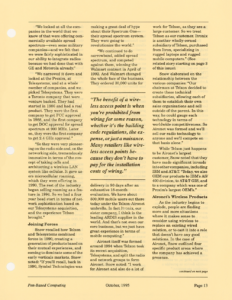
“We looked at all the companies in the world that we knew of that were offering commercially available spread spectrum—even some military companies—and we felt that we were fairly sophisticated in our ability to integrate radios because we had done that with GE and Motorola already.”
“We narrowed it down and looked at the Proxim, at Telesystems, and a whole number of companies, and we picked Telesystems. They were a Toronto company that were venture backed. They had started in 1986 and had a real product. They were the first company to get FCC approval in 1988, and the first company to get DOC approval for spread spectrum at 900 MHz. Later on, they were the first company to get 2.4 GHz approval.”
“So they were very pioneering on the radio side and, on the manufacturing side technology in terms of taking cells and architecting a wireless LAN system like cellular. It gave users microcellular roaming, which they were offering in 1990. The rest of the industry began selling roaming as a feature in 1994. So we had a four year head start in terms of network sophistication based on our Telesystems acquisition, and the experience Telxon brought.”
Joining Forces
Snow recalled how Telxon and Telesystems combined forces in 1990, creating a generation of products based on their mutual experiences, and coming to dominate some of the early verticals markets. Snow noted: “If you’ll recall, back in 1990, Symbol Technologies was making a great deal of hype about their Spectrum One—their spread spectrum system. They were going to revolutionize the world.”
“We continued to do narrowband, added spread spectrum, and competed against them, winning the Walmart contract in April of 1992. And Walmart changed the whole face of the business. They ordered 30,000 units for delivery in 90 days after an exhaustive 18-month evaluation. We have about 500,000 mobile users out there today under the Telxon-Aironet umbrella. In fact Itronix, our sister company, I think is the leading ARDIS supplier in the world. And that’s not even our core business, but we just have great experience in terms of mobile computing.”
“The benefit of a wireless access point is when you’re prohibited from wiring for some reason, whether it’s the building code regulations, the expense, or just a nuisance. Many retailers like wireless access points because they don’t have to pay for the installation costs of wiring.”
Aironet itself was formed around 1994 when Telxon took its recent acquisition, Telesystems, and split the radio and network groups to form Aironet. Snow noted: “I work for Aironet and also do a lot of work for Telxon, as they are a large customer. So we treat Telxon as our customer. Itronix is another wholly-owned subsidiary of Telxon, purchased from Itron, specializing in rugged laptops and rugged mobile computers.” (See related story starting on page 3 of this issue.)
Snow elaborated on the relationship between the various companies: “Our chairman at Telxon decided to create these technical subsidiaries, allowing each of them to establish their own sales organizations and sell outside of the parent. In this way, he could gauge each technology in terms of worldwide competitiveness. So Aironet was formed and we’ll sell our radio technology to anyone and we’ll compete on that basis alone.”
While Telxon just happens to be Aironet’s largest customer, Snow noted that they have made significant inroads into other companies, including IBM and AT&T. “Today, we also OEM our products to IBM’s AS/400 division, to AT&T GIS, and to a company which was one of Proxim’s largest OEM’s.”
Aironet’s Wireless Products
As the industry begins to explode, people are finding more and more situations where it makes sense to consider using wireless to replace an existing wired solution, or to cast it into a role that doesn’t have any good solutions. In the case of Aironet, Snow outlined four specific product areas where the company has achieved a presence.
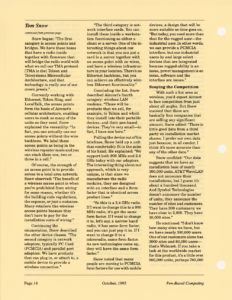
Snow began: “The first category is access points and bridges. We have these boxes that have a radio inside together with firmware that will bridge the radio world with what we call our TMA protocol. [TMA is the] Telxon and Telesystems Microcellular Architecture, and that technology is really one of our crown jewels.”
Currently working with Ethernet, Token Ring, and LocalTalk, these access points form the basis of Aironet’s cellular architecture, enabling users to stack as many of the units as they need. Snow explained the versatility: “In fact, you can actually use our access points without the wire backbone. We label these access points as being in the wireless repeater mode and you can stack them one, two or three in a cell.”
Of course, the strength of an access point is to provide access to a local area network. Snow observed: “The benefit of a wireless access point is when you’re prohibited from wiring for some reason, whether it’s the building code regulations, the expense, or just a nuisance. Many retailers like wireless access points because they don’t have to pay for the installation costs of wiring.”
Continuing the enumeration, Snow described the other device classes. “The second category is network adaptors, typically PC Card (PCMCIA) and parallel port adaptors. We have products that can plug in, or attach to, a mobile device to provide a wireless connection.”
“The third category is network interface cards. You can install these inside a workstation functioning as either a client or a server. One of the interesting things about our network is that you can put a card in a server together with an access point with no wires, and have a wireless infrastructure in your location. There’s no Ethernet backbone, but you can achieve an effectively wireless Ethernet functionality.”
Concluding the list, Snow described Aironet’s fourth category: wireless LAN modems. “Those will be products that we sell, for example, to Telxon and which they install into their portable devices, and their pen-based devices. They’re very small—in fact, I have one here.”
Pulling the device out of his briefcase, Snow held up a unit that comfortably fit in the palm of his hand. He explained: “We support both 900 MHz and 2.4 GHz today with our adaptors. The interesting thing about our approach, which is very unique, is that since we manufacture the radio modules, they are designed with an interface and a form factor that is identical across product lines.”
“So this is a 2.4 GHz radio. If I want to change this to a 900 MHz radio, it’s got the same form factor. If I want to change it to, let’s say, a narrow band radio, it has just pop it in. If I want to change it to a microradio, same form factor. As new technologies come up, they will have the same form factor.”
Snow noted that many people are moving to PCMCIA form factors for use with mobile devices, a design that will be more suitable as time goes on. “But today, you need more than that for the rugged user—the industrial user. In other words, we can provide a PCMCIA interface, but our industrial users by and large select devices that are integrated because rugged-ability is an issue, power management is an issue, software and the interface are issues.”
Scoping the Competition
With such a hot area as wireless, you’d expect Aironet to face competition from just about all angles. But Snow insisted that there are basically four companies that are selling any significant amount. Snow added: “There is little good data from a third party on installation market shares. I prefer our own data just because, in all candor, I think it’s more accurate than any of the other data.”
Snow confided: “Our data suggests that we have an installation base of nearly 300,000 units. AT&T WaveLAN does not announce their installations, but I guess it’s about a hundred thousand. And Symbol Technologies doesn’t announce the number of units, they announce the number of sites and customers. They have 300 customers; we have close to 3,000. They have 10,000 sites.”
He continued: “I don’t know how many sites we have, but we have nearly 300,000 users. One of our customers alone has 3000 sites and 60,000 users—that’s Walmart. If you take a look at the worldwide market for this product, it’s a little over 500,000 units, perhaps 700,000 units now. And we’re making money at it.”
Snow noted that even with the popularity and appeal of wireless, there is a relatively high barrier to entry in the marketplace. “You’ve seen all the announcements; everyone is announcing something wireless and there’s probably 30 companies over there that market it. But of these 30, only four and maybe now six companies are shipping any significant volume.” Snow was talking about manufacturers, adding that there are Aironet OEM’s that are shipping volume but, as he noted: “that’s kind of double accounting.”
Snow summarized the situation: “The challenges are: do you have the technical expertise to blend sophisticated radio technology with sophisticated computer networking technology in one company? Not many companies do. Also, how do you manufacture that? Radio is not digital at its core. it’s an analog medium that acts digitally, but it does not behave like a digital circuit in many cases. And it’s not something that you can just design on a breadboard and pop it over to manufacturing.”
“You can look at many companies who have announced product and haven’t shipped after a year or two of fighting with the FCC. Just the act of getting something FCC approved is a new experience in terms of the radio for these companies.”
Wireless Expectations
Wireless faces many challenges not unlike mobile computing in general, namely setting proper expectations or, if expectations have already been set, achieving them. In the case of local area networks, many people will clearly be influenced by their experiences with wired networks, such as Ethernet. Snow acknowledged this, but added his own twist.
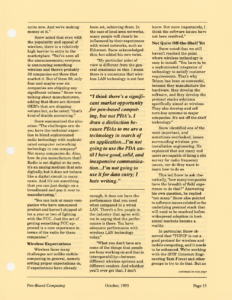
“I think there’s a significant market opportunity for pen-based computing, but not PDA’s. I draw a distinction because PDAs to me are a technology in search of an application…I’m not going to use the PDA until I have good, solid, and inexpensive communication…I’m not going to use it for data entry; I hate writing.”
“My particular point of view is different from the general consensus on this. I mean there is a consensus that wireless LAN technology is not fast enough, it does not have the performance that you need when compared to a wired LAN. There’s a few people in the industry that agree with me in saying that the performance is there. You have adequate performance with wireless LAN technology today.”
“What you don’t have are some of the things that people are busy working on and that is interoperability—between different wireless systems and different vendors. And whether you’ll ever get that, I don’t know. But more importantly, I think the software issues have not been resolved.”
Not Quite Off-the-Shelf Yet
Snow noted that we still haven’t reached the point where wireless technology is easy to install. “You have to be a sophisticated integrator of technology to satisfy customer requirements. That’s why Telxon has been so successful, because they manufacture the hardware, they develop the software, and they develop the protocol stacks solutions specifically aimed at wireless. They also develop and sell turn-key systems to major companies. It’s not off the shelf technology.”
Snow identified one of the most important, and sometimes overlooked, issues surrounding wireless: pre-installation engineering. He explained that not many end users are capable of doing a site survey for radio frequency issues, nor do they want to learn how to do so.
This led Snow to ask rhetorically, “how many companies have the breadth of field experience to do that?” Answering his own question, he replied “not many.” Snow also pointed to software issues related to the underlying protocol stack that will need to be resolved before widespread adoption in horizontal markets become a reality.
In particular, Snow observed that “TCP/IP is not a good protocol for wireless and mobile computing, and it needs to be enhanced. We’re working with the IETF (Internet Engineering Task Force) and other groups to try to do that. But as a result, for customers today by and large are using proprietary extensions to TCP/IP just to overcome those radio and mobile deficiencies in that protocol.”
Snow concluded: “Many of the issues center around the uniqueness of radio.” Of course, TCP/IP was never designed with wireless in mind. In fact, the protocols often make very poor use of scarce bandwidth.
Snow expanded on this: “A user can install wireless LAN technology today and use it in mission critical applications if they are prepared to address the protocol stack issues either by writing custom applications tuned for wireless, or by employing various wireless gateways to insulate the wireless users from the wired protocols.”
Snow predicted: “This is still going to be necessary for a year or two until we can work out the standard efforts and the extensions for wireless and mobile computing.”
Increasing Competitiveness
Notwithstanding the protocol issues, Snow insisted that companies that adopt wireless are doing it for one reason: to increase their competitiveness. For example, Snow noted that: “Ford Motor Company thinks they can improve quality by putting wireless in their manufacturing facilities. Walmart thinks they can reduce their operating expenses by using wireless technology and increase customer service and productivity.”
Elaborating, Snow explained: “Ford uses pen-based and handheld computers and, as products come down through the manufacturing process, workers do various quality control checklists using wireless. With wireless, you’re not connected, you’re free, and flexible. You go to the work, the work doesn’t come to you.”
“What wireless technology does for you is that it cleans up one of the most difficult areas of computing information systems and that is data entry. Using wireless and a pen-based or mobile computer, you can get good, clean, audited, edited data entry—real-time and real-time reconciliation and verification. And that’s a very powerful tool to manufacturers.”
Snow summarized: “It is often used in directing distribution center logistics, or retailers doing shop-based management, inventory control, order entry, or receiving goods from a back door—those operations are often wireless. These are way out of the early adaptors stages, it’s proven technology for the verticals.”
Wireless in Health Care
Compelling information indeed. But what about other data intensive operations, most notably health care? Interestingly, Snow has encountered some distinctly non-technical barriers when it comes to managing this life-critical information. He revealed: “the barrier, in my opinion, is the fact that hospitals [in the United States] are managed and operated independently.”
“In other words, in retail, I can talk to Walmart and have access to 3,000 locations. This means that it’s going to be a very big investment, which also means that they can afford the MIS staff to learn about the technology to support it and make it uniform. So the economies of scale apply.”
“With hospitals, there’s no single organization I can go to and reach 3,000 hospitals—they have different computing environments. The next best thing with health care is that there are about a half dozen software companies that are integral in health care information systems.”
“The wireless business will be run through those companies I think. As soon as these companies are ready to install wireless and write some applications that are tuned for wireless, you will see the growth of the health care market.”
With respect to other vertical markets, Snow supplied some unexpected examples: “Here’s a niche market but in the robotics market, we have a number of robotics manufacturers that use our radios for guidance systems and all kinds of creative things. A number of automotive companies use our product to communicate with the engine data in test tracks.”
“Finally, we have submarines using our product to communicate ship-to-shore when they’re arriving in a port through a mile or so—a lot of niche applications. The Holy Grail, the horizontal market of laptop computing, does not exist yet, but it will.”
The Holy Grail?
Snow sees several elements that need to be addressed before we reach the stage of mass adoption for wireless. Snow summarized: “All the network operating systems need to embrace mobility along with the wireless providers to make it a worthwhile solution for their customer base. That’s when this market is going to take off, when we start seeing some bulletproof applications.”
“The hard work is the middle layers of the protocol stack which, in my opinion, are preventing this technology from exploding. But actually, another is awareness. The awareness is lacking in the end-user community as to the benefits of wireless LAN technology.”
Pooh-Poohing PDAs
When it comes to the horizontal market, Snow is talking about laptop and tablet computer users, but definitely not personal digital assistants. He predicted: “I think there’s a significant market opportunity for pen-based computing, but not PDA’s. I draw a distinction because PDAs to me are a technology in search of an application. Why would I use a PDA?”
Of course there are several reasons for using a PDA over a laptop, but Snow remains unconvinced. “I’m not going to use the PDA until I have good, solid, and inexpensive communication, with a good application and interface. I’m not going to use it for data entry; I hate writing. But you can give me voice on a PDA, that might interest me.”
“I would make a guess that there’s already a significant installation based on pen-based computers with wireless LAN functionality and it just so happens that most of those pen-based units are in the vertical market applications, while most laptops are in the horizontal market. As the horizontal takes off, I don’t think wireless is going to drive pen-based systems.”
“I don’t think the pen as a input device for characters is a very effective device. Personally, this is not a pen-based guy talking, this is a communications guy. I think the people that have been most successful in implementing pen-based technology today in the verticals have viewed the pen as a mouse, very limited at inputting characters and numbers and vertical in terms of applications. For example, for an insurance adjuster, there may be a device specifically for insurance adjusters, with communications.”
He continued: “I see the mobile professional PDA a long way off. I don’t even like the format. I want 8 1/2″ x 11″ and very thin like a sheet of paper so it fits in my briefcase. It would have voice with wireless communication locally when I’m in the campus, and wide area [communication] while off campus. I think that would be a highly effective product, but I know the component technology isn’t ready yet and it’s a few years off.”
Snow concluded: “So pen-based is a little bit similar, with some parallels, to wireless LANs in that it’s primarily vertical right now because of its state on the technology curve. The early adaptors, and the people that really use it, are the ones that can have justifiable pay-backs right now. The ones with soft pay-backs are not going to buy the technology.”
Snow also had some interesting views on the future of pen computing as it relates to wireless technology. He observed: “I think that you may be able to make a case that there are more pen-based units today that are wireless LAN enabled than there are laptops. It’s not as if the pen is going to have an impact on laptops.”
“I would make a guess that there’s already a significant installation based on pen-based computers with wireless LAN functionality and it just so happens that most of those pen-based units are in the vertical market applications, while most laptops are in the horizontal market.”
“As the horizontal takes off, I don’t think wireless is going to drive pen-based systems. However, if pen-based technology answers the questions they need to address in terms of software compatibility, ease of use, and acceptability, then wireless is an absolute natural for it.”
Thomas G. Snow
Vice President Sales and Marketing
Aironet Wireless Communications, Inc.
160 Gould Street, Suite 130
Needham, MA 02194
(617) 449-2111
(617) 449-7937
[email protected]
Transcribed from Pen-Based Computing, Volume 5, Number 10 — October 1995. Pages 12, 13, 14, 15, 16, 17.