
GO Corp. Ships PenPoint
From the Original Pages
Click a page to enlarge · Alt-click to open the full issue
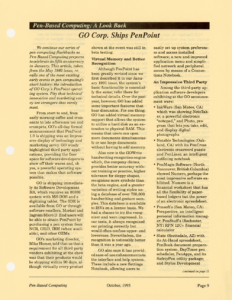
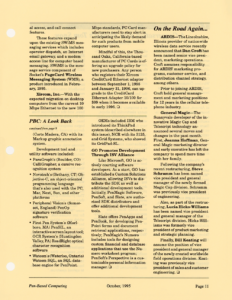
We continue our series of pen computing flashbacks as Pen-Based Computing celebrates its fifth anniversary in January. This article, taken from the May 1992 issue, recalls one of the most exciting early events in pen computing’s short history: the introduction of GO Corp.’s PenPoint operating system. Pity that technical innovative and marketing savvy are strangers that rarely meet.
From start to end, from early morning coffee and croissants to late afternoon tea and crumpets, GO’s all-day formal announcement that PenPoint 1.0 is shipping was an impressive display of technology and marketing savvy. GO wisely highlighted third party applications, providing the floor space for software developers to show off their wares and, oh yes, a powerful operating system that makes that software possible.
GO is shipping immediately its Software Development Kit, which requires an 80386 system with MS-DOS and a digitizing tablet. The SDK is available from GO or through software resellers, Merisel and Ingram/Micro D. End users will be able to obtain PenPoint by purchasing a pen system from NCR, GRiD, IBM (when available), and other OEMs.
GO’s marketing director, Mike Homer, told that us that a requirement for all third party vendors exhibiting at the show was that their products would be shipping within 90 days, although virtually every product shown at the event was still in beta testing.
Virtual Memory and Better Recognition
Although PenPoint has been greatly revised since we first described it in our January 1991 issue, the system’s basic functionality is essentially the same; refer there for technical details. Over the past year, GO has added some important features that bear discussion. For one thing, GO has added virtual memory support that allows the system to utilize a hard disk as an extension to physical RAM. This means that users can open more documents simultaneously without having to add memory.
Also new is the GOWrite handwriting recognition engine which, the company claims, provides better accuracy without training or practice, higher tolerance for sloppy shapes, recognizes more symbols than the beta engine, and a greater variation of writing styles using a database of over 700,000 handwriting and gesture samples. This database is available to ISVs on a license basis. We had a chance to try the recognizer and were impressed. In our tests, it always recognized our printing correctly but would often confuse upper- and lowercase. Nevertheless, the recognition is noticeably better than it was a year ago.
GO also says it has provided ease-of-use enhancements to the interface and help system. These include a new Settings Notebook, allowing users to easily set up system preferences and access installed software; a new and improved application menu and simplified network and peripheral access by means of a Connections Notebook.
An Impressive Third Party
Among the third-party application software developers exhibiting at the GO announcement were:
- InkWare (San Mateo, CA) which was showing NoteTaker, a powerful electronic “notepad,” and Photo, a program that lets you take, edit, and display digital photographs
- Notable Technologies (Oakland, CA) with its PenCross electronic crossword puzzle and PenLiner, an intelligent outlining notebook
- PenMagic Software (North Vancouver, British Columbia) showed Numero, perhaps the most impressive software exhibited. Numero is a financial worksheet that has all the flexibility of paper-based ledgers but the power of an electronic spreadsheet.
- Pensoft’s (San Mateo, CA) Perspective, an intelligent personal information manager; PenStuff’s (Rochester, NY) RPN 12C+ financial calculator
- Slate (Scottsdale, AZ) with its At-Hand spreadsheet, PenBook document preparation system, DayTimer pen scheduler, PenApps, and its SafetyPen utility package; and Stylos Development (Corte Madera, CA) with its Markup graphic annotation system.
Development tool and utility software included:
- ParaGraph’s (Boulder, CO) CalliGrapher, a cursive recognition system
- Novotech’s (Bethany, CT) Objective-C, an object-oriented programming language that’s also used with the PC, Mac, Next, Sun, and other platforms
- Peripheral Vision’s (Somerset, England) PenPoint signature verification software
- First Pen System’s (Marlboro, MA) PenSIL, an interactive screen layout tool; OCR System’s (Huntington Valley, PA) ReadRight optical character recognition software
- Watcom’s (Waterloo, Ontario) Watcom SQL, an SQL database engine for PenPoint.
OEMs included IBM who introduced the ThinkPad system (described elsewhere in this issue), NCR with its 3125, and Grid Systems, who showed its GridPad-SL.
GO Promotes Development Through ISV Alliance
Like Microsoft, GO is actively courting software developers. As a start, GO has established a Custom Solutions Alliance, allowing ISVs to distribute the SDK as well as additional development tools. Initially, PenMagic Software, PenSoft, and Slate, are authorized SDK distributors and offer additional development tools.
Slate offers PenApps and PenBook, for developing PenPoint forms and document retrieval applications, respectively; PenMagic’s Numero includes tools for designing custom financial and database applications that use the Numero worksheet program; PenSoft’s Perspective is a customizable personal information manager.
Transcribed from Pen-Based Computing, Volume 5, Number 10 — October 1995. Pages 9, 11.