
Short Cuts: Roaming Around the Mobile Computing Industry
From the Original Pages
Click a page to enlarge · Alt-click to open the full issue
U.S. Robotics Buys Palm Computing
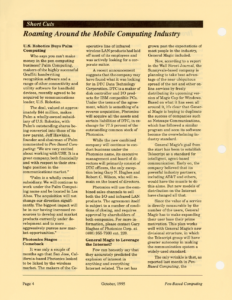
Who says you can’t make money in the pen computing business? Palm Computing, makers of the highly successful Graffiti handwriting recognition software and a range of other connectivity and utility software for handheld devices, recently agreed to be acquired by communications leader, U.S. Robotics.
The deal, valued at approximately $44 million, makes Palm a wholly-owned subsidiary of U.S. Robotics, with Palm’s outstanding shares being converted into those of its new parent. Jeff Hawkins, founder and chairman of Palm commented to Pen-Based Computing: “We are very excited about working with USR. It is a great company, both financially and with respect to their strategic position in the communications market.”
“Palm is a wholly owned subsidiary. We will continue to work under the Palm Computing name and be located in Los Altos. The acquisition will not change our direction significantly. The biggest impact will be in our having increased resources to develop and market products currently under development and to more aggressively pursue new market opportunities.”
Photonics Stages Comeback
It was only a couple of months ago that San Jose, California-based Photonics looked to be licked by the wireless market. The makers of the Cooperative line of infrared wireless LAN products had laid off most of its employees and was actively looking for a corporate suitor.
A recent announcement suggests that the company may have found what it was looking for in DTC Data Technology Corporation. DTC is a maker of disk controller and I/O products for IBM compatible PCs. Under the terms of the agreement, which is something of a reverse acquisition, Photonics will acquire all the assets and certain liabilities of DTC, in exchange for 77.5 percent of the outstanding common stock of Photonics.
While the new combined company will continue to conduct business under the Photonics name, its executive management and board of directors will primarily consist of DTC officers, the only exception being Gary N. Hughes and Robert C. Wilson, who will remain on the board of directors.
Photonics will use the combined sales channels to sell both the I/O and infrared LAN products. The agreement itself is subject to a number of conditions of closing, and requires approval by shareholders of both companies. For more information, please contact Gary Hughes of Photonics Corp. at (408) 955-7930 ext. 220.
General Magic to Leverage the Internet?
Few can honestly say that they accurately predicted the explosion of interest in anything and everything Internet related. The net has grown past the expectations of most people in the industry, General Magic included.
Now, according to a report in the Wall Street Journal, the Sunnyvale-based company is planning to take best advantage of the near ubiquitous spread of the net and other on-line services by freely distributing its unbundling version of Magic Cap for Windows. Based on what it has seen all around it, it’s clear that General Magic is hoping to duplicate the success of companies such as Netscape Communications, which has followed a similar program and seen its software become the overwhelming industry standard.
General Magic’s goal from the start has been to establish Telescript as a standard for intelligent, agent-based communication. Early on, the company believed that its powerful industry partners, including AT&T and others, would have the muscle to do this alone. But new models of distribution on the Internet have changed all that.
Since the value of a service is directly measurable by the number of the users, General Magic has to make expanding their user base their prime motivation. This plan works well with General Magic’s new divisional structure, in which the Telescript group will have greater autonomy in making the communication system a widely-used standard.
The only wrinkle is that, as reported last month in Pen-Based Computing, the Windows version of Magic Cap is suffering ongoing delays. Reports vary on the cause, but one thing is certain: Windows users form an important audience that is essential to the success of Telescript and perhaps even Magic Cap.
PCS on the Move
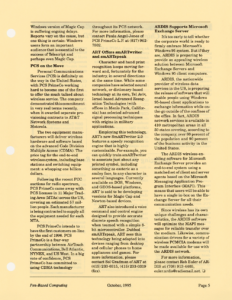
Personal Communications Services (PCS) is definitely on the way in the United States, with PCS PrimeCo working hard to become one of the first to offer the much talked about wireless service. The company demonstrated this commitment in very real terms recently, when it awarded separate provisioning contracts to AT&T Network Systems and Motorola.
The two equipment manufacturers will deliver wireless hardware and software based on the advanced Code Division Multiple Access (CDMA). The price tag for the end-to-end wireless system, including base stations and switching equipment: a whopping one billion dollars.
Following the recent FCC auctions for radio spectrum, PCS PrimeCo came away with PCS licenses in 11 Major Trading Area (MTAs) across the US, covering an estimated 57 million people. Each manufacturer is being contracted to supply all the equipment needed for each MTA.
PCS PrimeCo intends to have the first customers on-line by the end of 1996. PCS PrimeCo is a four-way partnership between AirTouch Communications, Bell Atlantic, NYNEX, and US West. In a big vote of confidence, PCS PrimeCo has committed to using CDMA technology throughout its PCS network. For more information, please contact Paula Angel-Jones of PCS PrimeCo L.P. at (817) 962-7802.
ART Offers smARTwriter and smARTspeak
Character and hand print recognition keeps moving forward and, fortunately for the industry, in several directions at the same time. While some companies have selected neural network, or dictionary-based technology at its core, Tel Aviv, Israel-based Advanced Recognition Technologies (with offices in Menlo Park, California) has selected advanced signal processing techniques with origins in military applications.
Employing this technology, ART’s new SmARTwriter 2.0 features a speedy recognition engine that is highly customizable. For example, you can quickly train smARTwriter to associate just about any printed symbol, including something as esoteric as a smiley face, to any character in several languages. Currently available on DOS, Windows, and GEOS-based platforms, ART is said to be developing versions for Magic Cap and Newton-based devices.
ART also introduced a voice command and control engine designed to provide accurate discrete speech recognition when teamed with a simple 8-bit microcontroller. Dubbed smARTspeak, ART sees this technology being adapted into devices ranging from desktop and cellular phones to home appliances and games. For more information, please contact Sol Gradman of ART at (415) 233-0315, (415) 233-0319 (fax).
ARDIS Supports Microsoft Exchange Server
It’s too early to tell whether the corporate world is ready to firmly embrace Microsoft’s Windows 95 system. But if they are, ARDIS is preparing to provide an appealing wireless solution between Microsoft Exchange Servers and Windows 95 client computers.
ARDIS, the nationwide provider of wireless data services in the US, is preparing the release of software that will enable people using Windows 95-based client applications to exchange information while on-the-go outside of the confines of the office. In fact, ARDIS network services is available in 410 metropolitan areas in all 50 states covering, according to the company, over 80 percent of the population and 90 percent of the business activity in the United States.
The ARDIS wireless-enabling software for Microsoft Exchange Server provides an end-to-end system using a matched set of client and server agents based on the Microsoft Messaging Application Program Interface (MAPI). This means that users will be able to have a single in-box on the Exchange Server for all their communication needs.
Since wireless has its own unique challenges and characteristics, the ARDIS software will optimize the MAPI messages for reliable transfer over the medium. Likewise, communication drivers for a variety of wireless PCMCIA modems will be made available for use with the ARDIS network.
For more information, please contact Rob Euler of ARDIS at (708) 913-4405, [email protected].
Transcribed from Pen-Based Computing, Volume 5, Number 10 — October 1995. Pages 4, 5.