
Geoworks GEOS 3.0 Stresses Communication
From the Original Pages
Click a page to enlarge · Alt-click to open the full issue
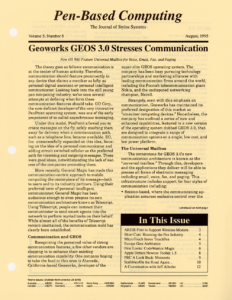
New OS Will Feature Universal Mailbox for Voice, Email, Fax, and Paging
The theory goes as follows: communication is at the center of human activity. Therefore, communication should feature prominently in any device that claims a moniker as lofty as personal digital assistant or personal intelligent communicator. Looking back into the still young pen computing industry, we’ve seen several attempts at defining what form these communication features should take. GO Corp., the now-defunct developer of the very innovative PenPoint operating system, was one of the early proponents of so-called asynchronous messaging.
Under this model, PenPoint allowed you to create messages on the fly, safely stashing them away for delivery when a communication path, such as a telephone line, became available. EO, Inc. unsuccessfully expanded on this idea, focusing on the idea of a personal communicator and adding circuit switched cellular as the preferred path for incoming and outgoing messages. These were good ideas, notwithstanding the lack of success of the companies promoting them.
More recently, General Magic has made this communication-centric approach to mobile computing the centerpiece of its message—both to users and to its industry partners. Using their preferred term of personal intelligent communicator, General Magic has been audacious enough to even propose its own communication architecture known as Telescript. Using Telescript, people can instruct their communicator to send smart agents into the network to perform myriad tasks on their behalf. While almost all of the benefits of Telescript remain unattained, the communication mold has clearly been established.
Communication and GEOS
Recognizing the perceived value of strong communication features, a few other vendors are stepping in to enhance their existing communication capability. One company hoping to take the lead in this area is Alameda, California-based Geoworks, developer of the super-slim GEOS operating system. The company has been busy pursuing technology partnerships and marketing alliances with leading communication firms around the world, including the Finnish telecommunication giant Nokia, and the undisputed networking champion, Novell.
Strangely, even with this emphasis on communication, Geoworks has maintained its preferred designation of this market as “consumer computing devices.” Nonetheless, the company has outlined a series of new and enhanced capabilities, featured in a new version of the operating system dubbed GEOS 3.0, that are designed to integrate a range of communication options on a single, low cost, and low power platform.
The Universal Mailbox
The cornerstone for GEOS 3.0’s new communication architecture is known as the “universal mailbox.” Through this, developers and the applications they deliver will be able to process all forms of electronic messaging including email, voice, fax, and paging. This infrastructure includes support for four styles of communication including:
- Session-based, where the communicating application assumes exclusive control over the port, establishing a session with a remote device. Terminal sessions to an online service such as America Online is a good example of session-based communication.
- Socket-based, suitable for applications that need to share a common channel such as a local or wide area network. Socket-based communication breaks the transmitted data into discrete packets which are reassembled at the destination. The Internet, and its corresponding protocol IP, is an example familiar to many.
- Message-based, characterized by applications that send self-contained messages, such as electronic mail. Messages are stored in an Outbox until a suitable medium becomes available for delivery.
- File Transfers, useful for moving large amounts of file-based information between devices.
The advantage of having these communication features within the operating system are twofold. First, application developers are free to concentrate on aspects of their application other than the plumbing through which they need to move information.
Second, consumers benefit by having a consistent and universal model of communication, reducing the need for proprietary solutions, and enhancing the likelihood that applications will be able to exchange information.
A Bit of Terminology
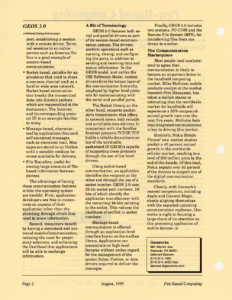
GEOS 3.0 features both serial and parallel drivers as part of its session-based communication options. The drivers perform operations such as opening, closing, and configuring the ports, in addition to sending and receiving data and status information. In the GEOS model, and unlike the OSI Reference Model, session drivers form the bottom layer of the communication hierarchy, employed by higher level protocols for communicating with the serial and parallel ports.
The Socket library, on the other hand, supports packet-style transmission that offers, in network terms, both reliable and unreliable data delivery. In comparison with the familiar Internet protocols TCP/IP, TCP builds a reliable data stream on top of the unreliable, packetized IP. GEOS is capable of supporting these protocols through the use of low-level drivers.
Using socket-based communication, an application identifies the recipient at the other end through the use of a socket number. GEOS 3.0 uses 32-bit socket port numbers, 16-bits of which identify the application manufacturer with the remaining 16-bits pointing to the socket. This reduces the likelihood of conflict in socket numbers.
Message-based communication is effected through an application-level interface known as the mailbox library. Applications can concentrate on high-level features without undue regard for the management of the system Inbox, Outbox, or data drivers required to deliver the messages.
Finally, GEOS 3.0 includes two systems, PC-COM and the Remote File System (RFS), for transferring files from one device to another.
The Communication Marketplace
Most people (and analysts) tend to agree that communication is likely to become an important factor in the handheld computing market. Mike McGuire, mobile products analyst at the market research firm Dataquest, has taken a bullish stance in estimating that the worldwide market for handhelds will experience a 50% compound-annual growth rate over the next five years. McGuire feels that integrated communication is key to driving this market.
Similarly, Nokia Mobile Phones’ own market studies predict a 40 percent annual growth in the worldwide cellular market, reaching to a level of 200 million units by the end of the decade. Of this total, Nokia expects over 50 percent of the devices to support one of the digital communication standards.
Clearly, with Geowork’s nearest competitors, including Apple and General Magic, closely aligning themselves with the expected upcoming communication explosion, Geoworks is right in focusing a large share of its attention on this promising application of mobile devices.
Geoworks
960 Atlantic Ave.
Alameda, CA 94501
Deborah Dawson
(510) 814-1660
(510) 814-4250 (fax)
[email protected]
Transcribed from Pen-Based Computing, Volume 5, Number 8 — August 1995. Pages 1, 2.