
Microsoft Comes to the Aid of Developers
From the Original Pages
Click a page to enlarge · Alt-click to open the full issue

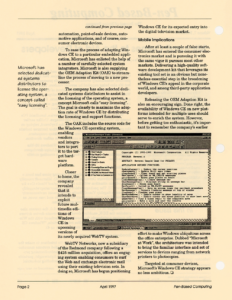
Visual C++ for Windows CE Now Available
Talk with corporate developers today and they will tell you that Windows CE offers tremendous promise. Not only is the platform immediately available on multiple processor platforms but it’s also being supplied by several vendors. They’ll also mention that Windows CE represents a subset of the widely-known Windows 95 API, enabling application developers to more quickly adapt their skills to the new platform. Equally reassuring is a parent company on very firm footing, actively searching for new markets and new OEMs (more about this later).
With a street price around $500 per device, handheld PCs based on Windows CE offer other advantages. Unlike earlier PDAs, Win CE devices place focus on the keyboard, relying on the pen essentially as a navigation tool. Other features include tight integration with Windows-based desktop computers, allowing information to more easily flow in either direction.
Corporate users also cite the familiar Windows 95-like interface which reduces training costs, and helps developers leverage their user interface knowledge in creating mobile applications.
The Missing Piece
For vertical developers, the only missing piece has been a dedicated Software Development Kit (SDK). Microsoft recently rectified this situation with the introduction of Visual C++ for Windows CE. The package, which seamlessly integrates with Microsoft’s flagship Visual Studio development environment, contains all the tools necessary to edit code and resources, as well as compile, link, and debug applications.
Packaged as an add-on for Visual C++ 5.0, the system also contains the DDK, enabling developers to create device drivers for custom peripherals that need to be interfaced with the Windows CE operating system. (See related article, “Windows CE Development in a Nutshell,” starting on page 4).
Broadening the Reach of CE
Microsoft also recently made clear its intention to make the Windows CE platform available to embedded systems manufacturers. To this end, Microsoft has established a licensing program encouraging developers to adopt the lightweight, portable system for use in a range of applications including industrial automation, point-of-sale devices, automotive applications, and of course, consumer electronic devices.
To ease the process of adapting Windows CE to a particular embedded application, Microsoft has enlisted the help of a number of carefully selected system integrators. Microsoft is also supplying the OEM Adaption Kit (OAK) to streamline the process of moving to a new processor.
The company has also selected dedicated systems distributors to assist in the licensing of the operating system, a concept Microsoft calls “easy licensing”. The goal is clearly to maximize the adoption rate of Windows CE by distributing the licensing and support functions.
“Microsoft has selected dedicated systems distributors to license the operating system, a concept called “easy licensing”.”
The OAK includes the source code for the Windows CE operating system, enabling vendors and integrators to port it to the target hardware platform.
Closer to home, the company revealed that it intends to exploit future multimedia editions of Windows CE in upcoming versions of its newly acquired WebTV system.
WebTV Networks, now a subsidiary of the Redmond company following a $425 million acquisition, offers an engaging system enabling consumers to surf the Web and exchange electronic mail using their existing television sets. In doing so, Microsoft has begun positioning Windows CE for its expected entry into the digital television market.
Mobile Implications
After at least a couple of false starts, Microsoft has entered the consumer electronics market and is pursuing it with the same vigor it pursues most other markets. Delivering a high-quality software development kit that leverages its existing tool set is an obvious but nonetheless essential step in the broadening of Windows CE’s appeal in the corporate world, and among third-party application developers.
Releasing the OEM Adaption Kit is also an encouraging sign. Done right, the availability of Windows CE on new platforms intended for multiple uses should serve to enrich the system. However, before getting too enthusiastic, it’s important to remember the company’s earlier effort to make Windows ubiquitous across the office enterprise. Dubbed “Microsoft at Work”, the architecture was intended to bring the familiar interface and set of services to devices ranging from network printers to photocopies.
Targeted at consumer devices, Microsoft’s Windows CE strategy appears no less ambitious.
Transcribed from Pen-Based Computing, Volume 7, Number 4 — April 1997. Pages 1, 2.