
Speaking with Geoff Walker of Fujitsu Personal Systems
From the Original Pages
Click a page to enlarge · Alt-click to open the full issue
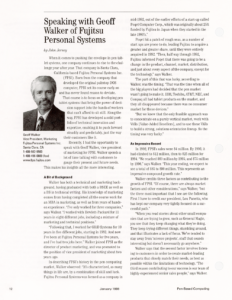
When it comes to pushing the envelope in pen tablet systems, one company continues to rise to the challenge year after year. That company is Santa Clara, California-based Fujitsu Personal Systems Inc. (FPSI). Born from the company that developed the original palmtop DOS computer, FPSI set its course early on and has never found reason to deviate.

That course is to focus on developing pen tablet systems that bring the power of decision support into the hands of workers that can’t afford to sit still. Along the way, FPSI has developed a solid portfolio of technical innovation and expertise, enabling it to push forward steadily and predictably, just the way their customers like it.
Recently, I had the opportunity to speak with Geoff Walker, vice president of marketing for FPSI. Walker spends a lot of time talking with customers to gauge their present and future needs. This makes his insights all the more interesting.
A Bit of Background
Walker has both a technical and marketing background, having graduated with both a BSEE as well as a BS in technical writing. His knowledge of marketing comes from having completed all the course work for an MBA in marketing, as well as from years of hands-on experience. “I’ve only worked for three companies,” says Walker. “I worked with Hewlett-Packard for 11 years in eight different jobs, including a mixture of marketing and technical positions.”
“Following that, I worked for GRiD Systems for 10 years in five different jobs, starting in 1982. And now I’ve been at Fujitsu Personal Systems for five years, and I’ve had two jobs here.” Walker joined FPSI as the director of product marketing, and was promoted to the position of vice president of marketing about two years ago.
In describing FPSI’s history in the pen computing market, Walker observed: “It’s characterized, as many things in life are, by a combination of skill and luck. Fujitsu Personal Systems was formed as a company in mid-1992, out of the earlier efforts of a start-up called Poqet Computer Corp., which was originally about 25% funded by Fujitsu in Japan when they started in the late 1980’s.”
Poqet hit a patch of rough seas, as a number of start ups are prone to do, leading Fujitsu to acquire a greater and greater share, until they were entirely acquired in 1992. “Then, half way through 1992, Fujitsu informed Poqet that there was going to be a change in the product, channel, market, distribution, and just about every aspect of the company, except for the technology,” says Walker.
The part of this that was lucky, according to Walker, was the timing. “That was the time when all of the big players had decided that the pen market wasn’t going to make it. IBM, Toshiba, AT&T, NEC, and Compaq all had tablet products on the market, and they all disappeared because there was no consumer market for these devices.”
“But we knew that the only feasible approach was to concentrate on a purely vertical market, work with VARs [Value-Added Resellers], and to use these VARs to build a strong, solutions orientation lineup. So the timing was very lucky.”
An Impressive Record
In 1992, FPSI’s sales were $4 million. By 1993, it had climbed to $12 million, then to $25 million for 1994. “We reached $60 million by 1995, and $75 million by 1996,” says Walker. “This year ending, we expect to see a total of $85 to $90 million. This represents an impressive compound growth rate.”
Walker credits three factors as contributing to the growth of FPSI. “Of course, there are always market factors and other considerations,” says Walker, “but the three most important that I see are the following. First I have to credit our president, Lou Panetta, who has kept our company very tightly focused on a successful path.”
“When you read stories about other small companies that are trying to grow, such as General Magic, you see that they keep changing what they’re doing. They keep trying different things, stumbling around, and that illustrates a lack of focus. We’ve tended to stay away from ‘science projects’, stuff that sounds interesting but doesn’t necessarily go anywhere.”
Walker says that the second factor involves listening to customers in order to create market-leading products that closely match their needs, as best as possible within the limitations of technology. “The third reason contributing to our success is our team of highly-experienced senior sales people,” says Walker. “Our typical sale is a million dollars and higher, and that takes a certain talent to identify the strategic needs of our customers. And it involves an advanced methodology to be able to develop that plan.”
A Moving Target
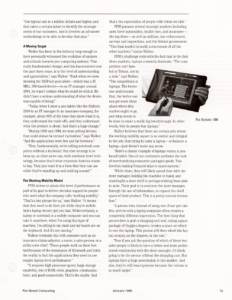
Walker has been in the industry long enough to have personally witnessed the evolution of opinion and attitude towards pen computing systems. “One really fundamental change, and this has occurred over the past three years, is in the level of understanding and appreciation,” says Walker. “Back when we were showing the 325Point pen tablet—which was a 25 MHz, 386-based device—to an IT manager around 1994, he wasn’t certain what he could do with it. He didn’t have a serious understanding of what the device was capable of doing.”
“Today, when I show a pen tablet like the Stylistic 1200 to an IT manager in an insurance company, for example, about 80% of the time they know what it is, they understand the trade-offs, and they understand what the product is about. And that’s a huge change.”
“During 1993 and 1994, we were selling devices that could almost be termed ‘curiosities’,” says Walker. “And the applications were few and far between.”
“Now, fundamentally, we’re selling notebook computers without a keyboard. Our core strategy is to keep up, as close as we can, with notebook level technology, because that’s what corporate America wants to buy. They just want it in a form that they can use while they’re standing up and walking around.”
The Working Mobility Model
FPSI strives to attain this level of performance as part of its goal to deliver decision support to people who need what the company calls ‘working mobility’. “That’s a key phrase for us,” says Walker. “It means that they need to do their job while they’re mobile. And a laptop doesn’t get you that. While certainly, a laptop or notebook is a mobile computer and you can take it anywhere, when I’m using that type of machine, I’m sitting in my chair and my hands are on the keyboard. And it’s not moving.”
Walker contrasts this with someone such as an insurance claims adjustor, a nurse, a sales person, or a utility crew chief. “These people work on their feet. And because of the dominance of Microsoft and Intel, the reality is that the applications they need to use require laptop-level performance.”
“It requires high processor speed, large storage capability, lots of RAM, color, graphics, communications, and good connectivity. That’s the reality. And that’s the expectation of people with whom we talk.”
FPSI pursues several strategic markets including sales force automation, health care, and insurance—the top three—as well as utilities, law enforcement, surveys and inspections, and the federal government. “This final market is really a microcosm of all the other markets,” claims Walker.
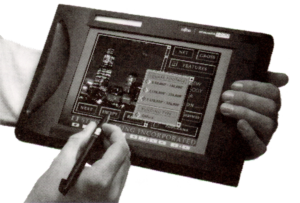
FPSI’s challenge rests with the fact that in the first three markets, laptops currently dominate. “The competition isn’t Symbol or Telxon, not by a mile,” says Walker. “The competition is laptops. The better one understands that, the better one can get some ideas about where this market ought to go, and what needs to be done to make a really big breakthrough. In other words, why do people buy laptops.”
Walker believes that there are certain jobs where the working mobility aspect is so central and integral to the job, that trying to carry a laptop—or balance a laptop—just doesn’t make any sense.
“Here’s a classic example of laptops versus a pen-based tablet. One of our customers performs the task of merchandising consumer packaged goods. This involves making frequent trips to supermarkets.”
“While there, they will likely spend time with the store manager, holding the machine in hand, and standing by a store shelf or perhaps walking from aisle to aisle. Their goal is to convince the store manager, through the use of information, to expand the shelf space of their product. This is a pretty natural interaction.”
“A person who, instead of using one of our pen tablets, arrives with a laptop computer often creates a completely different impression. The first thing that person does is grab a shopping cart and, taking a giant package of Huggies diapers, creates a place on which to rest the laptop. This person will then wheel the laptop around, on the diapers, in the cart.”
“Now if you ask the question of which of these two sales people is likely to have a better and more professional relationship with the store manager, it’s likely going to be the person without the shopping cart. But laptops have a huge penetration in this market. And also, they’re still less expensive because the volume is so much larger.”
The Magic Number
Granted pen computing systems cost more than laptops. But how much is too much? The limit is probably two times a laptop cost, assuming equivalent functionality says Walker. “The point at which everyone starts to get excited is about 1.5 times the cost. However, I’m talking about total solution cost. I’m not talking about the price of the hardware to the VAR, but the price to the end user through the VAR.”
Walker would venture that the typical laptop that’s purchased for a worker is likely in the $2000 to $2500 price range. “So if we can come in at the $3500 to $4000 range, that’s about the maximum. And when you start getting under $3000, you’re getting very competitive.”
The other key to reaching into the corporate market is to offer distinctive solutions. Walker is proud of FPSI’s record of bringing forward new technology. “We tend to be a technology leader on a pretty consistent basis. And when you look at companies such as Norand, Symbol, and Telxon, I think there’s a good reason for that. We are, in a sense, coming from the notebook down, while they’re coming from the DOS handheld up, in my opinion.”
“Their history is DOS handhelds, all flavors of them. And our strategy, if you look at Fujitsu as a whole, is to apply the technologies from the $4 billion notebook operation into our kind of products. It’s one heck of a lot easier to achieve good compatibility coming from a notebook down, than it is from a DOS handheld up.”
“Our strategy, if you look at Fujitsu as a whole, is to apply the technologies from the $4 billion notebook operation into our kind of products. It’s one heck of a lot easier to achieve good compatibility coming from a notebook down, than it is from a DOS handheld up.”
Walker points to Windows 95 as a good example. “Some of our competitors are still having problems with compatibility in this area, while we introduced Windows 95 support on a pen tablet in the Fall of 1995. We introduced NT on a pen tablet last August. No one else today, to my knowledge, has NT 4.0 with power management and card support—along with all the other things—shipping on a tablet.”
Another important differentiator from Walker’s perspective is FPSI’s channel. “We have, in North America alone, over 300 VARs under contract,” says Walker. “Those aren’t just casual relationships, those are contractual resellers. And those resellers cover a huge range from KPMG, up at the high end, down to the five person type of shop that specializes on serving a particular industry well. Every kind of skill and every type of market is represented.”
“In addition, one of the more interesting things I discovered recently was that around 70% of our VARs do software development. You think of a VAR often just as an integrator. But 70% of them are producing some form of vertical application. That’s a significant engine driving our products forward.”
Calculating Returns
One would think that the ‘working mobility’ notion carries with it some intangible that can affect the return on investment calculation, but Walker insists that this isn’t so. “I don’t think people are calculating any of the intangibles when performing this calculation. It’s really very simple. People are taking the entire cost of the system, with all the peripherals, and are simply putting them side by side with the savings that it will likely generate.”
“All of them are doing hard dollar return on investment justifications. And, in general, the pay back ranges from one month to two years.”
Walker also notes that the days are gone when people would buy pen computers to boost personal productivity. “That’s another huge change since 1993 and 1994. Take a company like Gillette,” offers Walker. “They’ve automated something like 900 of their sales people, which are fundamentally merchandisers, in France, Germany, the U.K., Canada, and the U.S.”
“And while the application is for sales force automation, the focus of the application isn’t so much to make the sales person more productive, the focus of the application is to get competitive information back to headquarters as quickly as possible. That is a corporate IT objective.”
In 1993 and 1994, no one talked about applying these devices to solve corporate IT objectives. They were talking, if anything, about making the sales representative more productive. “Now,” says Walker, “these devices are bought because they do a few fundamental things. They improve the competitiveness of the company, and they reduce the cost to the company.”
Handwriting is Still an Issue
Unfortunately, one of the major factors still limiting the growth of pen computers is the input mechanism. “It’s still difficult if the application requires any significant degree of data entry,” says Walker. “For example, I recently spoke with a large insurance company in the mid-west. They totally understand the benefits of working mobility, and they understand and appreciate the idea of a pen interface.”
“In fact, they would love to give their workers a pen tablet with which to walk around the car to collect damage information and assess charges. The problem is that they have a policy that after the adjustor does that, they have to write something called diary notes. These are relatively free form descriptions of why the particular decisions relating to this case were made. This is particularly important if a legal situation were to arise at some later point.”
“They need solid information about each particular case. This tends to be too difficult to do using handwriting. While about half of the information could be codified into a pick list, there’s still a significant body of information that can’t easily be formularized. They need a keyboard.”
“These people have decided that they can fake the working mobility to a degree by putting the laptop on the hood of the car or something. But they can’t do without a keyboard.”
What about a hybrid solution, similar to the now-obsolete GRiD Convertible. Walker personally likes the idea, but can’t seem to get a positive reaction from the customers with whom he talks. “I do quite a bit of market research, interviewing more than 50 companies each year,” says Walker, “and one of the things I ask them about is convertibles.”
You’ll recall that the Convertible integrated a pen tablet into a notebook-style device using an innovative flip-top display that could be switched from notebook to tablet mode in a couple of seconds.
“Less than ten percent of the VARs and corporate users that I interview say that they want a convertible. They want the highest degree of working mobility that they can get when they’re on their feet. They don’t want to have a keyboard, and they don’t want a potentially unreliable hinge mechanism. They want a tablet. Yet when they are sitting down, they want the equivalent of a laptop.”
Walker says that this is the simple reason why the company has not brought a convertible to market. “Repeatedly, my own research seems to indicate that the resulting product would not be acceptable, either because it would be too heavy, bulky, or too expensive.”
So we’re back to handwriting. Walker is guardedly optimistic about handwriting, but understands that there still are issues related to accuracy. “Handwriting has crept along for the last five years,” says Walker. “But it has gotten better. In the early 90’s, my perception was that the accuracy was around 85%, now it’s 95%. But that’s still not good enough.”
“Even the best recognizer is still not good enough to allow a user with average handwriting to input any reasonable amount of information without a significant amount of correction. Remember that 95% still means that one character out of twenty is wrong. And that translates to roughly one word in four requiring correction. That’s a lot. And the process of correction, even with the good gesture support you get with products such as those from CIC, is not something that many users want to do.”
Speech on the Horizon
Instead of waiting for this situation to change, Walker is looking to an even more innovative technology. “I think what’s going to happen is that voice, sometime in the next five years, is pretty much going to take over from handwriting.”
“I think what’s going to happen is that voice, sometime in the next five years, is pretty much going to take over from handwriting.”
Walker explains it as follows: “Moore’s Law is driving the hardware so fast that it has finally caught up with what has always been the fairly heavy processor requirement for accurate speech recognition. Now, pretty consistently, speech recognition can be performed on roughly a 133 MHz Pentium processor. And that type of processor will soon be left behind.”
“Even though there are no tablets on the market today faster than 133 MHz, that will change rapidly. Now that there is enough hardware to finally implement and execute the software required for speech recognition, it’s getting practical. For the first time, on my last trip back from Japan in December, I saw a person on the airplane—a typical business person, not a techie—with a laptop and a headset dictating a memo.”
“He had the microphone right next to his month, to compensate for the airplane noise, but he was doing it. I was watching him over his shoulder, and it was working. So it’s here. And the interesting thing is that I couldn’t hear what he was saying.”
In this scenario, Walker believes that the pen can act pretty much as a mouse. “Doing mouse manipulation with your voice is a pain,” observes Walker. “Plus, in our market today, no one buys voice recognition for command and control. They purchase it for data entry. I like to think that sometime in the future there will be a shared architecture between voice and pen, perhaps along the lines of a common dictionary approach. When I talk to experts in the field, they tell me that the underlying technologies aren’t that different, it’s a matter of pattern recognition.”
Walker seems to have also found a solid ally to support his vision. “I recently heard someone from Microsoft say that in their pure research and development efforts, a full one third of their budget is being spent on what’s known as natural input technologies. They apparently are performing a lot of research in the areas of pen and speech input, as well as other related technologies along the lines of contextual data processing. I don’t know what their overall R&D budget is, but I suspect that it’s significant.”
But what are the social factors that may influence the use of speech in a particular environment? For example, will a doctor speak into a computer? “All the clinicians that I’ve ever talked to are somewhat reluctant to use any type of voice capture or recognition near the patient,” explains Walker. “This is because they may be recording things that they don’t want the patient to hear.”
“On the flip side, I was at Bear Stearns, the investment firm, in New York recently and they have masses of speech-recognition driven trading terminals. And you have this room full of people with desktops, all with headsets, and all talking. And it works.”
According to Walker, FPSI is closing in technically, as far as the requirements of speech recognition hardware are concerned. “The speech companies generally say that 133 MHz is the traditional minimum. We are roughly at 120-133 MHz today for a pen tablet, so we’re almost there. There is still, however, significant resistance to the headset, and there’s no really good ergonomic way to integrate a microphone into a pen tablet that isn’t tiring to use while still providing the key noise cancelling features. Plus, there isn’t a killer application for voice recognition in our markets yet.”
The Question of NT
NT is increasingly becoming the operating system of choice throughout the corporate world. But what about pen tablets? Walker observes that many of his customers are beginning to plan for it. However, it’s too early to make specific predictions. “It’s like asking in 1995, when everyone was using Windows 3.1, how important is Windows 95,” says Walker. “But corporate America perceived that it was going to be important. And the same thing is going to happen for Windows NT 5.0. NT 4.0 is not terribly important, but Microsoft is going to put $100 million behind positioning NT as the corporate solution. So it’s going to be critically important.”
Capability-wise, there are a number of reasons why a corporate manager should be interested in NT 5.0, according to Walker. “One of the most common is the overwhelming deserve to have a common standard operating system for the corporation. Some companies believe that everything from the laptop to the desktop should be running NT, and they won’t buy anything that isn’t running NT.”
“Another reason is security,” says Walker. “This aspect gets mentioned more than just about any other feature. And related to that is the ability of the corporate IT manager to manage users and their privileges. Now of course this is being driven by desktops, and what Microsoft calls ZAK, or the Zero Administration Kit. But that technology flows onto portables just as quickly. IT departments want to set limits on what workers can do with corporate resources and information. And NT 5.0 will offer significantly more tools to accomplish that than Windows 98 ever will.”
“IT departments want to set limits on what workers can do with corporate resources and information. And NT 5.0 will offer significantly more tools to accomplish that than Windows 98 ever will.”
Walker sees this as part of Microsoft’s key differentiation strategy, to help drive the corporate user towards NT by solidly focusing on things that corporations need; and to drive consumers by focusing it on support for entertainment hardware, including 3D graphics, TV integration, and the Internet.
“It’s soon going to become a no-brainer,” says Walker. “If you look at the penetration of NT today, 11% of all computers shipped have NT on them—that’s all computers. And of course, the majority of those are desktops. Microsoft’s goal within three years is to have 50% of computers ship with NT. And that’s going to affect us, radically.”
And the Question of Java
Java too is drawing significant interest among corporate managers. The notion of “write-once, run-anywhere” is a compelling idea. So too is the notion of a wireless thin client. Walker is somewhat split on the two topics. “Wireless thin clients are getting increasingly important in health care, and that’s the only market where they matter at all to us. That’s also the only market where wireless LANs account for anything for us.”
According to Walker, thin clients are becoming important for the same reason that NT is becoming important, and that is the idea of central control and security. “Basically there are a couple of approaches to wireless thin clients. The simplest perhaps is the one adopted by proponents of the CruisePad. This creates an environment where the mobile computer is like a terminal.”
“I don’t see many people implementing this option, and we’ve lost very few contracts in health care to this approach. The next level up is Java. There’s two ways to look at Java. The first is as a language. Held in this light, we think Java is great. There’s a lot of development being done in Java, and probably a third of our VARs are experimenting with Java as a language. The majority of them, however, tell me that they don’t think it’s mature enough to use in major production applications in the way that they’d use something like C++, but it’ll get there.”
The other approach is Java as an operating system. “None of the people with whom I’ve spoken are at a point yet where they are seriously ready to consider a thin client with a native Java OS system. I’ve talked to five or six companies that have experimented with Java OS, and their reaction is that the performance is not up to expectations.”
“For example, a major retailer recently announced that they plan to deploy $30 million worth of Java-equipped mobile computers. But if you read the announcement carefully, it says that they plan to start off with Windows, and migrate to Java OS later in 1998. Not a single person I’ve talked to has suggested that this strategy makes any sense. Why pay the money for an operating system, such as Windows, for half a year or a year, and then junk it for another operating system that, on the same hardware, offers less advantages.”
To Walker, this seems more like a positioning effort, and not a business case driven example of why Java makes sense. “However, I’m willing to be patient and see, because I’m sure something will change over the coming year.”
Finally, the next level up employs a browser on a mobile computer. “But one of the issues that people discover when they start looking at browser-based thin client applications is the inherent stateless-ness of the browser. It has no sense of state, it’s just looking at the next page.”
“So what happens is that people turn to Java applets that either get downloaded, if there is only a few of them, or stored locally if there’s a lot of them, to manage the state of the patient care information, for example. So what some of the software developers have told me is that you get right back to where you started from. Once you have 50-100 modules, you might as well use Windows.”
RISC is also something that doesn’t appear to be making much of an impression on FPSI’s customers. “Remember that corporate America is quite conservative—you wouldn’t really characterize them as bleeding edge. They’re, for the most part, married to Intel and Microsoft. The subject of hardware independence doesn’t really interest them. And that’s the reality today.”
The 802.11 Saga
Wireless LANs also play an integral part in FPSI’s business, making Walker a keen observer of the saga that was the IEEE 802.11 committee. “A year ago in the wireless LAN marketplace, 802.11 was seen as something that would eventually happen, maybe, since it had been under development for seven years. And then, last Fall, it was approved. Now, I notice a significant difference in the outlook of our prospects when it comes to the standard.”
“And what customers are looking at is not the technical capability, because it’s essentially what vendors already have today. But because it’s now a standard, this means a lot to the corporate world. I am predicting a significant crossover from the non-standard implementations to those that are, and can prove compliance with, IEEE 802.11.”
However, it’s the last item that’s the key according to Walker. “Today there is no agreed upon test suite. That should come by the end of this quarter, perhaps early next quarter. But until there is, all the claims you hear from all the vendors about IEEE 802.11 compliance is a bit premature. There’s no way at this time to say that they’ve passed the test, because the test doesn’t exist yet.”
“Today there is no agreed upon test suite. That should come by the end of this quarter, perhaps early next quarter. But until there is, all the claims you hear from all the vendors about IEEE 802.11 compliance is a bit premature.”
While welcoming the standard, Walker concedes that it’s not perfect. “The most obvious problem with IEEE 802.11 is that there is no standard for roaming between access points of different kinds. Now there’s a group that’s working on that, but there’s significant division among the vendors as to whether it’s necessary and whether it’s even a good idea.”
“Ultimately though, the standard is going to have an effect simply because it’s a standard. But the standard is not going to have an effect on who dominates the market. As soon as everyone has a compliant product, it’s back to the question of why someone buys from one vendor and not another.”
“It’s helps to have interchangeability at the radio level, but it took too long to develop, and technology kind of caught up to it. And I don’t see the technology evolving too quickly after this, as some other standards have.”
The fundamental application for wireless LANs in FPSI’s business is clinical data. “As for 801.11, I simply don’t see anything radical happening in our part of the wireless LAN business—it’s very straightforward. For us, the best thing to happen is for the ‘fear quotient’ to go down.”
“The one thing that slows down the rate of implementation at the moment is still fear related to the economics and reliability of the technology. Our feedback indicates that speed, or data throughput, is not an issue. The percentage of users who are speed-limited is very low, perhaps five to ten percent.”
Fujitsu Personal Systems, Inc.
www.fpsi.fujitsu.com
Transcribed from Pen-Based Computing, Volume 8, Number 1 — January 1998. Pages 12, 13, 14, 15, 16, 17.