
The Reemergence of General Magic
From the Original Pages
Click a page to enlarge · Alt-click to open the full issue
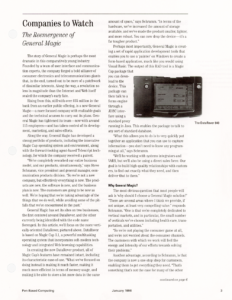
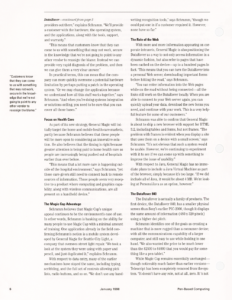
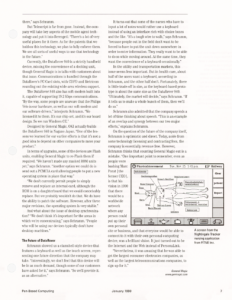
The story of General Magic is perhaps the most dramatic in this comparatively young industry. Founded by a team of user interface and communication experts, the company forged a bold alliance of consumer electronics and telecommunications giants that, in the end, turned out to be more of a patchwork of dissimilar interests. Along the way, a revolution no less in magnitude than the Internet and Web itself sealed the company’s early fate.
Rising from this, still with over $35 million in the bank from an earlier public offering, is a new General Magic—a more focused company with realizable goals and the technical acumen to carry out its plans. General Magic has tightened its team—now with around 115 employees—and has taken control of its development, marketing, and sales efforts.
Along the way, General Magic has developed a strong portfolio of products, including the innovative Magic Cap operating system and environment, along with the forward-looking agent-based Telescript technology, for which the company received a patent.
“We’ve completely reworked our entire business model, and our products, simultaneously,” says Steve Schramm, vice president and general manager, communication products division. “So we’re not a new company, but effectively everything is new. The products are new, the software is new, and the business plan is new. The customers are going to be new as well. We’re hoping that we’re taking advantage of the things that we do well, while avoiding some of the pitfalls that we’ve encountered in the past.”
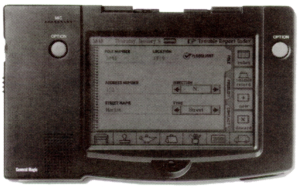
General Magic has set its sites on two businesses, the first centered around DataRover, and the other currently being identified with the code name Serengeti. In this article, we’ll focus on the more vertically-oriented DataRover, pictured above. DataRover is based on Magic Cap 3.1, a powerful multitasking operating system that incorporates soft-modem technology and integrated Web browsing capabilities.
In creating the new DataRover product, all of Magic Cap’s features have remained intact, including its characteristic ease-of-use. “What we’ve focused on doing instead is making it much faster, making it much more efficient in terms of memory usage, and making it be able to store a lot more data in the same amount of space,” says Schramm. “In terms of the hardware, we’ve increased the amount of storage available, and we’ve made the product smaller, lighter, and more robust. You can now drop the device—it’s a far tougher product.”
Perhaps most importantly, General Magic is creating a set of rapid application development tools that enables you to use a ‘painter’ on Windows to create a form-based application, much like you would using Visual Basic. The output of this RAD tool is a Magic Cap package that you can download to the device. This package can then talk to a forms engine through a JDBC interface using a standard proxy running in Java. This enables the package to talk to any sort of standard database.
“What this allows you to do is to very quickly put together an application that you can use to capture information—you don’t need to know any programming at all,” says Schramm.
“We’ll be working with systems integrators and VARS, but we’ll also be using a direct sales force. Our goal is to build high-quality relationships with customers, to find out exactly what they need, and then deliver that to them.”
Why General Magic?
The most obvious question that most people will ask is ‘why should I choose a General Magic solution?’ “There are several areas where I think we provide, if not unique, at least very compelling value.” responds Schramm. “One is that we’re completely dedicated to vertical markets, and in particular, the small number of verticals we’ve chosen including health care, transportation, and utilities.”
“So we’re not playing the consumer game at all, and we’re not worried about the consumer channels. The customers with which we work will feel the energy and intensity of our efforts towards solving their problems.”
Another advantage, according to Schramm, is that the company is now a one-stop shop for customers. enabling them to get everything they need. “That’s something that’s not the case for many of the other providers out there,” explains Schramm. “We’ll provide a customer with the hardware, the operating system, and the applications, along with the tools, support, and warranty.”
“This means that customers know that they can come to us with something that may not work, secure in the knowledge that we’re not going to point to any other vendor to reassign the blame. Instead we can provide very rapid diagnosis of the problem, and then we can give them a very clear answer.”
“Customers know that they can come to us with something that may not work, secure in the knowledge that we’re not going to point to any other vendor to reassign the blame.”
In practical terms, this can mean that the company can more quickly overcome a potential hardware limitation by perhaps putting a patch in the operating system. “Or we may change the application because we understand how all this stuff works together,” says Schramm. “And when you’re doing systems integration or solutions-selling, you need to be sure that you can cover all those bases.”
Focus on Health Care
As part of its new strategy, General Magic will initially target the home and mobile health care markets, partly because Schramm believes that these people will be more open to considering an innovative solution. He also believes that the timing is right because greater attention is being paid to home health care as people are increasingly being pushed out of hospitals earlier than ever before.
“This means that a lot more care is happening outside of the hospital environment,” says Schramm, “yet those care-givers still need to connect back to remote sources of information. Those people seem very receptive to a product where computing and graphics capability, along with wireless communications, are all present on a handheld device.”
The Magic Cap Advantage
Schramm believes that Magic Cap’s unique appeal continues to be the environment’s ease of use. In other words, Schramm is banking on the ability for many people to use Magic Cap with a minimal amount of training. One application already in the field confirming Schramm’s notion is a mobile system developed by General Magic for Seattle City Light, a company that oversees street light repair. “We took a look at the system they were using with paper and pencil, and just duplicated it,” explains Schramm.
With respect to data entry, many of the earlier mechanisms have stayed the same, including typing, scribbling, and the full set of controls allowing pick lists, radio buttons, and so on. “We don’t use any handwriting recognition tools,” says Schramm, “though we could put one in if a customer required it. However, none have so far.”
The Role of the Web
With more and more information appearing on corporate intranets, General Magic is also positioning the DataRover as a way to not only access information in a dynamic fashion, but also refer to pages that have been cached on the device—up to a hundred pages in fact. “This means that you can turn the DataRover into a personal Web server, downloading important forms before hitting the road,” says Schramm.
“You can enter information into the Web pages while on the road without being connected—all the links still work on the DataRover locally. When you are able to connect to your Web server again, you can quickly upload your data, download the new forms you need, and continue with your work. This is a very helpful feature for some of our customers.”
Schramm was able to confirm that General Magic is about to ship a new browser with support for HTML 3.2, including tables and forms, but not frames. “The problem with frames is evident when you display a site that uses them on a device with a small screen,” says Schramm. “It’s not obvious that such a system would be usable. However, we’re continuing to experiment with it to see if we can come up with something to improve the issue of usability.”
With respect to Java, General Magic has no immediate plans to include a Java Virtual Machine as part of the browser, simply because it’s too large. “If we did include all of Java, it would be about 4 MB. We’re looking at PersonalJava as an option, however.”
The DataRover 840
The DataRover is actually a family of products. The first device, the DataRover 840, has a smaller physical screen than Sony’s earlier PIC-2000, though it displays the same amount of information (480 x 320 pixels) using a higher dot pitch.
Schramm identifies one of the goals as creating a machine that is more rugged than a consumer device; with all the communications capability of a larger computer, and still easy to use while holding in one hand. “We also wanted the price to be much lower than the $2500 to $4000 that you would pay for something like a pen tablet.”
While Magic Cap remains essentially unchanged—though noticeably much faster than earlier versions—Telescript has been completely removed from the system. “It doesn’t have any role, not at all, zero. It’s not there,” says Schramm.
But Telescript is far from gone. Instead, the company will take key aspects of the mobile agent technology and put it into Serengeti. “There’s a lot of very useful places for it there. As for the patents that we hold on this technology, we plan to fully enforce them. We see all sorts of useful ways to use that technology in the future.”
Currently, the DataRover 840 is a strictly handheld device, missing the convenience of a docking unit, though General Magic is in talks with customers about that issue. Communications is handled through the DataRover’s PC Card slots, with CDPD and Metricom rounding out the existing wide-area wireless support.
The DataRover 840 also has soft-modem built into it, capable of supporting 19.2 Kbps communications. “By the way, some people are unaware that the Philips Velo is our hardware, as well as our soft-modem and our software drivers,” interjects Schramm. “We licensed it to them. It’s our chip-set, and it’s our board design. So we run Windows CE.”
Designed by General Magic, OKI actually builds the DataRover 840 in Nagano Japan. “One of the lessons we learned for our earlier efforts is that it’s not a good idea to depend on other companies to move your product.”
In terms of upgrades, some of the devices are Flash units, enabling General Magic to re-Flash them if required. “We haven’t made any masked ROM units yet,” says Schramm. “Another option we could do is send out a PCMCIA card allowing people to put a new operating system in place that way.”
“We don’t currently permit people to simply remove and replace an internal card, although the ROM is on a daughterboard that we could conceivably replace. But we probably wouldn’t do that. We do have the ability to patch the software. However, after three major revisions, the operating system is very stable.”
And what about the issue of desktop synchronization? “We don’t think it’s important for the areas in which we’re concentrating,” says Schramm. “People who will be using our devices typically don’t have desktop machines.”
The Future of DataRover
Schramm showed us a clamshell-style device that features a keyboard as well as the touch screen, representing one future direction that the company may take. “Interestingly, we don’t feel that this device will be in as much demand, though some of our customers have asked for it,” says Schramm. “So we’ll provide it. as an alternative.”
It turns out that some of the nurses who have to input a lot of notes would rather use a keyboard instead of using an interface rich with choice boxes and the like. “It’s a tough wire to walk,” says Schramm, “because people out in the field don’t want to be forced to have to put the unit down somewhere in order to enter information. They really want to be able to do so while moving around. At the same time, they want the convenience of a keyboard occasionally.”
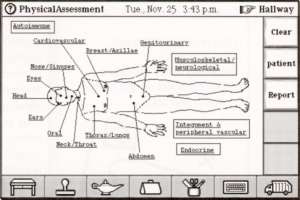
In the utility and transportation markets, this issue seems less important. But in health care, about half of the users want a keyboard, according to Schramm, and the other half don’t. Fortunately, there is little trade-off in size, as the keyboard-based prototype is about the same size as the DataRover 840. “Ultimately, the market will decide,” says Schramm. “If it tells us to make a whole bunch of them, then we’ll do so.”
Schramm also admitted that the company spends a lot of time thinking about speech. “This is an example of an overlap and synergy between our two major efforts,” explains Schramm.
On the question of the future of the company itself, Schramm is optimistic and direct. Today, aside from some technology licensing and contracting fees, the company is essentially revenue free. However, Schramm thinks that counting General Magic out is a mistake. “One important point to remember, even as people were bashing Marc Porat [the former CEO], is that his vision in 1990 that there would be a worldwide network where any person could put up their own personal site or business, and that everyone would be able to connect to it with their own personal computing device, was a brilliant vision. It just turned out to be the Internet and the Web instead of PersonaLink.
“Nevertheless, it was amazing that he was able to get the largest consumer electronics companies, as well as the largest telecommunications companies, to sign up for it.”
General Magic
www.genmagic.com
Transcribed from Pen-Based Computing, Volume 8, Number 1 — January 1998. Pages 3, 6, 7.