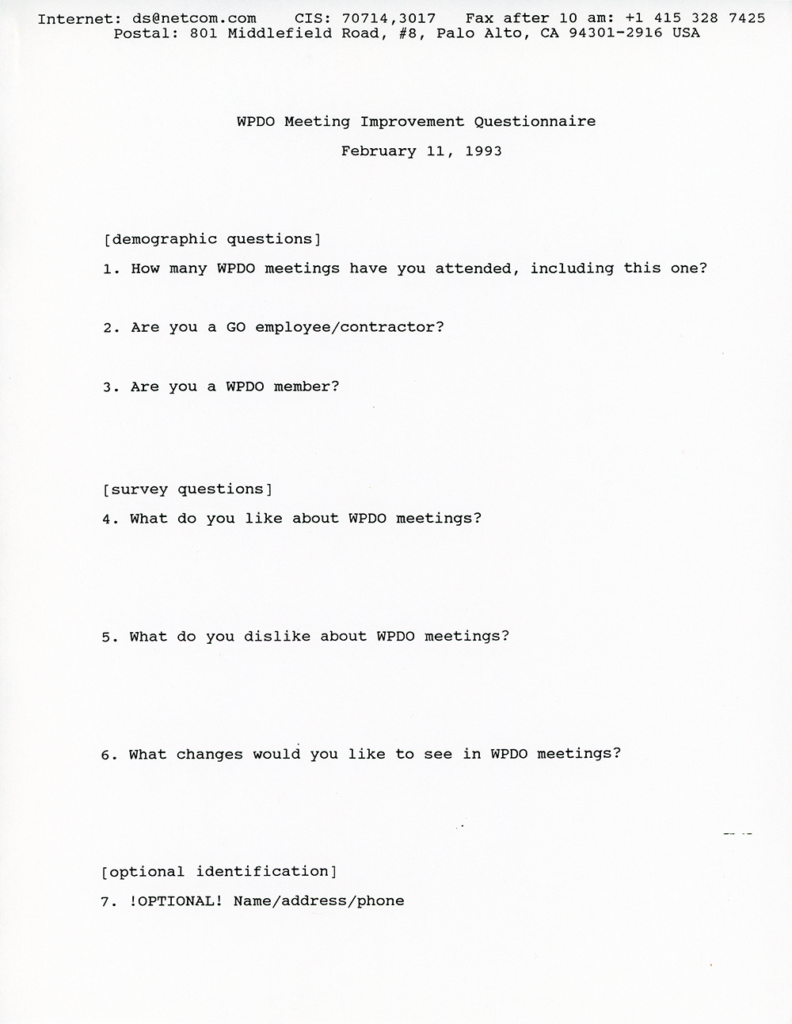
WPDO Meeting Improvement Questionnaire (February 11, 1993)
This questionnaire was handed out at the February 11, 1993 Worldwide PenPoint Developers Organization meeting at GO Corp's headquarters in Foster City, California.
Were you involved with this artifact? If so, we would like to include your story on this page. Let us know how you contributed.
Artifact Details
Worldwide PenPoint Developers Organization
United States
English
February 11, 1993
Single-sided photocopied page.
8.5" 11"
C8NFPZQFC8
February 11, 1993
Acquired from WPDO
2026-06-02
People

History
The WPDO Meeting Improvement Questionnaire is a single-page feedback form distributed at the February 11, 1993 meeting of the Worldwide PenPoint Developers Organization (WPDO).1 The form asked attendees how many WPDO meetings they had attended, whether they were GO Corporation employees or contractors, and whether they were WPDO members, then invited open comments on what they liked and disliked about the meetings and what changes they wished to see.1 It carried the contact information of David Schachter at a Palo Alto address and left the respondent's own name, address, and telephone number optional.1
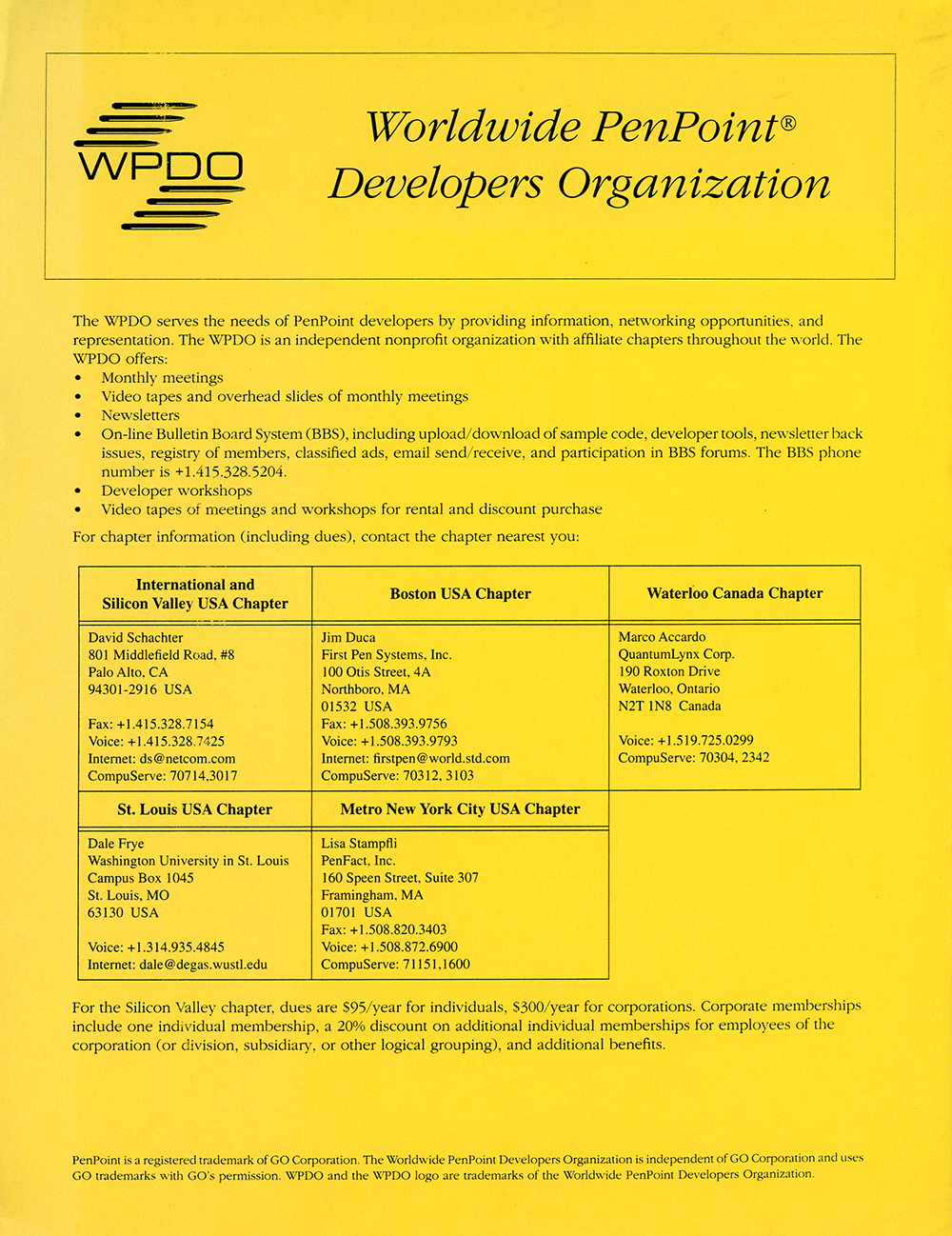
The WPDO described itself as an independent nonprofit organization, not a division of GO Corporation, formed to serve the needs of PenPoint developers through monthly meetings at which developers and GO representatives gave technical presentations and answered developer questions.2 By 1993 the organization had grown to offer monthly meetings, videotapes and overhead slides of those meetings, a newsletter, an online bulletin board system, and developer workshops, with affiliate chapters forming throughout the world.3
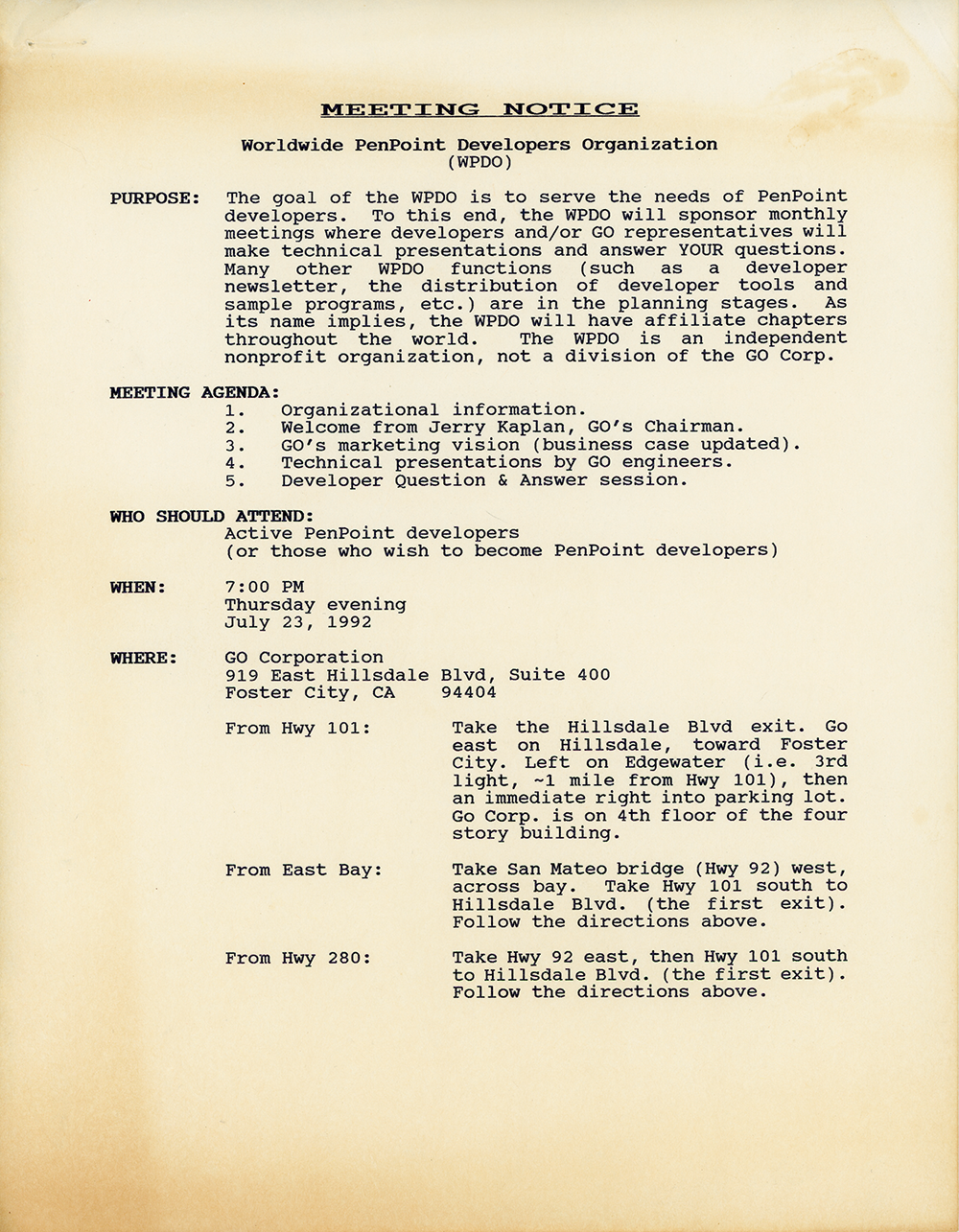
Gathering and forwarding member feedback to GO was a standing WPDO practice: the notice for its July 23, 1992 meeting had asked attendees to prioritize their feedback for GO on a scale of one to ten so that the responses could be accumulated and officially submitted to the company.2 The February 11 meeting was recorded as WPDO Meeting #7, and featured GO architect Joe Vierra on "The GO Message Center," a demonstration of the WPDO bulletin board by Joe Hayashi of Notable, Inc. and Lang Zerner of GO, and an announcement by GO's Thom Hogan of a new plan to distribute the PenPoint software developer's kit free of charge.4
David Schachter, who distributed the questionnaire, served as WPDO president and as coordinator of the organization's headquarters Silicon Valley chapter.5 The WPDO counted AT&T, GRiD Systems, Distributed Micro Systems, EO, GO Corporation, and Notable among its corporate sponsors, and ran its operations and its WPDO News newsletter from a headquarters at 901 Middlefield Road in Palo Alto, California.5 Membership cost $95 a year for individuals and $300 for corporations, with a $35 student rate, while non-members could attend the group's Silicon Valley meetings for $10.5
AI generated using primary sources referenced in the footnotes
Footnotes
- Worldwide PenPoint Developers Organization, WPDO Meeting Improvement Questionnaire (February 11, 1993) (image scan), February 11, 1993
- Worldwide PenPoint Developers Organization, Worldwide PenPoint Developers Organization (WPDO) Meeting Notice - July 23, 1992 (image scan), July 23, 1992
- Worldwide PenPoint Developers Organization, Worldwide PenPoint Developers Organization (WPDO) Flyer - 1993 (image scan), 1993
- Worldwide PenPoint Developers Organization, Worldwide PenPoint Developers Organization - Available Videotapes (July 8, 1993) (image scan), July 8, 1993
- Worldwide PenPoint Developers Organization, WPDO News - Volume 2, Number 3, May 1993 (image scan), May 1993
Oral History
The [email protected] email address in the top-left corner of the artifact is David Schachter, one of the WPDO founders. I first ran into David around 1990 at monthly meetings of the Software Entrepreneurs Forum (SEF), held at the Cubberley Community Center on Middlefield Road in Palo Alto.
In the late 1980s and 1990s, the SEF was, in some ways, the logical continuation of the famous Homebrew Computer Club (1975–1986). While the Homebrew Computer Club emerged when personal computing barely existed — its members were hobbyists, engineers, and hackers — the SEF was a product of a much more mature Silicon Valley.
Software had become a major industry, venture capital was well established, and many attendees were founders, executives, consultants, investors, and aspiring startup entrepreneurs rather than hobbyists.
A tall, fit, and striking figure, David attended every meeting and characteristically stood on the side steps near the middle of the auditorium. He was impossible to miss — always vocal, curious, and courteous. David was a very early pen computing entrepreneur, and he was the one who first invited me to Worldwide PenPoint Developers Organization meetings.
John Jerney
Editor, Pen-Based Computing: The Journal of Stylus Systems
Curator, Pen-Based Computing History Museum
Connections
This artifact's place in the wider network of people, organizations, and artifacts. Drag to pan, scroll to zoom, and tap any node to focus its connections.