
Pi Systems Hopes Pen-Based Is Just What the Doctor Ordered
From the Original Pages
Click a page to enlarge · Alt-click to open the full issue
A model for vertical hardware and software
by Ray Valdes
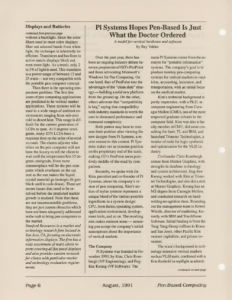
Over the past year, there has been an ongoing industry debate between proponents of GO’s PenPoint and those advocating Microsoft’s Windows for Pen Computing. On one hand, fans of PenPoint tout the advantages of the “clean slate” strategy — building a solid new platform from the ground up. On the other, others advocate that “compatibility is key,” saying that compatibility with industry standards is worth the cost in decreased performance and increased complexity.
Both parties may have to reassess their position after viewing the new designs from Pi Systems, a recent entrant to this contest. Pi Systems stakes out an extreme position on the proprietary end of the scale, making GO’s PenPoint seem positively middle-of-the-road by comparison.
Recently, we spoke with Jin Kim, president and co-founder of Pi Systems, about his company’s vision of pen computing. Kim’s notion of stylus systems represents a unique blend of the various possible ingredients in a system design: CPU, form factor, operating system, application environment, development tools, and so on. The resulting mix makes eminent sense — assuming you accept the company’s initial assumptions about the importance of vertical markets.
The Company
Pi Systems was founded in November 1990, by Kim, Chris Roseburgh (VP Engineering), and Eng-Kee Kwang (VP Software). The name Pi Systems comes from the acronym for “portable information” systems. The company’s goal is to produce turnkey pen-computing systems for vertical markets in medicine, accounting, insurance, and transportation, with an initial focus on the medical market.
Kim’s technical background is pretty impressive, with a Ph.D. in computer engineering from Carnegie Mellon (CMU), one of the most respected graduate schools in the computer field. Kim was also a faculty member at CMU, did some consulting for Intel, TI, and IBM, and launched Trimeter Technologies, a vendor of tools for logic synthesis and optimization for the VLSI industry.
Co-founder Chris Roseburgh comes from Mentor Graphics, with strengths in database technology and system architecture. Eng-Kee Kwang worked with Kim at Trimeter Technologies, and also did a stint at Mentor Graphics. Kwang has an MS degree from Carnegie Mellon, and conducted research on handwriting recognition there. Rounding out the management team is Robert Whittle, director of marketing, formerly with IBM and TouchStone Software. Initial funding is from the Tong Yang Group (offices in Korea and San Jose), other Pacific Rim venture capitalists, and private investors.
The team’s background in technology-intensive vertical markets such as VLSI tools, combined with a firm foothold in topflight academic research, heavily influences their approach to pen computing. Compare this team with GO, which consists of an all-star team of players with successful track records in horizontal applications in the mainstream PC industry. Unlike those at GO, the team at Pi Systems is not interested in running DayTimer-like calendar programs and general-purpose spreadsheets on their computer. In the future, maybe, says Kim, but initially no.
The organizing principle behind Pi’s design is its choice of markets starting with the vertical arena of hospital information systems. The Pi design will be applicable to vertical markets in accounting, insurance, and transportation, but for the moment, the most active efforts are alpha sites at health care institutions. After beta testing later this year, the Pi System will be introduced early next year.
Kim and company think that the wave of pen-based computing will hit first in vertical markets, and only later in the broad horizontal ones. The idea is to become established first in vertical niches, and then to be nimble enough to move to general-purpose platforms when the time comes. The current hardware design, a closed proprietary system rather than an open general-purpose one, is therefore “disposable.”
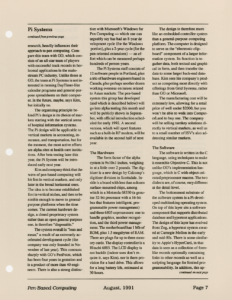
The system overall is “lean and mean,” a result of an extremely accelerated development cycle (the company was only founded in November of last year). This contrasts sharply with GO’s PenPoint, which has been four years in gestation and is a product of more than 40 engineers. There is also a strong distinction with Microsoft’s Windows for Pen Computing — which one can arguably say has had an 8-year de velopment cycle (for the Windows portion), plus a 2-year cycle (for the pen-oriented extensions) — an effort which can be measured perhaps hundreds of person-years.
The Pi Systems staff consists of 12 software people in Portland, plus a trio of hardware engineers based in Canada, plus perhaps another dozen working overseas on issues related to Asian markets. The pen-based system this group has developed (and which is described below) will go into alpha testing this month and will be publicly shown in September, with official introduction scheduled for early 1992. A second version, which will sport features such as a built-in RF modem, will be available in the second half of next year.
The Hardware
The form factor of the alpha system is 9x10x1 inches, weighing in at a little over 2 pounds. The digitizer is a new design by Calcomp’s digitizer division in Scottsdale. Inside is a board with less than a dozen surface-mounted chips, among which is a Motorola 68330 (a genuine 32-bit processor with a 16-bit bus that features intelligent, programmable power management) and three 6805 coprocessors: one to handle graphics, another recognition, and the third power management. The motherboard has 1 Mb of ROM, plus 1.5 megabytes of RAM. There are plugs for up to three memory cards. The display controller is a Hitachi 6885. The LCD display is not backlit (indoor uses don’t require it, says Kim), nor is there provision for a hard drive. This allows for a long battery life, estimated at 30 hours.
The design is therefore more like an embedded controller system than a general-purpose computing platform. The computer is designed to serve as the “electronic clipboard” component of a larger information system. Its function is to gather data, both textual and graphical in form, and then transfer the data to some larger back-end database. Kim sees his company’s product as competing most directly with offerings from Grid Systems, rather than GO or Microsoft.
The manufacturing cost will be extremely low, allowing for a retail price of well under $2000, but you won’t be able to walk into ComputerLand to buy one. The company will be selling turnkey solutions directly to vertical markets, as well as to a small number of ISV’s also addressing similar markets.
The Software
The software is written in the C language, using techniques to make it resemble Objective-C. This is not unlike GO’s implementation language, which is C with object-oriented preprocessor macros. The two dialects are, of course, very different at the detail level.
The bottommost substrate of the software system is a Pi-developed multitasking operating system. On top of this layer sits a software component that supports distributed database and hypertext applications. The design of this layer has evolved from Zog, a hypertext system created at Carnegie Mellon in the early and mid-80s. There is some similarity to Apple’s HyperCard, in that data is seen as a collection of form-like records optionally containing links to other records as well as a scripting language for limited programmability. In addition, this application support layer has resemblances to a spreadsheet. The graphics, says Kim, will be “Mac II quality.”
Form-oriented applications are developed on a host platform using a proprietary tool. In addition, it will be possible to do limited customization of an application on the handheld target system. At the moment, the host-based application development tool only runs on a Sun workstation (as befits the technical background of the company’s staff), but there are plans to port this to PCs and Mac. The application tools are effective but rudimentary, which is to say they are not as friendly as mass-market tools like Borland’s Turbo C. If you are a UNIX programmer, however, you’ll have no trouble learning these tools. The end-user applications, however, will be very easy to use. Kim feels that GO’s PenPoint is too complex, and is striving for an end-user manual that takes 20 minutes to read.
The handwriting recognition software is also homegrown, and fits in with the company philosophy of simple but effective tools. Rather than attempt a complex, general-purpose handwriting recognition module, the engineers at Pi have implemented a simple recognizer that relies heavily on context-specific constraints to achieve its goal. The basic idea is that, within a specific application in a specific industry, there is only a limited amount of data to recognize. By limiting the domain, the recognition problem becomes much more tractable.
Using the System
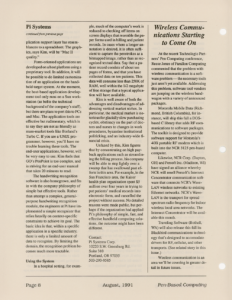
In a hospital setting, for example, much of the computer’s work is reduced to checking off items on screen displays that resemble the paper forms used in billing and patient records. In cases where a longer annotation is desired, it is often sufficient to capture the penstrokes as a bitmapped image, rather than as recognized textual data. Say that a patient record consists of about ten pages of forms, and that you have collected data on ten patients. This data will consume less than 250K of RAM, well within the 1/2 megabyte of free storage that a typical application will have available.
Kim is well aware of both the advantages and disadvantages of addressing vertical market niches. In particular, the medical market is notorious for glacially slow purchasing cycles, obstinacy on the part of doctors and nurses to changes in work procedures, byzantine institutional politicking, and an industry-wide financial crisis.
Unfazed by this, Kim figures that by concentrating on high payback applications such as streamlining the billing process, his company will be able to step lightly over a swamp that has swallowed past efforts in this area. For example, in the San Francisco area, the Kaiser health plan organization spent $5 million over four years in trying to put patients’ medical records into electronic form, and cancelled the project without success. No detailed reasons were made public, but perhaps if the organization had applied Pi’s philosophy of simple, fast, and effective handheld computing solutions, the outcome might have been different.
Contact:
Pi Systems Corp.
10220 S.W. Greenburg Rd.
Suite 310
Portland, OR 97035
503-293-9585
Transcribed from Pen-Based Computing, Volume 1, Number 4 — August 1991. Pages 6, 7, 8.