
Pen Palmtops are Smaller in Size, Price
From the Original Pages
Click a page to enlarge · Alt-click to open the full issue
Japan has a Yen for the Pen
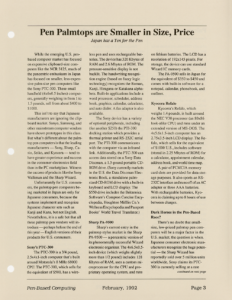
While the emerging U.S. pen-based computer market has focused on expensive clipboard-size computers like the NCR 3125, much of the pencentric enthusiasm in Japan has focused on smaller, less-expensive palm-size pen computers like the Sony PTC-300. These small handheld (4x6x0.5 inches) computers, generally weighing in from 1 to 1.5 pounds, sell from about $400 to $1000.
This isn’t to say that Japanese manufacturers are ignoring the clipboard market. Sanyo, Samsung, and other mainstream computer vendors have shown prototypes in this class. But what’s different about the palmtop pen computers is that the leading manufacturers — Sony, Sharp, Casio, Seiko, and Kyocera — tend to have greater experience and success in the consumer electronics field than in the PC marketplace. Witness the success of products like the Sony Walkman and the Sharp Wizard.
Unfortunately for U.S. consumers, the palmtop pen computers being marketed in Japan are only for Japanese consumers, because the systems implement and recognize Japanese character sets such as Kanji and Kana, but not English. Nevertheless, it is a safe bet that all these palmtop pen vendors will introduce — perhaps before the end of this year — English versions of their products for U.S. consumers.
Sony’s PTC-300
The PTC-300 is a 3/4 pound, 2.5x4x1-inch computer that’s built around Motorola’s 8 MHz 68000 CPU. The PTC-300, which sells for the equivalent of $500, has a wireless pen and uses rechargeable batteries. The device has 320 Kbytes of RAM and 2.6 Mbytes of ROM. The pressure-sensitive display is not backlit. The handwriting recognition engine (based on fuzzy logic technology) recognizes the Roman, Kanji, Hiragana or Katakana alphabets. Built-in applications include a word processor, scheduler, address book, graphics, calendar, calculator, and auto dialer. A fax adaptor is also available.
The Sony device has a variety of optional peripherals, including (for another $250) the PTI-300 docking station which provides a thermal printer and RS-232C serial port. The PTI-300 communicates with the computer via an infrared link. Additionally, the PTC-300 can access data stored on a Sony Data Discman, a 1.5-pound portable CD-ROM drive. (Sony currently markets in the U.S. the Data Discman Electronic Book, a standalone palm-sized CD-ROM drive with a built-in keyboard and LCD display. The $550 drive includes the Britannica Software’s Compton Concise Encyclopedia, Houghton Mifflin Co.’s Wellness Encyclopedia and Passport Books’ World Travel Translator.)
Sharp PA-9500
Sharp’s current entry in the palmtop stylus market is the Sharp PA-9500 — a pencentric version of its phenomenally successful Wizard electronic organizer. The 4×6.5×0.5-inch device (which weighs slightly more than 1/2 pound) includes 128 Kbytes of RAM, uses a custom microprocessor for the CPU and proprietary operating system, and runs on lithium batteries. The LCD has a resolution of 192×145 pixels. For storage, the device can use standard Wizard IC memory cards.
The PA-9500 sells in Japan for the equivalent of $350 to $450 and comes with built-in software for a notepad, calendar, phonebook, and outliner.
Kyocera Refalo
Kyocera’s Refalo, which weighs 1.4 pounds, is built around the NEC V30 processor (an 80×86 look-alike CPU) and runs under an extended version of MS-DOS. The 4×5.6×1.5-inch computer has an 2.75×3.5-inch LCD display. The Refalo, which sells for the equivalent of $1000 U.S., includes software (stored in 2.25 Mbytes of ROM) for a calculator, appointment calendar, address book, and world time map.
A pair of PCMCIA memory card slots are provided for data storage purposes. It also sports an RS-232C interface and runs off of an AC adapter or three AAA batteries. With rechargeable batteries, Kyocera is claiming up to 8 hours of use between charges.
Dark Horses in the Pen-Based Race?
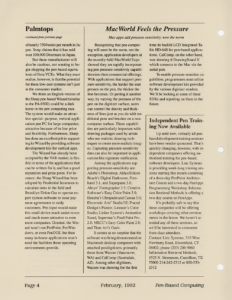
There’s no doubt that small-size, low-priced palmtop pen computers will be a major factor in the U.S. market; the question is when. Japanese consumer electronic manufacturers recognize the huge potential — the Sharp Wizard has reportedly sold over 5 million units worldwide, Sony claims its PTC-300 is currently selling at a rate of nearly 7500 units per month in Japan. Sony claims that it has sold over 100,000 Discmans in Japan.
But these manufacturers will also be cautious, not wanting to begin shipping the pen-based equivalents of Beta VCRs. What they must realize, however, is that the potential for these low-cost systems isn’t just in the consumer market.
We think an English version of the Sharp pen-based Wizard (similar to the PA-9500) could be a dark horse in the pen computing race. The system would make an attractive special-purpose, vertical-application pen PC for large companies; attractive because of its low price and flexibility. Furthermore, Sharp has done an excellent job in supporting its Wizard by providing software development kits for vertical apps.
The Wizard has already been accepted by the VAR market, is flexible in terms of the applications that can be written for it, and has a good reputation and price point. For instance, the Sharp Wizard has been adopted by Prudential Insurance to calculate rates in the field and Brooklyn Union Gas to operate expert system software to issue payment agreements to tardy customers. Pen input would make this small device much easier to use and much more attractive to even more companies. Granted, the Wizard won’t run PenPoint, PenWindows, or even PenDOS, but then many in-house applications won’t need the facilities these operating environments provide.
Transcribed from Pen-Based Computing, Volume 2, Number 1 — February 1992. Pages 3, 4.