
Executive View: A Conversation with PenMagic’s Norm Francis
From the Original Pages
Click a page to enlarge · Alt-click to open the full issue
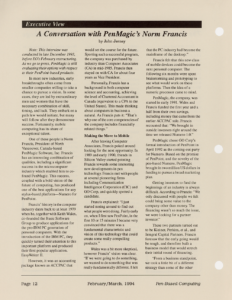
Note: This interview was conducted in late December 1993, before EO’s
February restructuring. As we go to press, PenMagic is still evaluating
their options with respect to their PenPoint-based products.
In most new industries, early breakthroughs often come from smaller companies willing to take a chance to pursue a vision. In some cases, they are led by extraordinary men and women that have the necessary combination of skill, timing, and luck. They embark on a path few would initiate, but many will follow after they demonstrate success. Fortunately, mobile computing has its share of exceptional talent.
One of these people is Norm Francis, President of North Vancouver, Canada-based PenMagic Software, Inc. Francis has an interesting combination of qualities, including a significant success in the microcomputer industry which enabled him to co-found PenMagic. This success, coupled with a bold vision of the future of computing, has produced one of the best applications for any stylus-based platform—Numero for PenPoint.
Francis’ history in the computer industry dates back to at least 1979 when he, together with Keith Wales, co-founded the Basic Software Group to produce applications for the pre-IBM PC generation of personal computers. With the introduction of the IBM PC, they quickly turned their attention to this important platform and produced their first popular application, EasyWriter II.
However, it was an accounting package known as ACCPAC that would set the course for the future. Sporting such a successful program, the company was purchased by industry titan Computer Associates (CA) in mid-1985. Francis then stayed on with CA for about four years as Vice President.
Personally, Francis has a background in both computer science and accounting, achieving the level of Chartered Accountant in Canada (equivalent to a CPA in the United States). This made thinking about computers in business a natural. As Francis puts it: “That’s why one of the core competencies of the company includes financially related things.”
Making the Move to Mobile
After leaving Computer Associates, Francis poked around looking for the next opportunity. In 1989 and early 1990, friends in Silicon Valley started pointing Francis towards some interesting new developments in pen technology. Francis met with people at several pioneering firms including Communication Intelligence Corporation (CIC) and GO Corp, and quickly spotted a candidate.
Francis explained: “I just started nosing around to find out what people were doing. Fairly early on, when I first saw PenPoint, in the first 10 or 15 minutes I became very convinced that there was a fundamental characteristic and vision of this technology that could create some really compelling products.”
Wales was a bit more skeptical, however Francis’ vision was clear. “If we were going to do something, we wanted to do something that was really fundamentally different. I felt that the PC industry had become the mainframe of the desktop.”
Francis felt that this new class of mobile devices could become the next personal computer. The following six months were spent brainstorming and prototyping to see what would work on these platforms. Then the idea of a numeric processor came to mind.
PenMagic, the company, was started in early 1991. Wales and Francis funded the first year and a half from their own savings, including money that came from the earlier ACCPAC sale. Francis recounted that: “We brought in outside investors right around the time we released Numero 1.0.”
PenMagic chose GO Corp’s formal introduction of PenPoint in April 1992 as the coming-out party for Numero. Based on the promise of PenPoint, and the novelty of the pen-based Numero, PenMagic brought in two million US dollars in funding to pursue a broad marketing plan.
Getting investors to fund the beginnings of an industry is always difficult. According to Francis: “We only discussed with people we felt could bring some value to the company other than money. The financing wasn’t so much the issue, we were looking for a partner investor.”
These two partners turned out to be Kleiner, Perkins, et al., and Integral Capital Partners. Francis foresaw that the early going would be rough, and therefore built a business model that would stretch their initial round of financing.
“From a business standpoint, we took a little bit of a different strategy than some of the other companies. We concentrated on being very efficient and leveraging other people. So we kept the organization relatively lean through that period. We took a conservative leading strategy, so we didn’t blow our money on big PR campaigns.”
Francis continued: “It’s good to be optimistic, but you can’t manage the business to your highest level of expectations. We started to build a core infrastructure that would allow us to grow when we needed to, but we kept the burn rate down to a manageable amount which is why we have not done another round of financing.”
Notwithstanding the recent restructuring at EO, Francis is positive about recent market activity. He commented that: “The action has picked up a lot in the last three or four months since August. The Newton definitely moved this thing up to the next step.”
“We’ve got a list of opportunities that’s as long as my arm. The difficulty is prioritizing them; figuring out which are the best ones strategically for the longer term.”
Mobile Computing in Canada
While maintaining close contact with Silicon Valley and other technology centers, Francis sees several advantages in being headquartered in Vancouver. In addition to being home to several leading wireless communication companies including Motorola’s wireless data group and Sierra Wireless, Francis states that the region provides a good supply of talented, high-quality people.
PenMagic also takes advantage of the availability of federal R&D tax credits that enables the company to lower the cost of this portion of the investment. Francis claimed that: “Our cost structure, at an R&D level, is lower than most of our competitors.”
The PenPoint Decision
Back in 1990, PenMagic selected PenPoint as their first stylus-based platform. Francis stated that: “We felt that it [PenPoint] embodied the best crafting of software in the user interface sense using object oriented programming. It was the truest system that was available at the time.”
Though familiar with the risks involved in selecting a new, unproven, and incompatible operating system, Francis justified the choice by saying: “We were not interesting in doing the same old thing—we were interested in doing something that had the potential to be new and great.”
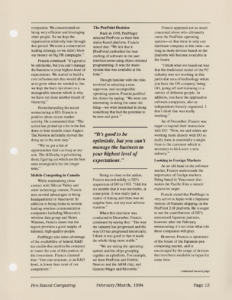
“It’s good to be optimistic, but you can’t manage the business to your
highest level of expectations.”
Being so close to the action, Francis reacted mildly to EO’s acquisition of GO in 1993. “I felt for six months that it was inevitable, at some point. It was really just a matter of timing and there was no surprise here, nor any real adverse reaction.”
When this interview was conducted in December, Francis continued by saying that: “The way the industry has progressed and the way GO has progressed historically, I think it was good in that it made the whole thing more stable.”
“We are seeing the operating system and the chips grouping together as a platform. For example, we have PenPoint and Hobbit, Newton and the ARM chip, and General Magic and Motorola.”
Francis appeared not so much concerned about who ultimately owns the PenPoint operating system—or that there is only one hardware company at this time—as long as more devices based on the platform will become available in the future.
“I think what we found out was that the traditional model of the PC industry was not working in this particular area of technology where you have the OS company, being GO, going off and licensing to a variety of different people. In addition, you have the application software companies, also as independents loosely organized. I don’t think that was really working.”
As of December, Francis was eager to expand their interaction with EO. “Now, we and others are working more closely with EO so really there is essentially a single front to the customer which is necessary to kick-start a new industry.”
Looking to Foreign Markets
As an old hand in the software market, Francis understands the importance of foreign markets. Being based in Vancouver also makes the Pacific Rim a natural expansion target.
Francis stated that PenMagic is very active in Japan with a Japanese version of Numero shipping on the PenPoint 2.0J platform. He is eager to see the contributions of EO’s announced Japanese partners, however after the February restructuring, it’s not clear what role these companies will play.
However, Francis is optimistic of the future of the Japanese pen computing market, and is encouraged by the range of devices that have been available in Japan for some time.
Francis also sees some fundamental challenges that must be met. “The reason why I believe they [the Japanese] haven’t been able to take it to full fruition is that most of those devices were really underpowered. I think they need more powerful hardware and platforms, however every Japanese company I know of is working on stuff in this area in one form or another.”
“Some of them are working with EO/GO, while some will be doing Microsoft related devices. Of course, General Magic has announced their partners. In some cases, such as Matsushita, I think they’ve announced the licensing of every one of them.”
Betting on the Apple Newton
In addition to their significant investment in PenPoint, PenMagic recently licensed their first pair of Newton products to StarCore, Apple’s new software publisher and distributor.
The products, marketed under the Money Magazine label, include: Money Magazine Business Forms, and Money Magazine Financial Assistant. Under the arrangement, StarCore performs all sales and marketing of the titles.
Francis stated that: “We are very keen on the Newton.” Summing up the Newton’s attraction, he said: “In a different way than PenPoint, it had some innovation that we felt we could use—and that Apple would use—to create some compelling new solutions for people.”
So how does development compare from a company that produces both PenPoint and Newton software? Francis found it difficult to compare the platforms for two reasons.
First, since they were involved early in both platforms, it’s difficult to separate out how much is development and how much is debugging the environment.
Also, Francis feels that the comparison may be unfair anyway. “Because of the nature of the Newton so far, the applications tend to be smaller. They tend to be less ambitious in a computing sense.”
“However, I was impressed at the Apple Developers Conference with the number of applications that people have turned over relatively quickly, and the wide variety of them.”
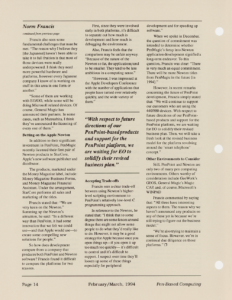
“With respect to future directions of our PenPoint-based products and
support for the PenPoint platform, we are waiting for EO to solidify their
revised business plan.”
Accepting Trade-offs
Francis sees a clear trade-off between using Newton’s higher-level scripting environment to PenPoint’s relatively low-level C programming approach.
In reference to the Newton, he stated that: “I think that to some degree there are some fences around things that might not allow some people to do what they’d really like to do. However, it may be a good strategy for Apple because once you open things up—if you open it up too much too quickly—it’s difficult to control and it’s difficult to support. I suspect over time they’ll loosen up some of these things especially for peripheral development and for speeding up software.”
When we spoke in December, the question of commitment was intended to determine whether PenMagic’s foray into Newton application development signified a long-term endeavor. To this question, Francis was clear: “There is very much an equal commitment. There will be more Newton titles from PenMagic in the future [in 1994].”
However, in recent remarks concerning the future of PenPoint development, Francis simply stated that: “We will continue to support our customers who are using the 440/880 devices. With respect to future directions of our PenPoint-based products and support for the PenPoint platform, we are waiting for EO to solidify their revised business plan. Then, we will take a fresh look at the revised business model for the platform revolving around the ‘smart telephone’ concept.”
Other Environments to Consider
Still, PenPoint and Newton are only two of many pen computing environments. Others worthy of consideration include GeoWork’s GEOS, General Magic’s Magic CAP, and, of course, Microsoft’s WINPAD.
Francis commented by saying that: “All three have interesting aspects to them. The reason why we haven’t announced any products on any of these yet is because we’re still trying to figure out the business model.”
“We’re also trying to maintain a sense of focus. However, we’re in continual due diligence on those platforms.”
Transcribed from Pen-Based Computing, Volume 4, Number 2 — March 1994. Pages 12, 13, 14.