
A Conversation with MobileSoft’s Pete Snell
From the Original Pages
Click a page to enlarge · Alt-click to open the full issue
Even though the new generation of personal digital assistants promise to reshape the way we work and communicate, some tasks are so universal that they are likely to appear in some form or another on any platform we can imagine.
Certainly, we are likely to continue communicating using written words, making some form of word processor a universal application. Likewise, in the business world, the fundamental need to manipulate numbers makes some type of spreadsheet a natural.
Peter Snell and his associates quickly recognized this need for the new Newton platform. In fact Snell, age 37, described the decision as almost a “no-brainer.”
However, the part that does require a lot of intelligence is turning the opportunity into a business. Snell, Vice President and co-founder of Campbell California-based MobileSoft, has done just that.
A Varied Background
Snell started innocently enough as a Stanford graduate working in the computer time-sharing industry. His trek in mobile computing started in 1982 as the first salesperson at laptop pioneer GRiD Systems. Snell came on board just prior to the shipping of the magnesium-cased GRiD Compass.
At GRiD, Snell was responsible for sales and product management, and also served as national sales manager for indirect channels (OEMs and VARs).
From GRiD, Snell went to terminal and computer manufacturer Wyse Technology—serving as regional sales manager—and then on to Granite Computer Products, a direct marketing and order fulfillment company.
“I asked: is [the Newton] a business tool, can this solve somebody’s business problem, will people open their wallet and pay money for this thing? And I said, yeah if it had a spreadsheet, people would pay money for this.”
Snell reflected on the experience by saying: “This, and being in charge of operations and marketing for GRiD, has given me both perspectives on the reseller channel. I’ve been a manufacturer who’s been selling into the channel, and I have also been the channel. Having been a reseller, I understand what their issues and concerns are.”
The Life of an ARTist
From Granite, Snell went on to Network General where he started a new division to concentrate on the entry level network analysis market. “I left that when I became smittened by the pen computing and mobility bug.”
Snell’s opportunity came in December, 1991 when a small company known as Advanced Recognition Technology (A.R.T.) set out to recruit him. He watched the demo and was impressed. “I said ‘Wow, this is amazing; this has incredible potential'”
Indeed, 1991 was an exciting time full of promise for the pen industry and Snell “got swept up into the whole whirlwind of activity that was going on around PenPoint as well.”
He recounted: “Jerry Kaplan was successful in getting a lot of people excited about pen computing, and by a lot of people, I mean not only people to come join his company, but venture capitalists, and licensees around the United States and Japan.”
Snell recalled that A.R.T. wanted to build a handwriting recognizer that was platform independent. However, Snell noted that: “The PenPoint environment turned out not to be independent recognizer friendly. It was difficult to get the recognizer to work well with it.”
He continued: “It’s not so much that the APIs were not well defined, but there was a decision made by the folks at GO about how much an independent recognizer should do and how much the PenPoint operating system should do.”
Snell concedes that: “At the time, with the information they had, it was probably the right decision for GO to make. However, it took so long for PenPoint to come out that recognizer companies had either become really good at, or had changed their opinion about this issue.”
Deja Vu All Over Again
It’s interesting to note that this is somewhat similar to the position faced by recognizer companies trying to crack the Apple Newton market.
In comparing the platforms, Snell observed that: “Apple is further down the spectrum. If you look at a spectrum of operating system vendors who support independent recognizers, Apple is on one side and Microsoft is on the other. Microsoft has a very open, published API to which anybody can develop.”
Indeed, by making the license for Windows for Pen Computing inexpensive, and its recognizer relatively expensive, Microsoft purposefully created a business model under which third-party recognizer parties could operate.
Snell summed it up by saying: “Like everything in life, there are pros and cons to both positions. In Apple’s case, I think they are trying to cram so much software in such a small space, and they have a limited number of people.”
Recognizing the Effort in Recognition
“Recognition takes a massive amount of effort, even as an operating system vendor, just to support APIs, publish them, and have developer services related to that is a tremendous effort. With all the things they [Apple] had to accomplish, that may be one where they said that we’ll just do that at a later date.”
Far from the typical criticism you hear from the press and early users, Snell is impressed with Apple’s efforts. “I personally believe that the recognizer in the Newton is far better than anything available on the market—and I’ve goofed around with a lot of them!”
He continued: “I’m a big believer in the word-based model of recognition, because I’ve come from the other field of character-based, and I’d much rather have an attempt to get a word and then give me a list of options.”
“This is much faster and easier on the user, in my opinion, than to write ten words and have six of them have one character wrong. To go in and change those characters is very frustrating.”
Snell noted: “The fact that in the MessagePad 110 they’ve added the ‘try by letters’ is a major feature boost which was needed, and have put them even further out in the lead in terms of recognition.”
The New Newton 110
From talking to Snell, it’s clear that the early Newton presented his company as much trouble as it did early owners. However, he appears quite pleased with Apple’s recent efforts.
“I think the Newton now, particularly the 110 or the new ROMs in the 100, makes the product very useful. In my opinion, it’s the first product that has crossed the line of being useful to people in the pen computing area—useful, with a combination of the right price point to give a good value.”
Snell continued: “I’m very pleased with the progress that’s been made, and I think we’re absolutely on the right trend to delivering usefulness and value to the market as opposed to just technology that might be brilliant but doesn’t solve anyone’s business problem at too high a price.”
Of course, it’s one thing to be excited about a technology. However, outside of his role as Vice President of Sales and Marketing, would he actually recommend this technology to a company. The answer: yes, with one or two caveats.
“Clearly, user’s expectations have to be set. This is a brand new product category—this is not a small notebook computer, it is not a cellular phone, it’s not a lot of things. It takes time for people to understand new things—they want to relate whatever comes out with something they are familiar with. The problem with this is that people tend to bring expectations with them.”
Snell stressed: “The first thing that needs to be done is that the expectations need to be set correctly, meaning that it is not a notebook computer, it does not have the power of a notebook computer, and you won’t use it for many of the things that you’d use a notebook computer for.”
“What it does very well though is that it is an excellent personal organizer that also gives you the ability to do some computing.”
Numbers on the Go
Snell shifted focus to MobileSoft’s early products for the Newton: “In our product, MobileMath and MobileCalc, you can do some very productive spreadsheet work.”
“There are software packages that are coming out that make you more productive, and the fact that you can carry around a 1 1/4 lbs. device is very convenient.”
During his time at A.R.T, Snell kept an eye on the new PDA market that was forming. In March, 1993, Snell decided it was time to leave A.R.T. and, together with Carleton Baab and Mark Kvamme, start MobileSoft.
In fact, Kvamme’s company, CKS Partners, was initially hired to help Apple with the roll-out of the Newton, which included programming the self-running demo for the PDA.
Snell recalled: “We decided that we could just do this as a project, or we could try to make this into a business. I asked: is this a business tool, can this solve somebody’s business problem, will people open their wallet and pay money for this thing? And I said, yeah if it had a spreadsheet, people would pay money for this.”
Snell observed: “It was very clear; there is a proven market for spreadsheets, people need to do budgeting and forecasting and what-if analysis. Not everyone needs to do it, but there certainly is a market out there for it. It’s the second largest application on the desktop after word processing.”
Somewhat jokingly, Snell recounted that: “The pen computing market, even at that time, was really a bust, a flat out bust.”
“Even though I had left GRiD, I had kept my ties and knew what they were doing. I really liked the GRiDPAD and I also liked the vision for it, which was not the computer for everybody and the ‘pen is the point.’ Instead, it was a vertical market product that absolutely solved the business problem for the people that bought it.”
Snell was adamant: “I still believe that the vision is very viable and will continue to grow. The problem came when GO, Microsoft, and everyone else inflamed the whole market; and the market went bust. However, even then, I felt there’s still an opportunity here.”
“Clearly, user’s expectations have to be set. This is a brand new product category—this is not a small notebook computer, it is not a cellular phone, it’s not a lot of things.”
“We felt that the single biggest barrier—besides the handwriting recognition and some of the other enabling technologies—is price.”
Snell observed: “When we started investigating the Newton, we felt it had a very good chance of being under $1000, and could even be driven down further. This, in fact, has been the case and is very compelling to us.”
The Great PR Machine
“We honestly didn’t believe all of Apple’s vision, but we sifted through the facts of what we understood the technology to be able to do and asked, could this be used by mobile professionals? Our conclusion was yes, absolutely.”
Snell continued: “We banked a lot of our business plan on Apple’s proven history of being able to get people excited about new technology and to educate them.”
So, how well has Apple performed so far?
Snell responded: “They did part of it successfully; with part of it, they really made some major mistakes. But, we need to hand a lot of the blame to Mr. Sculley who over-hyped the market…he set very high expectations.”
Snell confided: “August 2nd, 1993 became a religious date, a sacred date that could not be violated, regardless of common sense or reality. They should have started to deflate expectations; instead they rushed the product to market. It was clearly released well too early. As we know, there were substantial bugs in it and it wasn’t too useful.”
Snell lamented: “Why the computer industry needs to feel that they have to rush something out, even if it’s not a good product, to me it’s insanity. It’s a complete lack of common sense in my opinion. But yet, it’s not just Apple, many companies do this for fear of being left behind, I guess.”
Confusing the Message
Snell offered some particularly interesting insights on how an industry can become over-hyped.
“One thing we’ve learned in the computer business—at least in Silicon Valley and in Redmond—is we know how to paint a vision of the future that is very compelling, that is very attractive, that is very exciting.”
“And, as a result of that, it draws in people—people change careers or change jobs [editor’s note: or mortgage homes] to be part of making the vision happen. This leads venture capitalists to spend money on this, and in turn they also help this whole inflammatory process.”
Continuing, Snell noted: “The inflammatory process serves a useful purpose in that it gets people who can create the vision into the process. The bad news is that the same message, which is being received by the industry and acted on by the industry, is taken by the press and communicated out to the consumers.”
“The consumers get sucked up into these incredible stories about what’s going to happen in the future, and so they can’t help but have their expectations set awfully high. Unfortunately the computer industry has a rich history of not fulfilling on its vision and its commitment.”
“Steve Jobs did it correctly, at least initially, when he was doing the Lisa, the Mac, and even the NeXT, in that he had a deliberate purpose of trying to deliver a product and let the user of the product become surprised and delighted at what it could do.”
“And the product was insanely great, and it was really cool and people would get all excited about it. That’s a much more powerful force—you’ve set yourself up for failure when you go and tell everybody it’s going to do this, that, and the other thing.”
A New Approach
How does Snell feel about Microsoft’s new approach, especially with respect to the upcoming WinPad?
“Microsoft was part of the inflammatory get-everybody-whipped-up process, and much of that was to try to stop or slow down GO. But they’ve subsequently backed off quite a bit and lowered their public statements about what pen computing can do, which is very smart. That’s exactly what needs to be done.”
“We don’t need any more over-hyped potential users who are disappointed. All it does is set back the industry, it sets back the promise and delays the start of the adoption cycle, which is the absolute opposite of what we need.”
“What we need are properly set expectations. But I’ve been trying to figure out, how do you create an industry, how do you get all this money to be invested, how do you get licensees to sign up, how do you get software developers to write code, how do you get people to join your company, if you don’t paint a very promising picture of what the future holds.”
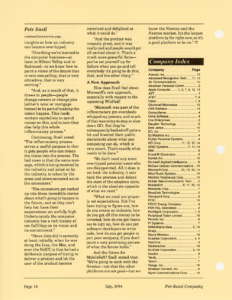
And the future for MobileSoft? Snell stated that: “We’re going to stick with the Newton—not that the other platforms are not good—but we know the Newton and the Newton market. It’s the largest platform far right now, so it’s a good platform to be on.”
Transcribed from Pen-Based Computing, Volume 4, Number 6 — July 1994. Pages 11, 12, 13, 14.