
Fujitsu’s Stylistic New Pen Computer
From the Original Pages
Click a page to enlarge · Alt-click to open the full issue
First Looks
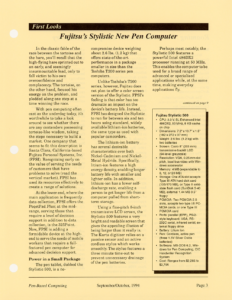
In the classic fable of the race between the tortoise and the hare, you’ll recall that the high-flying hare sprinted out to an early, and seemingly insurmountable lead, only to fall victim to his own overconfidence and complacency. The tortoise, on the other hand, focused his energy on the problem, and plodded along one step at a time winning the race.
With pen computing often cast as the underdog today, it’s worthwhile to take a look around to see whether there are any contenders possessing tortoise-like wisdom, taking the steps necessary to build a market. One company that seems to fit this description is Santa Clara, California-based Fujitsu Personal Systems, Inc. (FPSI). Recognizing early on the value of serving the needs of customers that have problems to solve (read the vertical market), FPSI has used its resources effectively to create a range of solutions.
At the lower end, where the main application is frequently data collection, FPSI offers the PoqetPad Plus; at the mid-range, serving those that require a level of decision support in addition to data collection, is the 325Point. Now, FPSI is adding a formidable device at the high-end to serve the needs of mobile workers that require a full-featured pen computer for advanced decision support.
Power in a Small Package
The pen tablet, dubbed the Stylistic 500, is a no-compromise device weighing about 2.6 lbs. (1.2 kg) that offers state-of-the-art performance in a package smaller in size than the Toshiba T200 series pen computers.
Unlike Toshiba’s T200 series, however, Fujitsu does not plan to offer a color screen version of the Stylistic. FPSI’s feeling is that color has too dramatic an impact on the device’s battery life. Instead, FPSI has designed the Stylistic to run for between six and ten hours using standard, widely available lithium-ion batteries, the same type as used with popular camcorders.
The lithium-ion battery has several desirable characteristics over both Nickel-Cadmium and Nickel-Metal Hydride. Specifically, lithium-ion features a high energy density, enabling longer battery life with smaller and lighter cells. In addition, lithium-ion has a lower self-discharge rate, enabling a person to get longer life from a computer pulled from short-term storage.
Using a fine-pitch 8-inch transmissive LCD screen, the Stylistic 500 features a very bright and readable screen that gives the appealing illusion of being larger than it really is. The Kurta digitizer rests on a passive sensor and an active cordless stylus which works smoothly. The stylus features a three minute time-out to prevent unnecessary drainage of the pen batteries.
Perhaps most notably, the Stylistic 500 features a powerful Intel 486DX2 processor running at 50 MHz. This enables the computer to be used for a broad range of advanced or specialized applications while, at the same time, making everyday applications fly.
Fujitsu Stylistic 500
- CPU: 3.3 V, SL Enhanced Intel 486DX2, 50 MHz, 8 KB cache on chip
- Dimensions: 7.2″ x 10.7″ x 1.5″ (182 x 272 x 37 mm)
- Weight: 2.6 lbs. (1.2 kg) with two batteries
- Screen: Casio 8″ (203 mm) transmissive backlit LCD (64-level greyscale)
- Resolution: VGA, 0.25 mm dot pitch, local bus video with Windows accelerator
- Memory: 4 MB (expandable to 8, 12, or 20 MB)
- Storage: One ATA slot accepts Type III ATA hard disk card (105/170 MB), or Type II solid-state flash card (SunDisk 5-40 MB), external 1.44 MB 3.5″ floppy
- PCMCIA: Two PCMCIA 2.0 slots, accepts two type I/II PCMCIA cards, or one Type III PCMCIA card
- Ports: parallel (EPP), PS/2-style keyboard, VGA, RS-232C serial, infrared serial, external floppy drive
- Battery: Lithium Ion
- Pen: Cordless, active pen (three 1.5V Silver Oxide batteries)
- Software: MS-DOS 6.2, Windows for Pen Computing, CIC Handwriter Recognition System
- Cost: Ranges from $2,285 to $2,795
While often not in direct competition with the new breed of high-powered laptops—also running at 50 MHz or more—FPSI understands the fact that customers nonetheless compare these laptops to the company’s pen-based products. FPSI is wisely making the purchasing decision of adopting a pen-based system a bit easier.
Using gas-injected, molded ABS plastic, FPSI has designed the Stylistic for active use in the field. The computer can also be protected using an optional fabric slipcase, or a foam laminate casing for even harsher environments.
Pricing and Availability
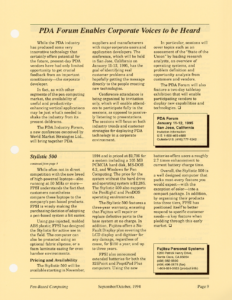
The Stylistic 500 will be available starting in November, 1994 and is priced at $2,795 for a system including a 105 MB PCMCIA hard disk, MS-DOS 6.2, and Windows for Pen Computing. The price for the system without the hard drive and operating system is $2,285. The Stylistic 500 also supports the PenRight! and PenDOS operating environments.
The Stylistic 500 features a three-year warranty, ensuring that Fujitsu will repair or replace defective parts to the base system at no charge. In addition, Fujitsu offers a No-Fault Display plan covering the LCD display and digitizer for any damage, regardless of cause, for $150 a year, and up to three years.
FPSI also announced extended batteries for both the 325Point and PoqetPad Plus computers. Using the new batteries offers users a roughly 2.7 times enhancement to current battery charge time.
Overall, the Stylistic 500 is a well designed computer that packs most every feature you would expect—with the exception of color—into a compact package. In addition, by organizing their products into three tiers, FPSI has positioned itself to better respond to specific customer needs—a key feature when plodding through this early market.
Fujitsu Personal Systems
5200 Patrick Henry Drive
Santa Clara, CA 95054
(408) 982-9500
(408) 496-0575 (fax)
1-800-831-3183 (product info)
Transcribed from Pen-Based Computing, Volume 4, Number 8 — October 1994. Pages 3, 9.