
A Conversation with Palm Computing’s Jeff Hawkins
From the Original Pages
Click a page to enlarge · Alt-click to open the full issue
Executive View
By John Jerney
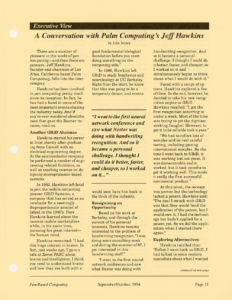
There are a number of pioneers in the world of pen computing—and then there are pioneers. Jeff Hawkins, founder and chairman of Los Altos, California-based Palm Computing, falls into the later category.
Hawkins has been involved in pen computing pretty much since its inception. In fact, he has had a hand in some of the most important events shaping the industry today. And if you’ve ever wondered about the man that gave the Zoomer its name, read on.
Another GRiD Alumnus
Hawkins started his career at Intel shortly after graduating from Cornell with an electrical engineering degree. At the semiconductor company he performed a number of engineering related functions, as well as teaching courses on designing microprocessor-based systems.
In 1982, Hawkins left Intel to join the mobile computing pioneer GRiD Systems, a company that has served as an incubator for a seemingly disproportionate amount of talent in the 1980’s. Here Hawkins learned about the nascent mobile marketplace while, in his spare time, pursuing his great interest—the human mind.
Hawkins recounted: “I had this huge interest in brains. In fact, just weeks ago, I gave a talk at Xerox PARC about brains and intelligence. I think you need to understand brains and how they are built with a good fundamental biological foundation before you start doing something on the computing side.”
In 1986, Hawkins left GRiD to study biophysics and neurobiology at UC Berkeley. Right from the start, he knew that this was going to be a temporary detour, and events would soon have him back in the thick of the industry.
Recognizing an Opportunity
Based on his work at Berkeley, and through the pursuit of his personal interests, Hawkins became interested in the problem of handwriting recognition. “I was doing some consulting work and during the summer of 87, I got interested in this handwriting stuff.”
“I went to the first neural network conference and saw what Nestor was doing with handwriting recognition. And so it became a personal challenge. I thought I could do it better, faster, and cheaper, so I worked on it…”
“I went to the first neural network conference and saw what Nestor was doing with handwriting recognition. And so it became a personal challenge. I thought I could do it better, faster, and cheaper, so I worked on it and simultaneously began to think about what I would do with it.”
Faced with a range of options, Hawkins explored a few of them. In the end, however, he decided to take his new recognition engine to GRiD. Hawkins recalled: “I got the first recognition occurring in under a week. Most of the time was trying to get the digitizer working [laughs]. However, to get it to be reliable took a year.”
“We had to collect lots of samples and do real careful testing, including getting international samples. By the time I went back to GRiD, it was working but not great. It was demonstrable and it worked, but it took months to get it working well. This made it really the first successful commercial product.”
At this point, the concept was proven but the technology lacked a patent. Hawkins said: “The deal I struck with GRiD was that they would fund the application of the patent, but I would own it. I had the technology but hadn’t applied for a patent yet. So we did the application when I started there again.”
Exploring Alternatives
Hawkins recalled that: “Before I went back to GRiD, I had talked to some venture capitalists about what I wanted to do with the pen and the interface. One of them pointed me towards GO [Corp]. That’s how I got in touch with them, and learned a bit about what they were doing.”
Describing his decision, Hawkins noted that: “I turned GO down because I felt that they were not being realistic in how they were starting a company and how they were going to do business. They were trying to take too academic an approach which, in hindsight, I can say is probably true.”
Pattern Matching Made Easy
At the time when Hawkins started work on his recognition system, there were precious few commercial models to guide him. However, his resulting algorithm has formed the basis of not only the GRiD recognizers, but also the technology behind Palm Computing’s products.
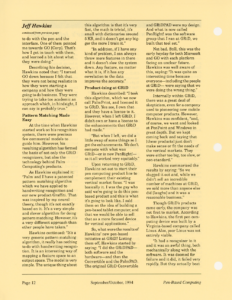
As Hawkins explained it: “Palm and I have a patented pattern matching algorithm which we have applied to handwriting recognition and our new product Graffiti. That was inspired by my neural theory, though it’s not exactly based on it. It’s a very simple and clever algorithm for doing pattern matching. However, it’s a very different approach than other people have taken.”
Hawkins continued: “It’s a very generic pattern matching algorithm, it really has nothing to do with handwriting recognition. It is an interesting way of mapping a feature space to an output space. The model is very simple. The unique thing about this algorithm is that it’s very fast, the math is trivial, it’s small with dictionaries around 5 KB, and it doesn’t get any bigger the more I train it.”
“In addition, if I have any kind of problem, I can always throw more features in there and it doesn’t slow the system down. Any feature, no matter what it is, if it has any correlation to the data improves the accuracy.”
Product-izing at GRiD
Hawkins described: “I took this algorithm, which we now call PalmPrint, and licensed it to GRiD. You see, I own that and they have a license to it. However, when I left GRiD, I didn’t own or have a license to the enhancements that GRiD had made.”
“But when I left, we did a little swap of some things so I got the enhancements. We don’t compete with what was GRiD—or is now PenRight!—so it all worked very equitably.”
Upon returning to GRiD, Hawkins set out to start their pen computing product line to complement their existing vertical market focus. “I was basically it. I was the guy who said we’re going to do this pen-based product and this is what it’s going to look like. I sold them on the idea of building a pen-based tablet computer, and that we would be able to sell that as a more focused device for vertical applications.”
So, what were the results of Hawkins’ new pen-based initiative at GRiD? Listing them off, Hawkins started by saying: “I did the GRiDPAD—both software and the hardware—and then the Convertible and the PalmPAD. The original GRiD Convertible and GRiDPAD were my design. And what is now called PenRight! was the software group that I ran at GRiD, we built that tool set.”
Not bad. Still, this was the early heyday for both Microsoft and GO with each platform facing an unclear future. Hawkins was well aware of this, saying: “It was quite an interesting time because everyone—including the people at GRiD—were saying that we were doing the wrong thing.”
Internally within GRiD, there was a great deal of skepticism, even for a company used to pioneering new mobile computer products. However, Hawkins was confident, “and, of course, we went and looked at PenPoint and Windows in great depth. But we kept coming back and saying that [these products] just don’t make sense or fit the needs of the vertical markets. They were either too big, too slow, or non-standard.”
Hawkins summarized the results by saying: “So we slugged it out and, while we didn’t sell an incredible number of machines at GRiD, we sold more than anyone else did [laughs] and it was a reasonable business.”
Though GRiD’s products came early, the company was not first to market. According to Hawkins, the first pen computing device was built by a Virginia-based company called Linus. Alas, poor Linus was not entirely viable.
“It had a recognizer in it and it was an awful thing, both mechanically along with the software. It was doomed for failure and it did, it failed very rapidly. But they actually beat us to market by six months or so. The GRiDPAD was the first machine that had any sort of commercial success.”
The “Post-it” Computer
Hawkins observed that: “The only success GRiD had in selling its laptops were into corporations using a direct sales force selling hundreds or thousands at a time. The whole company was structured around direct sales for corporate vertical applications.”
“That’s what GRiD knew and that’s what the proposal for the GRiDPAD was, except that this was to be for more mobile, data collection applications. We were doing some of that with the keyboard-based products already. People were mounting keyboard-based GRiD Compass computers in trucks and space shuttles.”
Hawkins mused: “We called it the “post-it” computer because the whole thing was in this little package that you could stick somewhere. That’s what they did with the space shuttle, they used velcro.”
While GRiD was firmly concentrating on the vertical—a market it understood well—Hawkins admitted keeping his eye on the competition. “I was worried about the competition from GO and Microsoft because we were losing mind-share since people kept saying that, while PenPoint wasn’t working today, we were eventually going to lose to these guys.”
“I kept saying no, we’re not going to lose to these guys because corporate developers are not going to want to write in PenPoint and they aren’t going to want these big machines that are too slow.”
Designing the Convertible
The idea for the now-famous GRiD Convertible was, in part, an acknowledgment to the power Microsoft exerts in any market that it chooses to enter. In designing a device to run Windows for Pen Computing, Hawkins recalled that: “I said to myself that it makes no sense to have a pure tablet Pen Windows machine. If we’re going to do that, let’s have a keyboard as well, with the pen as an accessory.”
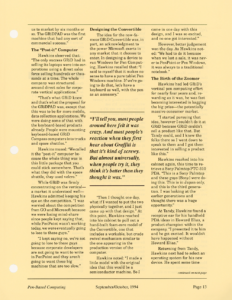
“I’ll tell you, most people around here felt it was crazy. And most people’s reaction when they first hear about Graffiti is that it’s kind of screwy. But almost universally, when people try it, they think it’s better than they thought it was.”
“Then I thought one day, what if I wanted to put the two physically together, and I just came up with that design.” At this point, Hawkins reached into his cabinet to pull out a hand-built foam-core model of the Convertible, one that includes a workable, but crude swivel mechanism similar to the one appearing in the production version of the computer.
Hawkins noted: “I made a little model with the original idea that this would be a semiconductor machine. So I came in one day with this design, and I was so excited, and no one got interested.”
However, better judgement won the day. As Hawkins noted: “We had to do it because when we lost a sale, it was never to PenPoint or Pen Windows, it was always to a traditional notebook.”
The Birth of the Zoomer
Hawkins had led GRiD’s vertical pen computing effort for nearly four years and, rewarding as it was, he was fast becoming interested in bagging the big prize—the potentially massive consumer market.
“I started pursuing that idea, however I couldn’t do it at GRiD because GRiD couldn’t sell a product like that. But Tandy could, and I knew the folks there so I went down to speak to them and I got them interested in selling a product like this.”
Hawkins reached into his cabinet again, this time to retrieve a Sony Palmtop PTC-310 PDA. “This is a Sony Palmtop and these guys [Sony] were doing this. This is in Japan only, and this is the third generation. I was looking at the earlier generations and thought there was a huge opportunity.”
At Tandy, Hawkins found a receptive ear for his handheld PDA ideas in Howard Elias, a product champion within the company. “I presented it to him and he got excited. It wouldn’t have happened without Howard Elias.”
Returning from Tandy, Hawkins next had to select an operating system for his new device. He spent some time exploring the GEOS system from GeoWorks and decided that the product was very strong technically, even if it was difficult to program.
Founding Palm Computing
By now, Hawkins realized that he would be better able to pursue his vision outside of GRiD. Raising between one and two million dollars in venture capital, Hawkins put together the core of Palm Computing. However, not everything happened in the order that you might expect.
Amusingly, Hawkins recalled that: “Howard Elias convinced Tandy to go for it, however this was after I started Palm. When I started Palm, we went with the assumption that something was going to happen and we would try to figure out the pieces.”
And what if Tandy had been overcome by cold feet? Hawkins replied: “I don’t know. I think the way to be successful in business is to start things before you have any idea how they’re going to turn out. And you basically place your bets.”
He continued: “You say “I’ll bet that this is going to be a really exciting area. And you start now and then opportunity comes to those in the right position, not to the people that figure it all out, because you can’t figure it all out. So, the Tandy deal did come through, and that’s how the Zoomer got started.”
And now, Graffiti…
Jumping ahead to today, Hawkins described his company’s newest product, Graffiti. “All my years in doing handwriting recognition, I’ve known that handwriting doesn’t work very well… So I thought, why don’t we just tell people how to write [a character].”
“I’ll tell you, most people around here felt it was crazy. And most people’s reaction when they first hear about Graffiti is that it’s kind of screwy. But almost universally, when people try it, they think it’s better than they thought it was.”
“We are calling it a ‘power writing option,’ it’s not handwriting, we say it’s a power writing option and it is an option. You can still use the on-screen keyboard, you can still use the ink and the handwriting recognition, and if you like, try this. And what we found is that when people try it, almost everyone loves it.”
A Rose is a Rose…
I asked Hawkins to recount an amusing story that he had told me earlier illustrating the importance of paying attention to naming things. Apparently, by GRiD edict, Hawkins had to select a code name for the new consumer device in a memo written to Tandy.
“I was repeating consumer pad, consumer pad, and then I said consumer, consumer, consumer, ah zoomer. So I wrote Zoomer at the top of this memo and this was six months or more before I left GRiD.”
“I hadn’t heard of the name [for some time after that]. I formed Palm and it was almost a year later when we were down at Tandy committing to do this product that they brought up their overhead about this new project called the Zoomer [laughs].”
“It was a total shock to me, a year later, and I’m seeing this word again and I know exactly where it came from. It was that one memo that I sent down. I never saw or though about it again, and it stuck.”
Transcribed from Pen-Based Computing, Volume 4, Number 8 — October 1994. Pages 11, 12, 13, 14.