
Is PenPoint the Way to GO? (Volume 1, Number 1)
From the Original Pages
Click a page to enlarge · Alt-click to open the full issue
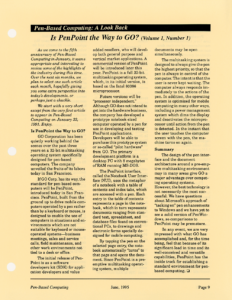
As we come to the fifth anniversary of Pen-Based Computing in January, it seems appropriate and interesting to review some of the highlights of the industry during this time. Over the next six months, we plan to select one such article each month, hopefully giving you some extra perspective into today’s developments, or perhaps just a chuckle.
We start with a very short excerpt from our first article to appear in Pen-Based Computing on January 22, 1991. Enjoy.
Is PenPoint the Way to GO?
GO Corporation has been quietly working behind the scenes over the past three years on a 32-bit multitasking operating system specifically designed for pen-based computers. The company unveiled the fruits of its labors today in San Francisco.
If GO Corp. has its way, the standard for pen-based computers will be PenPoint, introduced today in San Francisco. PenPoint, built from the ground up to drive mobile computers operated by a pen rather than by a keyboard or mouse, is designed to enable the use of computers in situations and environments which are not suitable for keyboard or mouse-operated systems—business meetings, sales and service calls, field maintenance, and other work environments not tied to a desk or office.
The initial release of PenPoint is as a software developers kit (SDK) for application developers and value added resellers, who will develop both general purpose and vertical market applications. A commercial version of PenPoint will be introduced later this year. PenPoint is a full 32-bit multitasking operating system, which, in its initial version, is based on the Intel 80386 microprocessor.
Future versions will be “processor independent.” Although GO does not intend to get into the hardware business, the company has developed a prototype notebook-sized computer operated by a pen for use in developing and testing PenPoint applications. Developers will be able to purchase this prototype system or so-called “pilot hardware” from GO. The primary development platform is a desktop PC with 8 megabytes of RAM running MS-DOS.
The PenPoint interface, called the Notebook User Interface (NUI), uses the metaphor of a notebook with a table of contents and index tabs, which are accessed with a pen. Each entry in the table of contents represents a page in the notebook, which in turn represents documents ranging from standard text, spreadsheet, and database files found on conventional PCs, to drawings and electronic forms specially designed for mobile computing.
By tapping the pen on the selected page entry, the notebook automatically “turns” to that page and opens the document. Since PenPoint is a preemptive multitasking operating system, multiple documents may be open simultaneously.
The multitasking system is designed to always give the pen the highest priority, so that the pen is always in control of the computer. The user is never kept waiting. The computer always responds immediately to the actions of the pen. In addition, the operating system is optimized for mobile computing in many other ways, including a power management system which dims the display and deactivates the microprocessor until action from the pen is detected. In the instant that the user touches the computer screen with the pen, the machine turns on again.
Summary
The design of the pen interface and the document architecture around a preemptive multitasking environment may in many areas give GO a major advantage over competing operating systems. However, the best technology is not necessarily the most successful. We have questions about Microsoft’s approach of “tacking on” pen enhancements to Windows and we have yet to see a solid version of PenWindows, so comparisons to PenPoint may be premature.
In any event, we are very impressed with what GO has accomplished and, for the time being, feel that because of its significant lead in time and its well-conceived and versatile capabilities, PenPoint has the inside track for establishing a standard environment for pen-based computing.
Transcribed from Pen-Based Computing, Volume 5, Number 6 — January 22, 1991. Page 9.