
Geoworks Scores Additional Wins
From the Original Pages
Click a page to enlarge · Alt-click to open the full issue
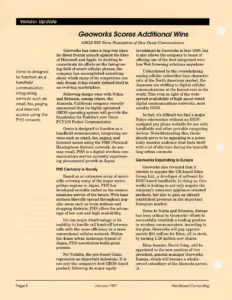
GEOS Will Form Foundation of New Genio Communicator
Geoworks has come a long way since its direct frontal assault against the likes of Microsoft and Apple. In deciding to concentrate its efforts on the fast-growing field of smart cellular phones, the company has accomplished something about which many of its competitors can only dream: it has clearly defined itself in an evolving marketplace.
Following design wins with Nokia and Ericsson, among others, the Alameda, California company recently announced that its highly optimized GEOS operating system will provide the foundation for Toshiba’s new Genio PCV100 Pocket Communicator.
Genio is designed to function as a handheld communicator, integrating services such as email, fax, paging, and Internet access using the PHS (Personal Handyphone System) network. As you may recall, PHS is a digital wireless communications service currently experiencing phenomenal growth in Japan.
“Genio is designed to function as a handheld communicator, integrating services such as email; fax, paging, and Internet access using the PHS network.”
PHS Certainly is Handy
Based on an extensive array of microcells covering many of the major metropolitan regions in Japan, PHS has developed enviable cachet as the communications service of the future. With base stations liberally spread throughout popular areas such as train stations and shopping districts, PHS offers the advantage of low cost and high availability.
It’s one major disadvantage is its inability to handle call hand-off between cells with the same efficiency as a more conventional cellular network. Within the dense urban landscape typical of Japan, PHS nonetheless holds great promise.
For Toshiba, the pen-based Genio represents an important milestone. It is not only the company’s first GEOS-based product, following its major equity investment in Geoworks in late 1995, but it also allows the company to boast of offering one of the first integrated wireless Web browsing solutions anywhere.
Unburdened by the overwhelming analog cellular subscriber base characteristic of the North American market, the Japanese are shifting to digital cellular communications at the fastest rate in the world. This even in light of the widespread availability of high-speed wired digital communications networks, most notably ISDN.
In fact, it’s difficult too find a major Tokyo intersection without an ISDN-equipped pay phone suitable for use with handhelds and other portable computing devices. Notwithstanding this, Genio should prove to be appealing to a potentially massive audience that finds itself with a lot of idle time during the typically long urban commute.
Geoworks Expanding in Europe
Geoworks also revealed that it intends to acquire the UK-based Eden Group Ltd., a developer of software for RISC-based handhelds. In doing so, Geoworks is looking to not only acquire the company’s consumer appliance-oriented products, but also to gain an already established presence in the important European market.
Home to Nokia and Ericsson, Europe has been critical to Geoworks’ efforts to successfully establish a leading position in wireless communicators. According to the plan, Geoworks will pay approximately $30 million for Eden, all in stock, by issuing 1.28 million new shares.
Eden founder, David Crisp, will be appointed to the new position of vice president, general manager Geoworks Europe, which will become a wholly-owned subsidiary of the Alameda parent.
Transcribed from Pen-Based Computing, Volume 7, Number 1 — January 1997. Page 8.