
Magic Reemerges From Drawing Board
From the Original Pages
Click a page to enlarge · Alt-click to open the full issue
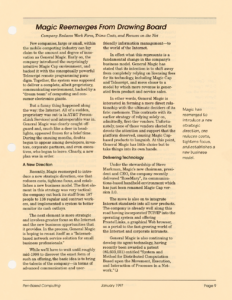
Company Reduces Work Force, Trims Costs, and Focuses on the Net
Few companies, large or small, within the mobile computing industry can lay claim to the amount and degree of innovation as General Magic. Early on, the company introduced the surprisingly intuitive Magic Cap environment, and backed it with the conceptually powerful Telescript remote programming paradigm. Together, the system was supposed to deliver a complete, albeit proprietary, communicating environment, backed by a “dream team” of computing and consumer electronics giants.
But a funny thing happened along the way: the Internet. All of a sudden, proprietary was out (a la AT&T PersonaLink Services) and interoperable was in. General Magic was clearly caught off-guard and, much like a deer in headlights, appeared frozen for a brief time. During the ensuing months, doubts began to appear among developers, investors, corporate partners, and even executives, who began to leave. Clearly, a new plan was in order.
A New Direction
Recently, Magic reemerged to introduce a new strategic direction, one that reduces costs, tightens focus, and establishes a new business model. The first element in this strategy was very tactical: the company cut back its staff from 187 people to 138 regular and contract workers, and implemented a system to better monitor its cash outlays.
“Magic has reemerged to introduce a new strategic direction, one reduces costs, tightens focus, and establishes a new business model.”
The next element is more strategic and involves greater focus on the Internet and the new business opportunities that it provides. In the process, General Magic is hoping to recast itself as a “Internet-based network service solution for small business professionals.”
While we’ll have to wait until roughly mid-1998 to discover the exact form of such an offering, the basic idea is to bring the talents of the company—in terms of advanced communication and user-friendly information management—to the world of the Internet.
In effect what this represents is a fundamental change in the company’s business model. General Magic has stated that its intention is to shift away from completely relying on licensing fees for its technology, including Magic Cap and Telescript, and move closer to a model by which more revenue is generated from product and service sales.
In other words, General Magic is interested in forming a more direct relationship with the ultimate deciders of its fate: customers. This contrasts with its earlier strategy of relying solely on, admittedly, first-tier vendors. Unfortunately, none of these vendors elected to devote the attention and support that the platform deserved, causing Magic Cap-based products to languish. At this point, General Magic has little choice but to take things into its own hands.
Delivering Technology
Under the stewardship of Steve Markman, Magic’s new chairman, president and CEO, the company recently delivered “RoseMary”, its communications-based handheld environment which has just been renamed Magic Cap version 3.0.
The move is also on to integrate Internet standards into all new products. The company is already well along this road having incorporated TCP/IP into the operating system and offering Presto!Links, a graphical Web browser, as a portal to the fast-growing world of the Internet and corporate intranets.
General Magic is also continuing to develop its agent technology, having recently been awarded a patent (#5,603,031) entitled “System and Method for Distributed Computation Based upon the Movement, Execution, and Interaction of Processes in a Network.”
Transcribed from Pen-Based Computing, Volume 7, Number 1 — January 1997. Page 9.