
UPS Goes PBC
From the Original Pages
Click a page to enlarge · Alt-click to open the full issue
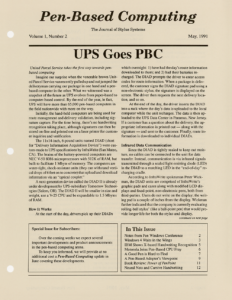
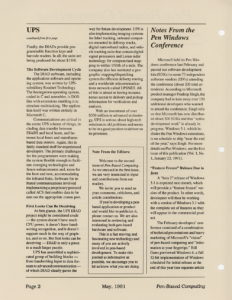
United Parcel Service takes the first step towards pen-based computing
Imagine our surprise when the venerable brown United Parcel Service van recently pulled up and out jumped the deliveryman carrying our package in one hand and a pen-based computer in the other. What we witnessed was a snapshot of the future as UPS evolves from paper-based to computer-based control. By the end of the year, in fact, UPS will have more than 65,000 pen-based computers in the field nationwide with more on the way.
Initially, the hand-held computers are being used for route management and delivery validation, including signature capture. For the time being, there’s no handwriting recognition taking place, although signatures can then be stored on-line and printed out on a laser printer for customer inquiries and verification.
The 11×14-inch, 6-pound units named DIAD (short for “Delivery Information Acquisition Device”) were custom-made to UPS specifications by InfraWrite (San Mateo, CA). The brains of the battery-powered computers are NEC V-50 8086 microprocessors with 512K of RAM, but built to facilitate 1 Mbyte of memory. The computers are water-tight, shock-resistant units (they can withstand vertical drops of 6 feet on to concrete) that upload and download information via an “optical coupler.”
A next-generation device called the DIAD II is already under development by UPS-subsidiary Tomorrow Technologies (Salem, OR). The DIAD II will be smaller in size and weight, use a V-25 CPU and be expandable to 1.5 Mbytes of RAM.
How It Works
At the start of the day, drivers pick up their DIADs which overnight: 1) have had the day’s route information downloaded to them; and 2) had their batteries recharged. The DIAD prompts the driver to enter access codes for route information. When a package is delivered, the customer signs the DIAD signature pad using a non-electronic stylus; the signature is displayed on the screen. The driver then requests the next delivery location, and so on.
At the end of the day, the driver inserts the DIAD into a rack where the day’s data is uploaded to the local computer while the unit recharges. The data is then uploaded to the UPS Data Center in Paramus, New Jersey. If a customer has a question about the delivery, the appropriate information is printed out — along with the signature — and sent to the customer. Finally, route information is downloaded to individual DIADs.
Infrared Data Communication
Since the DIAD is tightly sealed to keep out moisture, no cables can be connected to the unit for data transfer. Instead, communication is via infrared signals transmitted through a sealed light emitting diode (LED) in the DIAD to a matching LED in the “end-of-day” recharging cradle.
According to InfraWrite spokesman Peter Wickman, the DIAD units are comprised of InfraWrite’s graphic pads and cases along with modified LCD displays and fixed-point, non-electronic pens, both from third-parties. Users do not write on the display; the writing pad is a couple of inches from the display. Wickman further indicated that the company is currently evaluating rolling-ball stylus’ (like a ball-point pen) that would provide longer life for both the stylus and display.
Special Issue for Subscribers: Over the coming weeks we expect several important developments and product announcements in the pen-based computing arena. To keep you informed, we will provide at no additional cost a Pen-Based Computing update in June covering these developments.
Finally, the DIADs provide programmable function keys and barcode readers. In all, the units are being produced for about $1300.
The Software Development Cycle
The DIAD software, including the application software and operating system, was written by UPS-subsidiary Roadnet Technology. The homegrown operating system, coded in C and assembler, is DOS-like with extensions enabling it to simulate multitasking. The application itself was written entirely in Microsoft C.
Communications are critical to the entire UPS scheme of things, including data transfer between DIADS and local hosts, and between local hosts and mainframe-based data centers. Again, this is fairly standard stuff for experienced developers. The primary challenges for the programmers were making the system flexible enough to facilitate emerging technologies and future enhancements and, more for the here and now, accommodating the infrared links. Software for infrared communications involved implementing a proprietary protocol called ACS that enables data to be sent out the appropriate comm port.
First Looks Can Be Deceiving
At first glance, the UPS DIAD project might be considered crude — the system doesn’t have much CPU power, it doesn’t have handwriting recognition, and it doesn’t support much in the way of graphics, and so on. But first looks can be deceiving — DIAD is only a piece in a much larger puzzle.
UPS has assembled a sophisticated group of building blocks — from handwriting input to data formats to advanced communication — of which DIAD clearly paves the way for future development. UPS is also implementing imaging systems for label tracking, onboard computers mounted in delivery trucks, digital narrowband radios, and vehicle tracking units that contain digital signal processors and Loran radar technology for computerized mapping to within 1/10th of a mile. The company also has instituted a geographic mapping/dispatching system for efficient delivery routing and a worldwide telecommunications network called UPSNET. All of this is aimed at having instantaneous access to delivery and pickup information for verification and analysis.
With an investment of over $350 million in advanced technology, UPS is serious about high-tech solutions to old problems and seems to be in a good position to deliver on its promises.
Transcribed from Pen-Based Computing, Volume 1, Number 2 — May 1991. Pages 1, 2.