
Windows 4 Waits in the Wings
From the Original Pages
Click a page to enlarge · Alt-click to open the full issue
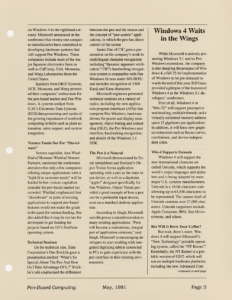
While Microsoft is actively promoting Windows 3.1 and its Pen Windows extensions, the company is also dangling the prospect of Windows 4, a full 32-bit implementation of Windows to be pre-released towards the end of this year. Bill Gates provided a glimpse of the features of Windows 4 at the Windows 3.1 developers’ conference.
First of all, Windows 4 or “Win-32” will support preemptive multitasking, multiple threads, and a virtually unlimited memory address space (2 gigabytes per application). In addition, it will have new graphics extensions such as Bezier curves, correlations, and device-independent color.
Win-4 Supports Unicode
Windows 4 will support the new international character set called Unicode, which supports the world’s major languages and alphabets and is being adopted by most major U.S. systems manufacturers. Unicode is a 16-bit character code allowing up to 65,536 characters to be represented. The current draft of Unicode contains over 27,000 characters. Unicode supporters include Apple Computer, IBM, Sun Microsystems, and others.
But Will It Brew Your Coffee?
But wait; there’s more. Windows 4 will support Microsoft’s “New Technology” portable operating system, called the “NT Kernel.” Essentially, the NT Kernel is a portable version of OS/2, which will run on multiple hardware platforms including the new Advanced Computing Environment based on Mips Computer’s R4000 RISC processor as well as on the Intel 80×86 line of processors. The NT Kernel will feature symmetric multiprocessing, fault tolerance, high security levels, and will probably brew your coffee automatically.
Windows 4 will include an “object oriented shell,” an “object oriented file system (OOFS),” new network interfaces, an external macro language, “object oriented development tools,” and visual macro recorder and programming tools.
According to Gates, migration of 16-bit Windows applications will be quite easy. According to Pen Windows product manager, Pradeep Singh, Windows 4 will require some “new drivers” but applications “won’t see the difference. It should be seamless; the APIs will carry over.”
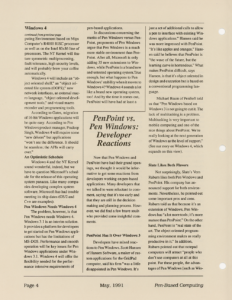
An Optimistic Schedule
Windows 4 and the NT Kernel sound wonderful, indeed, but we have to question Microsoft’s schedule for the release of this operating system panacea. Like many companies developing complex system software, Microsoft has had trouble meeting its ship dates (OS/2 and C++ are examples).
Pen Windows Needs Windows 4
The problem, however, is that Pen Windows needs Windows 4. Windows 3.1 is an interim solution. It provides a platform for developers to get started on Pen Windows applications but has the limitations of MS-DOS. Performance and smooth operation will be key issues for Pen Windows applications under Windows 3.1. Windows 4 will offer the flexibility needed for the performance intensive requirements of pen-based applications.
In discussions concerning the merits of Pen Windows versus PenPoint, proponents of Pen Windows argue that Pen Windows is a much more stable environment than PenPoint. After all, Microsoft is only adding 35 new extensions to Windows, while PenPoint is a brand new and untested operating system. True enough, but what happens to Pen Windows’ stability when it moves to Windows 4? Windows 4 sounds a lot like a brand new operating system, too!
Transcribed from Pen-Based Computing, Volume 1, Number 2 — May 1991. Pages 3, 4.