
Executive View: A Conversation with Fujitsu’s Lou Panetta
From the Original Pages
Click a page to enlarge · Alt-click to open the full issue
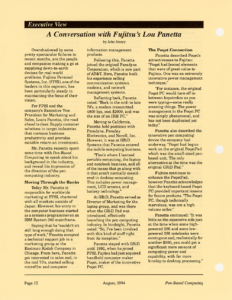
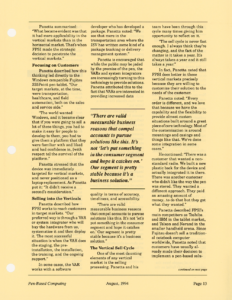
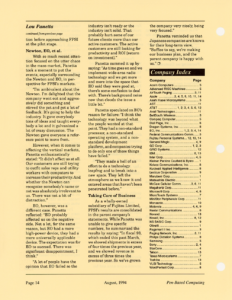
Overshadowed by some pretty spectacular failures in recent months, are the people and companies making a go at supplying down-to-earth devices for real-world problems. Fujitsu Personal Systems, Inc. (FPSI), one of the leaders in this segment, has been particularly steady in maintaining the focus of their vision.
For FPSI and the company’s Executive Vice President for Marketing and Sales, Louis Panetta, the road ahead is clear. Supply customer solutions in target industries that increase business productivity and provides suitable return on investment.
Mr. Panetta recently spent some time with Pen-Based Computing to speak about his background in the industry, and reveal his impression of the direction of the pen computing industry.
Moving Through the Ranks
Today Mr. Panetta is responsible for worldwide marketing at FPSI, chartered with all markets outside of Japan. However, his entry in the computer business started as a systems programmer on an IBM System 360 mainframe.
Saying that he “couldn’t sit still long enough doing that type of work,” Panetta accepted a technical support job in a marketing group at the Eastman Kodak Company in Chicago. From here, Panetta got interested in sales and, in the mid 70’s, started selling microfilm and computer information management products.
Following this, Panetta joined the original Paradyne Corporation, which is now part of AT&T. Here, Panetta built his experience selling communication systems, modems, and network management systems.
Reflecting back, Panetta noted: “Back in the mid- to late 70’s, a modem transmitted 4800 bps, cost $2000, and was the size of an IBM PC.”
Moving to California, Panetta held positions with Paradyne, Faraday Electronics, and Novell, Inc. However, it was at GRiD Systems that Panetta entered the mobile computing business.
“That’s where I learned portable computing, the laptop and notebook business, and all of the issues that go along with it that aren’t normally considered in desktop computing. This includes power management, LCD screens, and battery technology.”
At GRiD, Panetta served as Director of Marketing for the laptop group, and was there when the GRiD Pad was introduced, effectively launching the pen computing industry. In hindsight, Panetta noted: “So, I’ve been involved with this kind of stuff right from its inception.”
Panetta stayed with GRiD until 1992, when he joined FPSI. Fujitsu had just acquired handheld computer maker Poqet, maker of the innovative Poqet PC.
The Poqet Connection
Panetta described Poqet’s attractiveness to Fujitsu: “Poqet had [some] elements that were of great value to Fujitsu. One was an extremely innovative power management technique.”
“For instance, the original Poqet PC would turn off in between keystrokes as you were typing—some really amazing things. The power management in the Poqet PC was simply phenomenal, and has not been duplicated yet today.”
Panetta also described the innovative pen computing device the company had underway. “Poqet had begun work on the original PoqetPad which was the small-sized pen-based unit. The only alternative at the time was the original GRiD Pad.”
Fujitsu continues to enhance the PoqetPad, however Panetta acknowledges that the keyboard-based Poqet PC provided important lessons for future products. “The Poqet PC, though technically marvelous, was not a high volume seller.”
Panetta continued: “It was little on the expensive side just at the time when some high-powered 286 and some low-powered 386 notebooks were coming out and, realistically, for another $500, you could get a significant more amount of computing power and capability, with far more kinship to desktop processing.”
Panetta summarized: “What became evident was that it had more applicability in the vertical markets than in the horizontal market. That’s when FPSI made the strategic decision to penetrate the vertical markets.”
Focusing on Customers
Panetta described how this thinking led directly to the Windows compatible Fujitsu 325Point pen tablet. “Our target markets, at the time, were transportation, healthcare, and field automation, both on the sales and service side.”
“The world wanted Windows, and it became clear that if you were going to sell a lot of these things, you had to make it easy for people to develop to them, you had to give them a platform that they were familiar with and liked and had confidence in, [with respect to] the survival of the platform.”
Panetta stressed that the device was immediately targeted for vertical markets, and never positioned as a laptop replacement. As Panetta put it: “It didn’t receive a second’s consideration.”
Selling into the Verticals
Panetta described how FPSI works to reach customers in target markets. “Our preferred way is through a VAR or system integrator who will buy the hardware from us, systematize it and then deploy it. The most successful situation is when the VAR does the staging, the pre-installation, the installation, the training, and the ongoing support.”
In some cases, the VAR works with a software developer who has developed a package. Panetta noted: “We see that more in the transportation area where the ISV has written some kind of a package tracking or delivery management system.”
Panetta is encouraged that while the public may be jaded by the promise of the pen, the VARs and system integrators are increasingly turning to this technology to provide solutions. Panetta attributed this to the fact that VARs are interested in providing increased data quality in terms of accuracy, timeliness, and accessibility.
“There are valid measurable business reasons that compel accounts to pursue solutions like this. It’s not ‘let’s put something in the consumer segment and hope it catches on.’ Our segment is pretty stable because it’s a business solution.”
The Vertical Sell Cycle
One of the most daunting elements of any vertical market is the selling processing. Panetta and his team have been through this cycle many times giving him opportunity to reflect on it.
“The sell cycle is never fast enough. I always think they’re changing, and the fact of the matter is it takes a year. It’s always taken a year and it still takes a year.”
In fact, Panetta noted that FPSI does better in these vertical markets precisely because they are willing to customize their solution to the needs of the customer.
Panetta noted: “Every order is different, and we love that because we have the capability and the flexibility to provide almost custom situations built around a great piece of core technology. Most of the customization is around mountings and casings and things like that. We’ve done some integration in some cases.”
He continued: “There was a customer that wanted a non-standard radio. We built a new plastic back for the device and actually integrated it in there. There was another customer who didn’t like the way the pen was stored. They wanted a different approach. They paid an amazing amount of money…to do that but they got what they wanted.”
Panetta described FPSI’s main competitors as Toshiba and IBM in the tablet market, and Telxon and Norand in the smaller handheld arena. Since Fujitsu doesn’t sell a traditional notebook computer worldwide, Panetta noted that customers have usually already made their decision to implement a pen-based solution before approaching FPSI at the pilot stage.
Newton, EO, et al.
With so much recent attention focused on the utter chaos in the mass market, Panetta took a moment to put the events, especially surrounding the Newton and EO, in perspective for FPSI’s markets.
“I’m ambivalent about the Newton. I’m delighted that the company went out and aggressively did something and stirred the pot and got a lot of feedback. It’s going to help the industry. It gave everybody tons of ideas and taught everybody a lot and it galvanized a lot of crazy discussion. The Newton gave everyone a reference point to move from.
However, when it comes to affecting the vertical markets, Panetta enthusiastically stated: “It didn’t affect us at all. Our customers are still trying to outfit sales reps and utility workers with computers to increase their productivity. And whether the Newton can recognize somebody’s name or not was absolutely irrelevant to us. There was not a bit of distraction.”
EO, however, was a different case. Panetta reflected: “EO probably affected us on the negative side. Not a lot, for the same reason, but EO had a more high-power device, they had a more universally applicable device. The expectation was for EO to succeed. There was significant disappointment, I think.”
“A lot of people have the opinion that EO failed so the industry isn’t ready or the industry isn’t solid. That probably hurt some more than our active customers. The active customers are still looking for productivity and ROI [return on investment].”
Panetta summed it up by saying: “As time goes on and we implement wide-area radio technology and we get more and more into the space that EO said they were good at, there’s some confusion to deal with. There’s background noise now that clouds the issue a little bit.”
Panetta speculated on EO’s reason for failure: “I think the technology was beyond what the people wanted at that point. They had a non-standard processor, a non-standard operating system, and a non-standard development platform, and companies trying to do only one of those things have failed.
“They made a hell of an effort to do a technology leapfrog and to break into a new space. They left the atmosphere as we know it and entered areas that haven’t been penetrated before.”
Taking Care of Business
As a wholly-owned subsidiary of Fujitsu Limited, FPSI’s results are consolidated in the parent company’s statements. While Panetta was unable to give specific numbers, he summarized the results by saying: “In fiscal 93, which ended this past March, we showed shipments in excess of four times the previous year, and we showed revenue in excess of three times the previous year. So we’ve grown the company very nicely, being very focused.”
Panetta reminded us that Japanese companies are known for their long-term view. “Suffice to say, we’re making our business plan, and the parent company is happy with us.”
Transcribed from Pen-Based Computing, Volume 4, Number 7 — August 1994. Pages 12, 13, 14.