
Lexicus Releases Longhand Cursive Recognizer
From the Original Pages
Click a page to enlarge · Alt-click to open the full issue
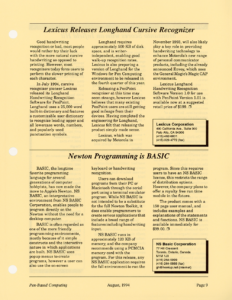
Good handwriting recognition or bad, most people would rather try their luck with the more natural cursive handwriting as opposed to printing. However, most recognizers today force users to perform the slower printing of each character.
In July 1994, cursive recognizer pioneer Lexicus released its Longhand Handwriting Recognition Software for PenPoint. Longhand uses a 25,000 word built-in dictionary and features a customizable user dictionary to recognize leading upper and all lowercase words, numbers, and popularly used punctuation symbols.
Longhand requires approximately 500 KB of disk space, and is writer-independent, enabling good walk-up recognition rates. Lexicus is also preparing a version of Longhand for the Windows for Pen Computing environment to be released in the fourth quarter of this year.
Releasing a PenPoint recognizer at this time may seem strange, however Lexicus believes that many existing PenPoint users are still getting good mileage from their devices. Having completed the engineering for Longhand, Lexicus felt that releasing the product simply made sense.
Lexicus, which was acquired by Motorola in November 1993, will also likely play a key role in providing handwriting technology to enhance Motorola’s new range of personal communicator products, including the already announced Envoy, which uses the General Magic’s Magic CAP environment.
Lexicus Longhand Handwriting Recognition Software Version 1.0 for use with PenPoint Version 1.01 is available now at a suggested retail price of $199.
Lexicus Corporation
490 California Ave., Suite 300
Palo Alto, CA 94306
(415) 462-6801
(415) 323-4772 (fax)
Transcribed from Pen-Based Computing, Volume 4, Number 7 — August 1994. Page 9.