
Graffiti Marks the Writing on the Wall
From the Original Pages
Click a page to enlarge · Alt-click to open the full issue
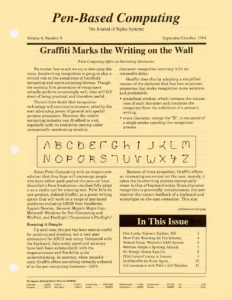
Palm Computing Offers an Interesting Alternative
No matter how much we try to downplay the issue, handwriting recognition is going to play a critical role in the acceptance of handheld computing and communicating devices. Though the existing first generation of recognizers actually perform surprisingly well, they still fall short of being practical and therefore useful.
There’s little doubt that recognition technology will continue to improve, aided by the ever advancing power of general and special purpose processors. However, the mobile computing industry can ill-afford to wait, especially with its credibility coming under unexpectedly penetrating scrutiny.

Enter Palm Computing with an elegant new solution that they hope will encourage people who have either pooh-poohed the pen—or have discarded it from frustration—to cheerfully adopt it as a viable tool for entering text. Palm bills its new product, dubbed Graffiti, as a power writing option that will work on a range of pen-based platforms including GEOS from GeoWorks, Apple’s Newton, General Magic’s Magic Cap, Microsoft Windows for Pen Computing and WinPad, and PenRight! Corporation’s PenRight!
Keeping it Simple
Up until now, the pen has been seen as useful for pointing and drawing, but a very poor alternative for ASCII text entry. Compared with the keyboard, data entry speed and accuracy have both been substandard, with the responsiveness and flexibility quite underwhelming. In contrast, when properly used, Graffiti offers something virtually unheard of in the pen computing business—100% character recognition accuracy with no noticeable delay.
Graffiti does this by adopting a simplified version of the alphabet that has two important properties that make recognition more accurate and predictable:
- predefined strokes, which increase the uniqueness of each character and insulates the recognizer from the subtleties of a person’s writing.
- every character, except the “X”, is composed of a single stroke speeding the recognition process.
Because of these properties, Graffiti effects an interesting conversion on the user, namely, it takes the handwriting process conceptually closer to that of keyboard entry. Since character recognition is practically instantaneous, the user receives the instant feedback of a keyboard and encourages on-the-spot correction. This also reduces the off-beat recognition errors that Newton’s word-based system frequently produces.
Like a Keyboard…
The keyboard model also shifts a bit of the burden from the computer to the user. This fact will probably be the main source of both the adulation and criticism of Graffiti. Much like the keyboard, users will no longer be justified in blaming the computer for mistakes in data entry. The increased accuracy comes at the price of having to learn a new skill akin to a short-hand.
Palm is aware of the trade-off and has conducted internal tests showing that users can achieve a useful level of competence with Graffiti in about 20 minutes, and can later achieve rates of up to 30 words per minute with 100% accuracy.
Users should also find it easier to enter punctuation marks and special symbols using Graffiti. The program also adopted a keyboard style for differentiating between upper and lower case by requiring users to “shift” Graffiti into upper case using an upstroke gesture.
By simplifying the characters and restricting each to a single stroke, Graffiti offers an interesting benefit that is difficult to match even using pen and paper. This is the ability to write characters on top of one another, in a very small space, without looking at the screen.
This makes the technology ideally suited for a new generation of even smaller communicating devices, such as advanced two-way paging systems, that are likely to come on line in the next two years.
When it comes to remembering Graffiti’s character set, Palm is upbeat, citing its very plausible internal studies that users recall about 97 percent of Graffiti’s alphabetic characters after a week away from the product.
Drawing Your Own Graffiti
The Graffiti package comes complete with an online tutorial and a help system, along with the recognition software. Graffiti is initially available for the GEOS (Zoomer) platforms, with the Apple Newton version available in the final quarter of 1994. Palm says that the General Magic version is ready to go and is waiting for the first Magic Cap devices to hit the market.
Graffiti is priced at $79, however if you are interested in experimenting with Graffiti, you can download a trial copy from America Online, CompuServe, the Internet, or get one direct from Palm Computing by calling 1-800-991-PALM. Users using vertical applications developed for PenRight! can also obtain a version for evaluation.
Palm promises that the Windows and WinPad versions of Graffiti are under development and should be available sometime next year.
Transcribed from Pen-Based Computing, Volume 4, Number 8 — October 1994. Pages 1, 2.