
A Survey of Fujitsu’s Vertical Approach
From the Original Pages
Click a page to enlarge · Alt-click to open the full issue
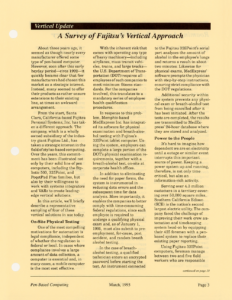
About three years ago, it seemed as though nearly every manufacturer offered some type of pen-based computer. However, soon after this early heyday period—circa 1992—it quickly became clear that few manufacturers had chosen this market as a strategic interest. Instead, many seemed to offer their products as rather unsure extensions to their existing line, at times an awkward arrangement.
From the start, Santa Clara, California-based Fujitsu Personal Systems, Inc. has taken a different approach. The company, which is a wholly owned subsidiary of the industry giant Fujitsu Ltd., has taken a strategic interest in the field of stylus-based computing. Over the years, this commitment has been illustrated not only by their solid line of pen computers, including the Stylistic 500, 325Point, and PoqetPad Plus families, but also by their willingness to work with systems integrators and VARs to create leading-edge vertical solutions.
In this article, we’ll briefly describe a representative sampling of four of these vertical solutions in use today.
On-Site Physical Testing
One of the most compelling motivations for automation is legal compliance, independent of whether the regulation is federal or local. In cases where compliance involves a large amount of data collection, a computer is essential and, in many cases, a mobile computer is the most cost effective.
With the inherent risk that comes with operating any type of heavy machinery—including airplanes, mass transit vehicles, trains, and large trucks—the U.S. Department of Transportation (DOT) requires all employees of such companies to meet minimum fitness standards. For the companies involved, this translates to a mandatory series of employee health qualification procedures.
In response to this problem, Memphis-based MedExpress Inc. has integrated its software for physical examination and breath-alcohol testing with Fujitsu’s 325Point tablet computer. Using the system, employers can complete a large portion of the DOT’s physical examination requirements, together with a breath-alcohol test, on-site at corporate health offices.
In addition to eliminating the need for paper forms, the system is instrumental in reducing data errors and the subsequent time for data analysis. More importantly, it enables the companies to better comply with time-consuming federal regulations, since each employee is required to undergo a qualifying physical exam and, as of January 1, 1995, must also submit to pre-employment, for-cause, post accident, and random breath alcohol testing.
In the case of breath-alcohol testing, a qualified technician enters an encrypted password before starting the test. An instrument connected to the Fujitsu 325Point’s serial port analyzes the amount of alcohol in the employee’s lungs and returns a result in about two minutes. Likewise for physical exams, MedExpress’ software prompts the physician with step-by-step instructions, ensuring strict compliance with the DOT regulations.
Additional security within the system prevents any physical exam or breath-alcohol test from being cancelled after it has been initiated. After the tests are completed, the results are transmitted to MedExpress’ 24-hour database where they are stored and analyzed.
Power to the People
It’s hard to imagine how dependent we are on electricity until a outage or similar event interrupts this important source of power. Keeping a power system up and running, therefore, is not only time critical, but also an information-rich activity.
Serving over 4.3 million customers in a territory covering over 50,000 square miles, Southern California Edison (SCE) is the nation’s second largest electric utility. The company faced the challenge of improving their work crew automation and timekeeping system head-on by equipping their 425 foremen with a pen-based system to replace their existing paper reporting.
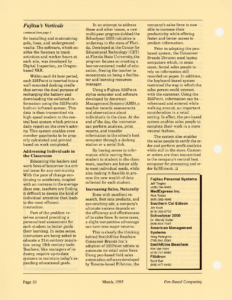
Using Fujitsu 325Point computers, foreman manage between two and five field workers who are responsible for installing and maintaining pole, lines, and underground vaults. The software, which enables the foremen to track activities and worker hours at each site, was developed by Digital Inspection, an Oregon-based VAR.
Within each 24 hour period, each 325Point is inserted into a wall-mounted docking cradle that serves the dual purpose of recharging the battery and downloading the collected information using the 325Point’s built-in infrared system. This data is then transmitted via high-speed modem to the central host system which prints a daily report on the crew’s activity. This system enables crew member paychecks to be properly calculated and printed based on work completed.
Addressing Individuals in the Classroom
Educating the leaders and work force of tomorrow is a critical issue for any community. With the pace of change continuing to accelerate, coupled with an increase in the average class size, teachers are finding it difficult to devote the kind of individual attention that leads to the most efficient instruction.
Part of the problem revolves around providing a personalized assessment for each student to better guide their learning. In some sense, instructors are being asked to educate a 21st century population using 19th century tools. Teachers, like managers of industry, require up-to-date systems to maintain today’s expanding educational goals.
In an attempt to address these and other issues, a new multi-year program dubbed the Schoolyear 2000 initiative is underway in the state of Florida. Developed at the Center for Educational Technology (CET) at Florida State University, the program focuses on creating a learner-centered model of education, freeing the teacher to concentrate on being a facilitator and learning resources manager.
Using a Fujitsu 325Point stylus computer and software developed by American Management Systems (AMS), a teacher records assessments and observations about individuals in the class. At the end of the day, the instructor can perform analysis, print reports, and transfer information to the school’s host computer through a docking station or a serial link.
By having access to information while moving from student to student in the classroom, teachers are better able to make individual needs, while also making it feasible to process the new wealth of data collected for each student.
Increasing Sales, Naturally
Even with excellent research, first rate products, and eye-catching ads, a company’s ultimate success depends on the efficiency and effectiveness of its sales force. In some cases, a slight competitive advantage can turn into major returns.
This is clearly the thinking behind SmithKline Beecham Consumer Brands Inc.’s adoption of 325Point tablets to automate its retail sales force. Using pen-based field sales automation software developed by Toronto-based Filbitron, the company’s sales force is now able to increase their productivity while offering faster and better access to product information.
Prior to adopting the pen-based system, the Consumer Brands Division used laptop computers which, in some cases, forced sales people to rely on information still recorded on paper. In addition, the keyboard-based system restricted the way in which the sales person could interact with the customer. Using the 325Point, information can be referenced and entered while walking around, an important consideration in a retail setting. In effect, the pen-based system enables sales people to complete their work in a more natural fashion.
The system also enables the sales people to verify the order and perform profit analysis while still in the store. Customer orders are then transmitted to the company’s central host computer for processing and order fulfillment.
Fujitsu Personal Systems — Jeff Tingley, (408) 764-9465
MedExpress Inc. — Rick Tobias, (901) 362-4646
Southern Cal Edison — Jim Koch, (818) 302-0753
Schoolyear 2000 — Dr. Wendy Cullar, (904) 644-7447
American Management Systems — Greg Pellegrino, (703) 841-5541
SmithKline Beecham — Kim Van Horn, (416) 741-8080
Filbitron — Scott Ball, (905) 477-0450
Transcribed from Pen-Based Computing, Volume 5, Number 3 — March 1995. Pages 3, 10.