
A Conversation with AllPen’s Wayne Yurtin
From the Original Pages
Click a page to enlarge · Alt-click to open the full issue
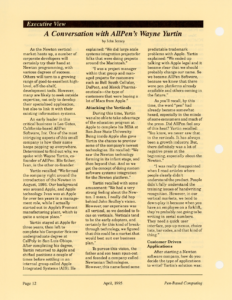
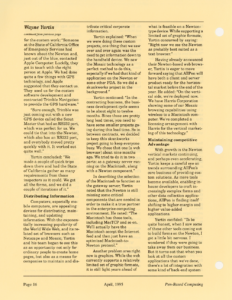
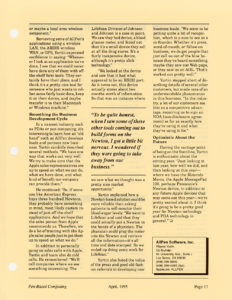
As the Newton vertical market heats up, a number of corporate developers will certainly try their hand at Newton programming, with various degrees of success. Others will turn to a growing range of good-to-excellent high-level, off-the-shelf, development tools. However, many are likely to seek outside expertise, not only to develop their specialized application, but also to link it with their existing information systems.
An early leader in this critical business in Los Gatos, California-based AllPen Software, Inc. One of the most intriguing aspects of this small company is how their name keeps popping up everywhere. Determined to find out why, we spoke with Wayne Yurtin, co-founder of AllPen. His father, Ivan, is the other co-founder.
Yurtin recalled: “We formed the company right around the introduction of the Newton in August, 1993. Our background was around Apple, and Apple technology. Ivan was at Apple for over ten years in a management role, while I actually started out in Apple’s Fremont manufacturing plant, which is quite a unique place.”
Yurtin stayed at Apple for three years, then left to complete his Computer Science undergraduate degree at CalPoly in San Luis Obispo. After completing his degree, Yurtin returned to Apple and shifted positions a couple of times before settling in an internal group called Apple Integrated Systems (AIS). He explained: “We did large scale systems integration projects for folks that were doing projects around the Macintosh.”
“I was a project manager within that group and managed projects for customers such as Bell South Cellular, DuPont, and Merck Pharmaceuticals—the type of customers that were buying a lot of Macs from Apple.”
Attacking the Verticals
During this time, Yurtin was also able to take advantage of the education program at Apple to complete his MBA at San Jose State University. Being inside Apple also gave Yurtin the chance to preview some of the company’s newest technologies. He recalled: “We saw the Newton technology forming in its infant stage, and then beyond that. And so we got the concept of doing custom software systems integration for the Newton platform.”
Yurtin recalled with some amusement: “We had a very strong feeling about the Newton. I mean, I really did hop behind John Sculley’s vision. However, our experience was all vertical, so we decided to focus on verticals. Verticals tend to be the early adopters, and certainly for this kind of breakthrough technology, we figured that this could be a market that would best suit our business plan.”
To pursue this vision, the father and son team spun-out and founded a company called Newtonian Technologies. However, this name faced some predictable trademark problems with Apple. Yurtin explained: “We ended up talking with Apple legal and it became clear that we should probably change our name. So we became AllPen Software, because we knew that there were pen platforms already available and others coming in the future.”
As you’ll recall, by this time, the word “pen” had already became somewhat hexed, especially in the minds of some consumers and much of the press. Did AllPen feel any of this heat? Yurtin recalled: “You know, we never saw that in the verticals. It has always been a growth industry. But, there definitely was a lot of negative press at the beginning, especially about the Newton.”
“I was really disappointed when I read articles where people clearly didn’t understand the product. People didn’t fully understand the training issues of handwriting recognition. However, in our vertical markets, we tend to down-play it because when you have an employee on a forklift, they’re probably not going to be writing in serial numbers. They need a quick user interface, pop-up menus, choice lists, bar codes, and that kind of thing.”
Customer Driven Applications
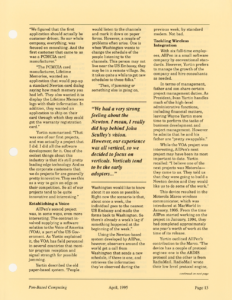
After starting a Newton software company, how do you decide the type of applications to write? Yurtin’s solution was: “We figured that the first application should actually be customer driven. So our whole company, everything, was focused on consulting. And the first customer that came to us was a PCMCIA card manufacturer.”
“The PCMCIA card manufacturer, Lifetime Memories, wanted an application that would pop-up a standard Newton card dialog saying how much memory you had left. They also wanted it to display the Lifetime Memories logo with their information. In addition, they wanted an application to ship on their card through which they could get the warranty registration card.”
Yurtin summarized: “That was one of our first projects, and was actually a project that I did. I did all the software development for it. One of the coolest things about this industry is that it’s still pretty young and leading edge technology. And so the corporate customers that we do projects for are generally pretty innovative. They see this as a way to gain an edge on their competition. So all of our projects tend to be quite innovative and interesting.”
Establishing a Voice
AllPen’s second project was, in some ways, even more interesting. The contract involved supplying a software solution to the Voice of America (VOA), a part of the US Government. As Yurtin explained it, the VOA has field personnel in several countries that monitor program reception and signal strength for possible jamming.
Yurtin described the old paper-based system. “People would listen to the channels and mark it down on paper forms. However, a couple of problems often arise. One is when Washington wants to change the schedule of the people listening to the channels. This person may not live near the US Embassy, they may be in a remote village. So, it takes quite a while to get new schedules to these folks.”
“Then, if jamming or something else is going on, Washington would like to know about it as soon as possible. Right now the scenario is that, about once a week, the individual goes to the nearest US Embassy and mails the forms back to Washington. So there’s already a week’s lag if something happened at the beginning of the week.”
“Using the Newton-based system developed by AllPen, however, observers around the world get a call from Washington that sends a new schedule, if there is one, and retrieves the information they’ve observed during the previous week, by standard modem. Not bad.”
“We had a very strong feeling about the Newton. I mean, I really did hop behind John Sculley’s vision. However, our experience was all vertical, so we decided to focus on verticals. Verticals tend to be the early adopters…”
Tackling Wireless Integration
With six full-time employees, AllPen is a small software company by conventional standards. However, Yurtin prefers to manage the growth of the company and hire consultants as needed.
In terms of management, father and son share certain project management duties. As President, Ivan Yurtin handles much of the high-level administrative functions, including financial matters, leaving Wayne Yurtin more time to perform the tasks of business development and project management. However he admits that he and his father are “pretty swappable.”
While the VOA project was interesting, AllPen’s next project may have been its most important to date. Yurtin recalled: “I believe one of the next projects was Motorola—they came to us. They told us that they were going to build a Newton device and they would like us to do some of the work.”
This device resulted in the Motorola Marco wireless communicator, which was introduced at MacWorld in January, 1995. From the time AllPen started working on the project in January, 1994, they had completed approximately one year’s worth of work at the time of its release.
Yurtin outlined AllPen’s contribution to the Marco. “The device has a couple of protocol engines: one is the ARDIS protocol and the other is from RadioMail. RadioMail wrote their low level protocol engine, but we did the ARDIS one. So whenever you send or receive data using ARDIS on the Marco, it’s going through our code which is in the ROM of the device.”
Yurtin described the project as: “kind of slick. We learned a lot about the intimate details of the Marco and about low level communication and wireless intricacies. We used NewtonScript, and Motorola did the level below that, which was programmed using all the C tools that they have. We didn’t have access to that.”
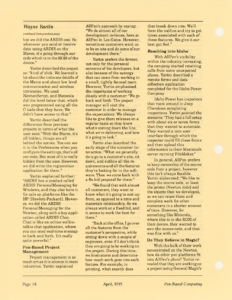
Yurtin described the differences from previous projects in terms of what the user sees: “With the Marco, it’s all hidden, things are all behind the scenes. You can see it in the Preferences when you configure the settings, that’s all our code. But most of it is really hidden from the user. However we did write the registration application for them.”
Yurtin explained further: “ARDIS has a product called ARDIS PersonalMessaging for Windows, and they also have it for sale on platforms like the HP [Hewlett-Packard]. However, we did the ARDIS PersonalMessaging for the Newton, along with a key application called ARDIS Chat. Chat is like an online walkie-talkie chat application, where you can send real-time messages back and forth. It’s really quite powerful.”
Pen-Based Project Management
Project management is as much art as it is science in most industries. Yurtin explained AllPen’s approach by saying: “We do almost all of our development in-house, here at AllPen in Los Gatos. However, sometimes customers want us to be on site and do some of our development there.”
Yurtin prefers the former, not only for the personal concerns of his developers, but also because of the synergy that can come from working in a small, tightly focused team. However, Yurtin emphasized the importance of working closely with a customer: “We go back and forth. The project manager will visit the customer in order to manage the expectations. We always like to give them releases on a regular basis so they know what’s coming down the line, what we’re delivering, and how it’s going to look.”
Yurtin also described the early stage of the customer interaction. “What we generally do is go to a customer’s site, sit down, and outline all the requirements and all the features they’re looking for in the software. Then we come back with a fix bid proposal for them.”
“We found that with almost all customers, they want to know what it’s going to cost up front, as opposed to a time and materials relationship. So we always work on a fixed bid, and it seems to work the best for them.”
“Back at the office, I go over all the features from the customer’s perspective, while sitting down with a couple of engineers, even if I don’t think they are going to be working on the project. During this time, we brainstorm and determine how much work goes into each feature. For example, in printing, what exactly does that break down into. We’ll form the outline and try to get times associated with each of these features. We give it our best gut feel.”
Reaching into Idaho
With AllPen’s visibility within the industry increasing, the company started receiving calls from some unexpected places. Yurtin described a remote forms and data collection application completed for the Idaho Power Company.
Idaho Power has inspectors that roam around in Jeep Cherokees completing inspections. Yurtin painted the scenario: “They had a full setup with about six or seven forms that they wanted to automate. They wanted a nice user interface through which the inspector could fill these forms and then upload this information to their Macintosh server running FileMaker.”
In general, AllPen prefers to keep ownership of the source code from a project, however this isn’t always feasible. Yurtin elaborated: “We like to keep the source code, at least the protos [Newton code] and the objects that we developed, so we can reuse them and complete work for other customers in a shorter amount of time. However, for something like Motorola, where this is in the ROM of their device, they wanted to own the source code, and that was fine with us.”
Do They Believe in Magic?
With the bulk of their work concentrated on the Newton, how do other pen platforms fit into AllPen’s plans? Yurtin revealed that they are working on a project using General Magic’s Magic Cap environment. Unable to elaborate about the project since it is under non-disclosure, Yurtin did describe some of their impressions in working with the new platform: “We had two of our engineers go through the General Magic developer course, and we have their development environment and tools, along with a few Sony Magic Links in-house.”
Yurtin recalled that it was an uphill battle to sell the idea of vertical applications to General Magic. Yurtin recounted: “We thought we had a lot to offer them in the vertical market. Unfortunately that sales pitch didn’t work because they really weren’t looking at these markets very much.”
“However, about three of four months after those conversations, they opened the doors and we came in to show them some of the things we’ve done in the Newton arena, and in the vertical industry. They were pretty excited and invited us to go through their development class.”
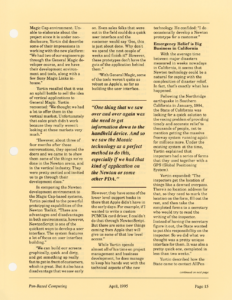
In comparing the Newton development environment to the Magic Cap-based systems, Yurtin pointed to the powerful prototyping capabilities of the Newton Toolkit. “There are advantages and disadvantages in both environments, however, NewtonScript is one of the quickest ways to develop a user interface. The system features a lot of focus on user interface building.”
“We can build our screens graphically, quick and dirty, and get something up really fast to get in front of customers, which is great. But it also has a disadvantage that we saw early on. Even sales folks that were out in the field could do a quick user interface and the customer would say ‘Gee, this is just about done. Why don’t we spend the next couple of weeks and finish it?’ However, these prototypes don’t have the guts of the application behind them.”
“With General Magic, some of the tools weren’t quite as robust as Apple’s, as far as building the user interface.”
“One thing that we saw over and over again was the need to get information down to the handheld device. And so we saw the Mosaic technology as a perfect method to do this, especially if we had that kind of application on the Newton or some other PDA.”
“However, they have some of the lower level support hooks in there that Apple didn’t have in the early days. For example, if I wanted to write a custom PCMCIA card driver, I couldn’t do that through NewtonScript. But there are some new things coming from Apple that will give us some of that low level access.”
While Yurtin spends almost all of his time on project management and business development, he does manage to keep his hands wet with the technical aspects of the new technology. He confided: “I do occasionally develop a Newton prototype for a customer.”
Emergency Relief is Big Business in California
With the average time between major disasters measured in weeks nowadays in California, it seems that Newton technology could be a natural for coping with the complexities of disaster relief. In fact, that’s exactly what has happened.
Following the Northridge earthquake in Southern California in January, 1994, the State of California was looking for a quick solution to the vexing problem of providing timely and accurate relief to thousands of people, not to mention getting the massive freeway system running again for millions more. Under the existing system at the time, Yurtin explained that inspectors had a series of forms that they used together with a GPS (Global Positioning System).
Yurtin expanded: “The inspectors get the location of things like a downed overpass. There’s no location address for that, so they need to mark the location on the form, fill out the rest, and then take the completed forms to a secretary who would try to read the writing of the inspector. Instead of having the secretary figure it out, the State wanted to put this responsibility on the inspector. So we did what we thought was a pretty unique interface for them. It was also a pretty quick one, completed in less than two weeks.”
Yurtin described how the State came to contact AllPen for the custom work: “Someone at the State of California Office of Emergency Services had known about the Newton and, just out of the blue, contacted Apple Computer. Luckily, they got in touch with the right person at Apple. We had done quite a few things with GPS technology, and Apple suggested that they contact us. They used us for the custom software development and contracted Trimble Navigation to provide the GPS hardware.”
“Sure enough, Trimble was just coming out with a new GPS device called the Scout Master that had an RS232 port, which was perfect for us. We could tie that into the Newton, which also has an RS232 port, and everybody moved pretty quickly with it. It worked out quite well.”
Yurtin concluded: “We made a couple of quick trips down there and had the State of California gather as many requirements from these inspectors as it could. We got all the forms, and we did a couple of iterations of it.”
Distributing Information
Computers, especially mobile computers, are appealing devices for distributing, maintaining, and updating information. With the exponentially increasing popularity of the World Wide Web, and its related set of browsers such as Netscape and Mosaic, Yurtin and his team began to see this as an opportunity not only for ordinary people to create home pages, but also as a means for companies to maintain and distribute critical corporate information.
Yurtin explained: “When we were doing these custom projects, one thing that we saw over and over again was the need to get information down to the handheld device. We saw the Mosaic technology as a perfect method to do this, especially if we had that kind of application on the Newton or some other PDA. So we did a skunkworks project in the background.”
Yurtin continued: “In the contracting business, the business development cycle seems to be about eight to twelve months. Since those are pretty long lead times, you need to have some smaller projects going during this lead time. So in between contracts, we decided to keep this skunkworks project going to keep everyone busy. We chose that one [a web browser] about nine months ago. We tried to do it in two parts: as a gateway server running on the Macintosh, along with a Newton component.”
In describing the selection of the Macintosh to function as the gateway server, Yurtin noted that the Newton is still missing several critical components that are needed in order to make it a true partner in the enterprise computing environment. He noted: “The Macintosh has those tools, including MacTCP and so on. We’ll actually have the Macintosh accept the Internet feed and then just have an optimized Macintosh-to-Newton protocol.”
“Another problem area right now is graphics. While the web currently supports a relatively limited set of graphic formats, it is still light years ahead of what is feasible on a Newton-type device. While supporting a limited set of graphic formats, Yurtin concurred by saying: “Right now we see the Newton as probably best suited as a text browser.”
Having already announced their Newton-based web browser, Yurtin is eager to move forward saying that AllPen will have both a client and server product ready for the horizontal market before the end of the year. He added: “On the vertical side, we’re deployed now. We have Harris Corporation showing some of our Mosaic browsing capabilities using wireless to a Macintosh computer. We’ve completed a licensing arrangement with Harris for the vertical marketing of this technology.”
Maintaining competitive Advantage
With growth in the Newton vertical markets continuing, and perhaps even accelerating, Yurtin takes a careful eye on trends surrounding AllPen’s core business of providing custom solutions. As more tools become available, enabling in-house developers to craft increasingly complex forms and other data collection applications, AllPen is finding itself shifting to higher-margin and higher value-added applications.
Yurtin confided: “To be quite honest, when I saw some of these other tools coming out to build forms on the Newton, I got a little bit nervous. I wondered if they were going to take away from our business. But it turns out that when you look at all the custom applications that we’ve done, there’s a lot of integration with some kind of back-end system or maybe a local area wireless component.”
Reviewing some of AllPen’s applications using a wireless LAN, the ARDIS wireless WAN, or GPS, Yurtin expressed confidence in saying: “Whenever I look at an application we’ve done, I see that we could never have done any of them with off-the-shelf form tools. They certainly have their place, and I think it’s a pretty nice tool for someone who just wants to collect some fairly basic data, keep it on their device, and maybe transfer it to their Macintosh or Windows machine.”
Smoothing the Business Development Cycle
In a nascent industry, such as PDAs or pen computing, it’s interesting to learn how an “old hand” such as AllPen develops leads and pursues new business. Yurtin candidly described several methods. “We have one way that works out very well. We try to make sure that the Apple sales representatives are up to speed on what we can do, what we have done, and what kind of benefit our company can provide them.”
He continued: “So, if someone like American Express buys three hundred Newtons, they probably have something in mind, most likely custom instead of just off-the-shelf applications. And we hope that the sales person from Apple recommends us. Therefore, we do a lot of training with the Apple sales people just to get them up to speed on what we do.”
“In addition to personally going on sales calls with Apple, Yurtin and team also do cold calls. He remembered: “We’ll call companies where we see something interesting. The LifeScan Division of Johnson and Johnson is a case in point. We saw they had device, a blood glucose meter, and found out that it’s a small device they sell at all the drug stores. It’s a fairly inexpensive device, although it’s pretty slick technology.”
“We looked at the device and saw that it had what appeared to be an RS232 port. As it turns out, this device actually stores about two months worth of information. So that was an instance where we saw what we thought was a pretty nice market opportunity.”
“To be quite honest, when I saw some of these other tools coming out to build forms on the Newton, I got a little bit nervous. I wondered if they were going to take away from our business.”
Yurtin explained how a Newton-based solution could be more reliable than asking patients to self-monitor their blood-sugar levels: “We went to LifeScan and said that they could actually put a Newton in the hands of a physician. The physician could plug the meter into the Newton and retrieve all the information—it’s all time and date stamped. So we ended up doing some work for LifeScan.”
Yurtin also listed the value of the press and good old-fashion referrals in developing new business leads. “We seem to be getting quite a bit of recognition, which is a nice to see as a co-founder. Whether it’s press, word-of-mouth, or follow-on business, we do get people that just call us out of the blue because they’ve heard something, maybe they saw our Web page, or they saw us on AOL. That’s worked out pretty well.”
Yurtin stopped short of describing details of several other customers, but made note of an understandable phenomenon in this business. “In the industry, a lot of our customers see this as a competitive advantage, requiring us to sign an NDA [non-disclosure agreement] as far as exactly how they’re using it and what they’re using it for.”
Optimistic About the Future
Having the vantage point of being on the frontline, Yurtin is enthusiastic about the coming year. “Just looking at last year, how well we did, and then looking at this year—where we have the Motorola Marco, the Apple MessagePad 120, perhaps Panasonic’s Newton device, in addition to any future Apple devices that may come out this year—we’re pretty excited about it. I think it’s going to be a pretty good year for Newton technology and PDA technology in general.”
AllPen Software, Inc.
Wayne Yurtin Co-founder
51 University Ave., Suite J
Los Gatos, CA 95030
(408) 399-8800
(408) 399-4395 (fax)
AppleLink: ALLPEN
Transcribed from Pen-Based Computing, Volume 5, Number 4 — April 1995. Pages 12, 13, 14, 15, 16, 17.