
AMD and HP Team to Advance Handheld Market
From the Original Pages
Click a page to enlarge · Alt-click to open the full issue
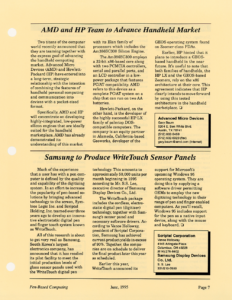
Two titans of the computer world recently announced that they are teaming together with the express goal of advancing the handheld computing market. Advanced Micro Devices (AMD) and Hewlett-Packard (HP) have entered into a long-term, strategic relationship with the intention of combining the features of handheld personal computing and communication into devices with a pocket-sized format.
Specifically, AMD and HP will concentrate on developing highly-integrated, low-power silicon engines that are ideally suited for the handheld marketplace. AMD has already demonstrated its understanding of this market with its Elan family of processors which includes the Am386SC300 Silicon Engine.
The Am386SC300 employs a 32-bit x86-based core along with two PCMCIA controllers, serial and parallel ports, and an LCD controller in a low-power package that features PC/AT compatibility. AMD refers to this device as a complete PC/AT system on a chip that can run on two AA batteries.
Hewlett-Packard, on the other hand, is the developer of the highly successful HP LX family of palmtop DOS-compatible computers. The company is an equity partner in Alameda, California-based Geoworks, developer of the GEOS operating system found on Zoomer-class PDAs.
Earlier, HP hinted that it plans to introduce a GEOS-based handheld in the near future. It’s useful to note that both families of handhelds, the HP LX and the GEOS-based Zoomers, rely on the x86 architecture at their core. This agreement indicates that HP clearly intends to move forward by using this tested architecture in the handheld marketplace.
Advanced Micro Devices
Gary Baum
5204 E. Ben White Blvd.
Austin, TX 78741
(512) 602-5459
(512) 602-6923 (fax)
[email protected] (Internet)
Transcribed from Pen-Based Computing, Volume 5, Number 6 — June 1995. Page 7.